This book, first published in 1977, attempts to show Mao Tse-tung in his relationship with the Chinese people. The author makes extensive use of a number of interviews with a cross-section of Chinese people, as well as examining the written records made by foreign visitors.
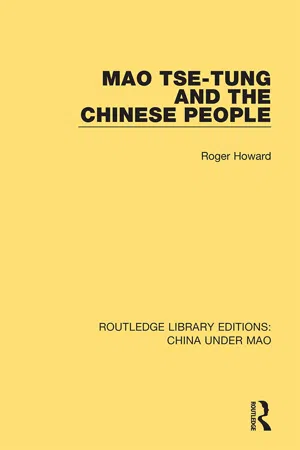
- 408 pages
- English
- ePUB (mobile friendly)
- Available on iOS & Android
eBook - ePub
Mao Tse-tung and the Chinese People
About this book
Information
1 We Pointed the Finger at Our Land
Early Years, 1893–1923
I was still confused, looking for, a road … I became more and more convinced that only mass political power, secured through mass action, could guarantee the realisation of dynamic reforms.
Mao to Edgar Snow, Red Star over China
Mao Tse-tung was born in the village of Shaoshan in Hunan province on 26 December 1893, one of four children — three sons and a daughter — of Mao Jen-sheng and his wife Wen Chi-mei.
Shaoshan Chung, a village of Hsiangtan County … stretches about ten li in length. It commands a lovely view, the hills and waters around all having that indefinable touch of the South which travellers find so pleasing. The houses are few and far between; the inhabitants are mostly honest, hard-working peasants. Among the local families is that of Mao.
Shaoshan Chung has an ‘Upper South Bank’ and a ‘Lower South Bank’. On the Lower South Bank is a road leading to the town of Hsiangtan and the adjacent Hsianghsiang County. Along the Upper South Bank is a stone bridge with a few shops clustering around selling meat, salt and other daily necessities. A stream runs under the bridge and meanders on by Shaoshan. Near this stream is a plain, tile-roofed house with two wings in which two families, one named Tsou and the other Mao, used to live. Each occupied half of the house, with the boundary line passing neatly through the middle of the living room. [1]
Mao’s father was stern and autocratic; beginning poor, he was thrifty, and when he had saved a little money from trading in pigs and rice he bought an acre or two of land which by careful management brought him more savings. He lent these savings at high rates of interest. Later he turned to buying, transporting and selling grain. Little by little he passed from ‘poor’, through ‘middle’ to ‘rich’ peasant. This lesson in social advance, a cruel man lifting himself by diligence and usury to the relative wealth of a trader, was not lost on Mao Tse-tung.
My father was in his early days, and in middle age, a sceptic, but my mother devoutly worshipped Buddha. She gave her children religious instruction, and we were all saddened that our father was an unbeliever. When I was nine years old I seriously discussed the problem of my father’s lack of piety with my mother. We made many attempts then and later on to convert him, but without success. He only cursed us, and, overwhelmed by his attacks, we withdrew to devise new plans. But he would have nothing to do with the gods … Then one day he went out on the road to collect some money, and on his way he met a tiger. The tiger was surprised at the encounter and fled at once, but my father was even more astonished and afterwards reflected a good deal on his miraculous escape. He began to wonder if he had not offended the gods. From then on he showed more respect to Buddhism and burned incense now and then … He prayed to the gods only when he was in difficulties. [2]
His mother gave, and received from Tse-tung, more affection. She was kindly and hard-working, and had strong moral feelings. ‘There were two “parties” in the family,’ Mao said. ‘One was my father, the Ruling Power. The opposition was made up of myself, my mother, my brother, and sometimes even a labourer. [But] my mother … criticised any overt display of emotion and attempts at open rebellion against the Ruling Power. She said it was not the Chinese way.’
When Tse-tung was about ten, his father cursed him one day and was going to beat him for his laziness’ and ‘useless-ness’. Tse-tung rushed out in a fury and, saying he would drown himself in a pond, demanded that his father withdraw the threats. He did so, and Tse-tung, too, apologised. This incident, though not untypical of families everywhere, taught Mao about the nature of power, ‘When I defended my rights by open rebellion my father relented, but when I remained meek and submissive he only cursed and beat me the more.’
Between the ages of five and seven years he worked on his father’s land. Then he went to a local primary school to be taught reading and writing so he could draw up business letters and keep accounts. He knew the classics but preferred the old romances about peasant rebellions which he and his schoolmates read in class, covering them up with a classic when the teacher walked past; they were discussed and rediscussed. These romances were banned by the old teachers yet loved by the villagers. Education, it seemed, did not include the people’s culture. Mao said that for two years he wondered about this. When he analysed even the old romances and tales he found the chief characters were warriors, officials and scholars, though they became bandits. There was never a peasant hero. They glorified those who ruled, ‘who did not have to work the land, because they owned and controlled it’.
Mao’s teacher used harsh methods.
His repertoire included many forms of corporal punishment such as flogging, beating on the palm, head, feet and thighs and ‘incense kneeling’. This last required the offender to kneel on a cash-board with sharp ridges or on a patch of gravelly earth for the length of the time it took a whole stick of incense to burn out. Naturally, Mao Tse-tung resisted. The first time he adopted the line of passive resistance, ie truancy. He ran away from school and went down the hill in the direction of an imaginary city. After a three-day journey, he discovered he had been going around the valley in circles and was only about ten li from home. Eventually, his family found him and brought him back. Upon reaching home he found his father no longer so hot-tempered as before, nor was the teacher so severe. The effect of this resistance left a deep imprint on his young mind. As he himself later on put it, borrowing a new term, he had carried out a successful ‘strike’. [3]
At thirteen he left school and hoed the fields and kept the cattle and pigs on the farm during the day and read books at night, covering up the window of his room so his father would not see the light.
I succeeded in continuing my reading, devouring everything I could find except the Classics. This annoyed my father, who wanted me to master the Classics, especially after he was defeated in a lawsuit because of an apt Classical quotation used by his adversary in the Chinese court … I read a book called Sheng-shih Wei-yen [Words of Warning, by Chung Kuang-ying], which I liked very much. The author, one of a number of old reformist scholars, thought that the weakness of China lay in her lack of Western appliances—railways, telephones, and steamships—and wanted to have them introduced into the country. My father considered such books a waste of time. He wanted me to read something practical like the Classics, which could help him in winning lawsuits.’ [4]
He quarrelled with his father and, disgusted by his labour for him, ran away from home to the house of an unemployed law student where he studied for six months.
That year, 1906, there was a flood in Hunan, causing a famine. The starving sent their spokesmen to the civil governor to beg for relief. He replied, ‘Why haven’t you any food? There is plenty in the city. I always have enough.’ The people were angry at this and they held meetings and demonstrated, finally attacking the government offices and driving out the governor. Later, a new governor arrived and ordered the execution of the leaders of the uprising, whose heads were displayed on poles as a warning.
At the same time, in a dispute at Shaoshan between a local landlord and the secret society, the Ke Lao Hui, the landlord bought a decision in a court of law. The society members rebelled, withdrew to a nearby mountain and built a stronghold. Troops attacked them, and their leader, Pang the Millstone Maker, was captured and beheaded.
During a food shortage the following year, the poor requested that the rich farmers help them. But the rich were selling their rice to the city, so the poor started a movement called ‘Let’s eat at the big house,’ that is, ‘Let’s take the rice free of charge.’ When one of his own consignments was seized Mao’s father was angry. Mao did not sympathise with him. On the other hand, he thought the villagers’ method was wrong, too. What lasting good would it do them? They would still be as poor the next year.
These incidents, occurring close together, made lasting impressions on my young mind, already rebellious. In this period also I began to have a certain amount of political consciousness, especially after I read a pamphlet telling of the dismemberment of China. I remember even now that this pamphlet opened with the sentence: ‘Alas, China will be subjugated!’ It told of Japan’s occupation of Korea and Taiwan, of the loss of suzerainty in Indochina, Burma, and elsewhere. After I read this I felt depressed about the future of my country and began to realise that it was the duty of all the people to help save it. [5]
Returning home again, Mao was given a wife six years older than himself, a marriage he refused to consummate. ‘I had never lived with her,’ he said in 1936, ‘and never subsequently did. I did not consider her my wife and at this time gave little thought to her.’
He worked three more years for his father before a cousin told him about the Tungshan Primary School in the neighbouring town of Hsianghsiang. The course was ‘modern’, laid less emphasis on the Classics and more on the ‘new knowledge’ from the West, and the teaching methods were ‘radical’. At sixteen Mao registered there and lodged at the school for a year, his father finally agreeing after friends had pointed out that ‘higher’ education would increase his son’s earning powers.
I had never before seen so many children together. Most of them were sons of landlords, wearing expensive clothes; very few peasants could afford to send their children to such a school. I was more poorly dressed than the others. I owned only one decent coat-and-trousers suit. Gowns were not worn by students, but only by the teachers, and none but ‘foreign devils’ wore foreign clothes. Many of the richer students despised me because usually I was wearing my ragged coat and trousers. However, among them I had friends, and two especially were my good comrades.
I was also disliked because I was not a native of Hsianghsiang. It was very important to be a native of Hsianghsiang and also important to be from a certain district of Hsianghsiang. There was an upper, lower and middle district, and lower and upper were continually fighting, purely on a regional basis. Neither could become reconciled to the existence of the other. I took a neutral position in this war, because I was not a native at all. Consequently all three factions despised me. I felt spiritually very depressed. [6]
Mao’s course included the classics, essay-writing, natural sciences, history and geography. He learnt something of foreign ‘great men’ and of the rulers of ancient China. As for the death of the Empress Dowager in 1908 he heard about it two years after the event. And he learnt of America for the first time.
One evening when the children had finished playing and were crowding into the study-room at the sound of the bell, Mao Tse-tung found himself in the company of another boy as he made his way towards the second gate of the school. The boy was holding a book in his hand. ‘What book do you have there?’ asked Mao Tse-tung. ‘Heroes and Great Men of the World.’ ‘May I have a look?’ A few days later, Mao Tse-tung returned the book. His manners were apologetic: ‘Forgive me for smearing your book.’ The curious student opened the book and found many passages marked out with circles and dots. The most heavily marked were the biographies of Washington, Napoleon, Peter the Great, Catherine the Great, Wellington, Gladstone, Rousseau, Montesquieu and Lincoln. Said Mao Tse-tung: ‘We should strive to make our country strong and prosperous, so as not to follow in the footsteps of Indochina, Korea and India. You know the ancient Chinese proverb: “One overturned chariot serves as a warning to the next.” We should all rally together. Ku Yen-wu was perfectly right in saying, “Every common man has a hand in determining the fate of his nation!” ’ Then, after a brief pause, he continued: ‘China’s decline did not begin yesterday. Therefore, to make her rich, strong and independent will also take a long time. But we shouldn’t let the length of time worry us. Look here,’ he opened the book and pointed at one page, ‘Victory and independence only came to the United States after eight years of fighting under Washington, eight long, bitter years …’ [7]
I made good progress at this school. The teachers liked me, especially those who taught the Classics, because I wrote good essays in the Classical manner. But my mind was not on the Classics. I was reading two books sent to me by my cousin, telling of the reform movement of Kang Yu-wei. One was by Liang Chi-chao, editor of the Hsin-min Tsung-pao [New People’s Miscellany] . I read and reread these books until I knew them by heart. I worshipped Kang Yu-wei and Liang Chi-chao.’ [8]
Kang and Liang were reformers, the ‘intellectual godfathers’ of the 1911 revolution that was about to break out.
At the age of seventeen, in the summer of 1911, Mao walked and boated the forty miles to the city of Changsha, the capital of Hunan province, to take the entrance examination to the Hunan First Middle School. When he arrived in Changsha, the country was on the eve of revolution, the overthrow of the Ching (Manchu) dynasty and the founding of the Republic.
Changsha … lies on the Hsiang River in a magnificent setting of hills growing to mountains, of lush fields and dense woods. It was, like all Chinese cities, a maze of small dark houses and twisted mud lanes, yet it held fine temples and residences, parks and great schools. It was, in the early 1900s, more than a provincial capital, a centre of intellectual radicalism … The hunger and misery of the countryside, despite the fertile soil, filled even ‘the scholars’ street’ with beggars and the corpses of those who had died of starvation.’ [9]
The republican uprising broke out on 10 October 1911 in Wuhan. Twelve days later at Changsha the white banners of the revolutionary army proclaimed ‘Long live the Great Han Republic’ In a few hours the old imperial administration in the city was swept away. Mao was caught up in the excitement.
Rebels were approaching the city along the Canton-Hankow railway, and fighting had begun. A big battle occurred outside the city walls of Changsha. There was at the same time an insurrection within the city, and the gates were stormed and taken by Chinese labourers. Through one of the gates I re-entered the city. Then I stood on a high place and watched the battle, until at last I saw the Han flag raised over the yamen. It was a white banner with the character Han in it. I returned to my school, to find it under military guard. [10]
As a result of reading The People’s Strength, a publication of Dr. Sun Yat-sen’s Alliance Society, he had already written a political essay heralding the republic and stuck it on the wall at school, his first tatsepao or big-character poster, a traditional form of public protest which was to become familiar the world over during the cultural revolution in 1966. He had joined with a friend in cutting off their queues, symbolising their rejection of t...
Table of contents
- Cover
- Half Title
- Title Page
- Copyright Page
- Table of Contents
- Acknowledgements
- Preface
- Introduction
- 1 WE POINTED THE FINGER AT OUR LAND: Early Years, 1893–1923
- 2 WHO ARE OUR ENEMIES? WHO ARE OUR FRIENDS?: The First Revolutionary Civil War, 1924—1927
- 3 THE ARMY OF THE POOR: The Second Revolutionary Civil War:: The Kiangsi Base, 1927–1934
- 4 A MANIFESTO, A PROPAGANDA FORCE, A SEEDING MACHINE: The Second Revolutionary Civil War:: The Long March, 1935
- 5 SAVE THE COUNTRY: SAVE THE REVOLUTION: The War of Resistance Against Japan:: The Yenan Base and the United Front, 1936—1938
- 6 TO SERVE THE PEOPLE: The War of Resistance Against Japan:: The Yenan Base and Towards New Democracy, 1938–1945
- 7 FILLING THE HOLES AND LEVELLING THE TOPS: The Third Revolutionary Civil War (the War of Liberation), 1945–1949
- 8 BUILDING THE NEW: The Foundations of the People’s Republic, 1949–1957
- 9 THE CLASH OF MODELS: The Great Leap Forward, the Communes and the Emergence of ‘Two Roads’, 1958—1964
- 10 THE BEAUTY OF OUR AGE: The Great Proletarian Cultural Revolution and After, 1965–1976
- Summary: The Main Trend
- References
- Further Reading
- Note on Editions and Sources
- Index
- MAPS: China
Trusted by 375,005 students
Access to over 1.5 million titles for a fair monthly price.
Study more efficiently using our study tools.
Frequently asked questions
Yes, you can cancel anytime from the Subscription tab in your account settings on the Perlego website. Your subscription will stay active until the end of your current billing period. Learn how to cancel your subscription
No, books cannot be downloaded as external files, such as PDFs, for use outside of Perlego. However, you can download books within the Perlego app for offline reading on mobile or tablet. Learn how to download books offline
Perlego offers two plans: Essential and Complete
- Essential is ideal for learners and professionals who enjoy exploring a wide range of subjects. Access the Essential Library with 800,000+ trusted titles and best-sellers across business, personal growth, and the humanities. Includes unlimited reading time and Standard Read Aloud voice.
- Complete: Perfect for advanced learners and researchers needing full, unrestricted access. Unlock 1.5M+ books across hundreds of subjects, including academic and specialized titles. The Complete Plan also includes advanced features like Premium Read Aloud and Research Assistant.
We are an online textbook subscription service, where you can get access to an entire online library for less than the price of a single book per month. With over 1.5 million books across 990+ topics, we’ve got you covered! Learn about our mission
Look out for the read-aloud symbol on your next book to see if you can listen to it. The read-aloud tool reads text aloud for you, highlighting the text as it is being read. You can pause it, speed it up and slow it down. Learn more about Read Aloud
Yes! You can use the Perlego app on both iOS and Android devices to read anytime, anywhere — even offline. Perfect for commutes or when you’re on the go.
Please note we cannot support devices running on iOS 13 and Android 7 or earlier. Learn more about using the app
Please note we cannot support devices running on iOS 13 and Android 7 or earlier. Learn more about using the app
Yes, you can access Mao Tse-tung and the Chinese People by Roger Howard in PDF and/or ePUB format, as well as other popular books in Social Sciences & Regional Studies. We have over 1.5 million books available in our catalogue for you to explore.