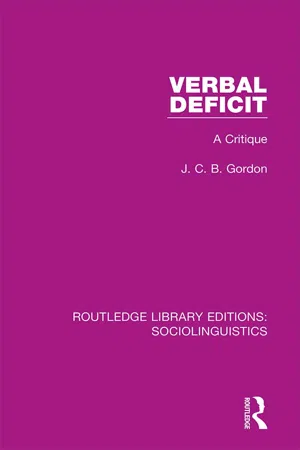
Originally published in 1981. Verbal deficit theories try to account for differential educational attainments in linguistic terms, suggesting that children reach varying levels of success in school as a result of their ability or inability to express themselves, and relate this to social class. This critique considers such theories, especially in the form propounded by Bernstein, primarily from a sociolinguistic viewpoint but with special attention to the historical and educational context behind the theories. It claims that verbal deficit theories are not only unscientific and non-linguistic, but are educationally damaging as well, and proposes instead a linguistic 'difference' theory.
- 176 pages
- English
- ePUB (mobile friendly)
- Available on iOS & Android
eBook - ePub
About this book
Information
1 DIFFERENTIAL EDUCATIONAL ATTAINMENT
Since verbal deficit theories are ultimately nothing more than attempts to account for differential educational attainment, it is essential to begin with a discussion of this more general area.
At various times in the history of mass education different explanations have been offered for the phenomenon called differential educational attainment – the fact that children who pass through an education system reach very different levels of attainment, as measured by the criteria in general use at the time. These differences are apparent not only in the qualifications obtained (and not obtained) by pupils on leaving the education system, but also in comparisons of children at any age-point within the system. To some extent such differences are also reflected in, and a result of, the age at which pupils leave the education system itself. The criteria currently used to measure or assess attainment are not confined to examinations and qualifications enjoying a measure of recognition among the general public (for example, the 11+, CSE, GCE ‘O’ and ‘A’ level examinations, diplomas and degrees) but also include tests devised specifically for the purpose of comparing large numbers of pupils in various skills and attainments at various ages (for example, the Watts-Vernon reading tests, NS6, Raven’s Progressive Matrices). Most of these latter tests are largely unknown to the general public, and it is unusual for pupils or their parents to be informed of individual results on such tests. There also exist a number of aptitude tests whose stated aim is purely to establish pupils’ suitability for certain kinds of courses. If such tests really measured pure aptitude, there might be a case for treating them as fundamentally different in kind from the tests discussed so far; but since they also measure attainment, if only indirectly in the form of (attained) ability to cope with formal tests, they should also be included in this list. Some such tests actually claim to test attainment in one skill on the grounds that it constitutes aptitude for another skill,1 and in any case it is unclear exactly what aptitude tests really measure.
There are four kinds of answer which can be given to the general question: Why do pupils passing through roughly the same (or apparently roughly the same) education system attain differently? (Phenomenon I). The four types of answer are as follows, though they are not mutually exclusive and various combinations are often found:
1. With the exception of a small number of genuinely pathological cases, children enter school roughly equal in terms of educability. Differences in attainment, at least up to the end of the elementary stage of schooling, can largely be accounted for by (i) unevenness in the quality of teaching and (ii) differences, stemming from parental and peer-group influences, among the children themselves in their motivation to learn, their willingness to work and to accept the discipline of the school. In principle such differences are amenable to change within the education system itself. In this context, elementary schooling is defined not by any arbitrary age-limits nor as the teaching of basic skills, but as the whole period during which children share a broadly common curriculum.2
2. The material circumstances of the various parts of the education system itself and of the pupils vary enormously: (i) Some schools are good, others, bad, and others intermediate. Some are well-equipped, well accommodated, have effective teachers with high qualifications and a low rate of staff turnover, while at the other extreme the very opposite is the case. (ii) Some children suffer from material disabilities which tend to impair their efficiency in learning. They may be undernourished, underslept, inadequately clothed and poorly housed. Other children may suffer none of these disabilities and may be able to operate at optimum efficiency for most of the time they spend at school and may also have excellent facilities for learning out of school and for doing homework (for example, own books, own study, extensive foreign travel).
3. The children are significantly different in terms of educability when they first enter school. This difference is the result of (i) heredity, (ii) environment or (iii) a combination of both.
4. The various institutions within the education system (including the whole concomitant apparatus of examinations, tests, continuous assessment and qualifications) actually create academic success and failure, in ‘good’ establishments as well as ‘bad’. Schools take in pupils who, with a handful of exceptions, are normal, healthy and educable and then systematically and inexorably turn them into successes and failures. According to this view success and failure are often seen as relatively meaningless labels, and it is often claimed that even those who are nominally successful understand very little about the subjects in which they formally qualified.
These are, of course, only very general answers, and questions about individual pupils’ performance in specific areas of examinations would have to be answered in rather different terms. As already noted, these explanations are not mutually exclusive.3 In particular the first two explanations can be combined without doing any great violence to either. For example, Runciman (1887, pp. 45–6) implies a combination of the first two types of explanation in his description of the achievements and thoughts of the fictitious (?) model teacher, PalHser:
The young master fought on stubbornly in his wretched shed; his efforts often failed, and in his first two years he had many a heartache. But his work was solid and useful, and his school finally became a favourite show-place, much frequented by gentlemen who wished to see ‘how we deal with this kind of material’. Palliser knew that the material could be moulded to almost any form, and he was quite ready to match those of his lads who happened to be well fed against any boys from more favoured neighbourhoods. The starvation problem beat him, and it is likely to puzzle the nation for some years to come.4
However, the broad thrust of the four types of explanation is in each case distinct, despite the fact that the first two explanations are to some extent complementary. The first stresses the efficiency of the school, the second stresses the socially conditioned efficiency of the child in learning, the third is fundamentally deterministic, and the fourth treats success and failure as artefacts created by the education system itself. Since these are only broad thrusts, or categories of explanation, a range of interpretations is possible, especially in the case of the third and fourth explanations. The third explanation includes not only the intelligence theory, but also theories of linguistic determinism and those psychological theories which attach an overriding significance to the child’s very early (and necessarily preschool) development. The fourth type of explanation comprises the relatively moderate view that schools create success and failure in order to ration access to various further steps on the educational ladder as well as the much more drastic suggestion that all educational establishments are intrinsically authoritarian and, as such, deeply corrupting; in this case the artificial creation of success and failure is seen as a prerequisite for maintaining and perpetuating the authoritarian hierarchy itself. However, of the four types of explanation, only the third invokes the concept of differential educability. In this crucial respect explanations of this kind are fundamentally different from all others, however much allowance they may make for environmental factors.
The matter does not end however with differential educational attainment as such (Phenomenon I). It is well known that there is – and apparently has been for a long time – a close correlation between educational attainment and social status (Phenomenon II). Broadly, the higher the parental rating on the Registrar-General’s scale, the more likely a child is to succeed in all tests of attainment at all levels within the school system; and children with parents in unskilled manual occupations and those from certain ethnic minority groups tend to leave the education system as soon as is legally permitted (or earlier) and do so with few, if any, formal qualifications. As a group they perform least well on all tests of attainment currently in use. Also, these children are the most likely to be classified as failures, ‘non-academic’ or educationally subnormal (ESN) at a relatively early stage in their school-lives.
In principle, it is perfectly possible to advance hypotheses to account for Phenomenon I without any reference to social class whatsoever: indeed, this is exactly what has just been done. On the other hand, it is utterly impossible to venture any hypothesis on Phenomenon II without having some hypothesis to explain Phenomenon I, even if only on an implicit level.
In the course of the present century educationalists, sociologists, politicians and the general public have become increasingly conscious of Phenomenon II – the relationship between educational success and social class – and in the last twenty-five years or so it has become a matter of widespread preoccupation. Since all major political parties throughout the industrialised countries (and in some cases elsewhere, too) publicly proclaim their commitment to equality of opportunity via the education system, it is not surprising that the matter has become an overtly political question in most Western nations. Questions immediately arise as to whether an education system offers something approximating to real equality of opportunity or whether it is loaded in such a way as to preserve the privileges of the privileged and perpetuate the disabilities of those at the lower end of the social scale. Thus any hypothesis on Phenomenon I has political implications, because it is potentially a partial explanation for Phenomenon II. Irrespective of whether or not an individual sees his explanation for Phenomenon I as ‘political’, nothing can alter the fact that it will have political implications.
Verbal deficit theories constitute a relatively recent attempt to explain differential educational attainment. Some people still refer to intelligence as if it were a self-evident, unassailable and virtually sufficient explanation. They would be surprised to discover that, at least in this country, it came into general fashion only in the early 1920s, and seem to forget that it has been under persistent and mounting criticism since about 1950. The concept of intelligence as an innate, fixed and measurable entity originated with the Social Darwinists, in particular Galton (1865 and 1869), but had virtually no impact on educational theory or practice till the mid-1880s at the earliest; even then its real impact remained slight and fragmentary till about 1918. For most of the nineteenth century differential attainment was explained almost exclusively in terms of the quality of teaching and also to some extent in terms of the moral qualities – real or alleged – of the pupils and by implication also of their parents. Although it is convenient in a British context to refer to such explanations as Victorian the term is, strictly speaking, misleading since the underlying ideas stemmed from the Enlightenment5 and in various forms were widely current in Protestant Europe, southern Germany, France and, to some extent, Austria from the late eighteenth century onwards. In The Wealth of Nations, for example, Adam Smith had commented:
The difference of natural talents in different men is, in reality, much less than we are aware of; and the very different genius which appears to distinguish men of different professions, when grown up to maturity, is not upon many occasions so much the cause as the effect of the division of labour. The difference between the most dissimilar characters, between a philosopher and a common street-porter, for example, seems to arise not so much from nature as from habit, custom, and education.6
To claim that the Victorians were unaware of differences in ability which they often interpreted as natural or innate would be absurd. Even Stow (1836) who stresses the need for systematic and effective teaching in addition to mere exposition, the need for appropriately designed, purpose-built schools and the importance of providing suitable apparatus, refers to ‘children of large and small capacities’7 and notes that within his proposed combined national system of education for both the working and middle classes some children may display different qualities early in life which will ultimately lead them to different callings in society. However, there are only four, brief references in the whole book to anything that can be interpreted as differences in innate ability.8 Dunn (1837, p. 3), quoting from another writer, refers to pupils of ‘every variety, both as to knowledge and capacity’, but it is the only such reference. Although most modern readers will probably find Dunn’s authoritarianism distasteful, his book, like Stow’s, is remarkable for its optimism regarding the potential of education. For example, Dunn (1837, p. 12) observes, ‘Children are, to a much greater extent than is generally supposed, reasonable and intelligent beings …’ Neither David Stow nor Henry Dunn were in any sense mere theorists; both were very active in their respective educational societies (the Glasgow Educational Society and the British and Foreign School Society) and had close contact with actual schools.
It is important to distinguish intelligence as an everyday concept, often applied to isolated actions and solutions to specific problems or in a loose and general sense to persons, from the much narrower and rigid psychometric concept of intelligence that arose from Social Darwinism.9 That the Victorians, along with other generations, possessed the former, essentially functional concept of intelligence is beyond doubt: indeed, in some form or other, this everyday concept is a prerequisite for judging the actions of others. Moreover, the Victorians were, of course, aware of idiocy and subnormality.10 At the other extreme much of their historiography, as well as their increasing reliance on competitive examinations for the awarding of scholarships, for appointments to some fellowships at Oxford and Cambridge and to the Civil Service, together with the gradual mystification of the First Class Honours degree, point to a widespread and growing concept of brilliance, and even of genius in something approaching the modern sense of the word. (Until relatively late in the nineteenth century the word genius was generally used in its modern sense only in literary and aesthetic criticism. It was more commonly used in the sense of natural ability or predisposition – whether exceptional, outstanding, or not.11 Similarly, for much of the nineteenth century the word intelligent was widely used in the sense of rational, well-informed, educated or discerning, and intelligence in the sense of reason.)
Obviously, in the nineteenth century people did have a general concept of (innate) intelligence, but apart from its everyday application, the concept seems to have been largely confined to the extremes of sub-normality and brilliance; no attempt was made to relate the concept in any systematic way to the education system. The evidence for much of this is fragmentary, as is often the case with the history of ideas, especially as for most of the Victorian era mere attendance was as much of a preoccupation as attainment. The evidence includes the general absence, almost up to the very end of the century, of any discussion of intelligence in HMI’s reports, the minutes of the Privy Council Committee on Education, teacher-training manuals and other writings on education.12 This absence of references to intelligence in teacher-training manuals tended to persist right up to the end of the century. For example, although Salmon (1898, pp. 13–14) acknowledges that all children are not alike, there is no mention anywhere in the book of intelligence (in its modern sense) or heredity. Like Stow (1836), Salmon (1898) is concerned first and foremost with the quality of teaching and the fundamental equality of educability of all children.
But perhaps the most interesting piece of evidence is the Revised Code of 1862 and its inauguration of the system of payment by results which did not disappear completely till 1897. If the notion that educability depended on intelligence had enjoyed any widespread degree of support in the 1860s and the following two decades the Revised Code would have-appeared patently absurd, even as a drastic economy measure; and one would have expected its critics (especially the teaching profession itself) to have argued that payment by results arbitrarily penalised those teachers who, irrespective of their individual merits, had the misfortune to have a large number of ‘unintelligent’ children in their classes. In such a climate of opinion, the adage that ‘even the gods fight in vain against stupidity’ wo...
Table of contents
- Cover
- Half Title
- Title Page
- Copyright Page
- Table of Contents
- Less Common Abbreviations
- Note on the Use of the ‘Harvard System’
- Introduction
- 1. Differential Educational Attainment
- 2. ‘Classical’ Verbal Deficit Theory
- 3. Bernstein’s Sociolinguistic Theory
- 4. Challenges and Alternatives
- 5. Verbal Deficit Theories in Context
- Conclusion and Prospect
- Appendix 1
- Appendix 2
- Bibliography
- Index
Trusted by 375,005 students
Access to over 1.5 million titles for a fair monthly price.
Study more efficiently using our study tools.
Frequently asked questions
Yes, you can cancel anytime from the Subscription tab in your account settings on the Perlego website. Your subscription will stay active until the end of your current billing period. Learn how to cancel your subscription
No, books cannot be downloaded as external files, such as PDFs, for use outside of Perlego. However, you can download books within the Perlego app for offline reading on mobile or tablet. Learn how to download books offline
Perlego offers two plans: Essential and Complete
- Essential is ideal for learners and professionals who enjoy exploring a wide range of subjects. Access the Essential Library with 800,000+ trusted titles and best-sellers across business, personal growth, and the humanities. Includes unlimited reading time and Standard Read Aloud voice.
- Complete: Perfect for advanced learners and researchers needing full, unrestricted access. Unlock 1.5M+ books across hundreds of subjects, including academic and specialized titles. The Complete Plan also includes advanced features like Premium Read Aloud and Research Assistant.
We are an online textbook subscription service, where you can get access to an entire online library for less than the price of a single book per month. With over 1.5 million books across 990+ topics, we’ve got you covered! Learn about our mission
Look out for the read-aloud symbol on your next book to see if you can listen to it. The read-aloud tool reads text aloud for you, highlighting the text as it is being read. You can pause it, speed it up and slow it down. Learn more about Read Aloud
Yes! You can use the Perlego app on both iOS and Android devices to read anytime, anywhere — even offline. Perfect for commutes or when you’re on the go.
Please note we cannot support devices running on iOS 13 and Android 7 or earlier. Learn more about using the app
Please note we cannot support devices running on iOS 13 and Android 7 or earlier. Learn more about using the app
Yes, you can access Verbal Deficit by J. C. B. Gordon in PDF and/or ePUB format, as well as other popular books in Languages & Linguistics & Linguistics. We have over 1.5 million books available in our catalogue for you to explore.