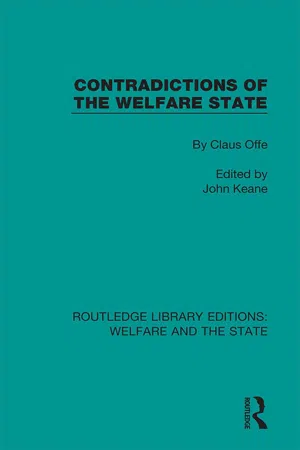
Originally published in 1984, Contradictions of the Welfare State is the first collection of Claus Offe's essays to appear in a single volume in English. The political writings in this volume are primarily concerned with the origins of the present difficulties of welfare capitalist states, and he indicates why in the present period, these states are no longer capable of fully managing the socio-political problems and conflicts generated by late capitalist societies. Offe discusses the viability of New Right, corporatist and democratic socialist proposals for restructuring the welfare state. He also offers fresh and penetrating insights into a range of other subjects, including social movements, political parties, law, social policy, and labour markets.
- 308 pages
- English
- ePUB (mobile friendly)
- Available on iOS & Android
eBook - ePub
Contradictions of the Welfare State
About this book
Information
1 ‘Crises of crisis management’: elements of a political crisis theory*
The concept of crisis
While there have been numerous attempts in political science to increase the reliability of strategies of political-administrative intervention through the improvement of information, organizational, planning and legal techniques, there are hardly any studies which proceed from the opposite point of view. The question of why the capacity of late capitalist societies1 for political regulation is so slight and their capacity for ‘planned social change’ so defective is either not asked or implicitly dismissed by conceiving the well-known limitations of state regulation as due to factors of a contingent nature which may in future be brought under control through improved administration and budgetary management.
This point of view, which dominates political science, and particularly its new branch of ‘policy sciences’, is justified neither by practical successes nor by theoretical reasons. The following contribution thus examines the interventionist, welfare state regulatory strategies of late capitalist societies not from the standpoint of how their effectiveness could be increased but rather from that of why their effectiveness is – in spite of all attempts at improvement – so limited. The object of this study is to theoretically comprehend the limits of the ‘policy-making capacity’ of the capitalist state, as well as to establish these limits through a discussion of specific examples.
This kind of theoretical approach, which amounts to a critique (in the sense of the determination of the limits) of the regulatory capacity of the capitalist state, is also a legitimate continuation of the kinds of questions asked by the Marxian critique of political economy. Today its subject has undergone a peculiar change. For Marx, the point was to examine the ‘laws of motion’ of capital in order to prove that capitalism as a social formation was – contrary to the usual belief in harmony of vulgar economics – in fact a ‘dynamic’, historical and transitory social formation. Today, by contrast, the tantalizing and baffling riddle (in a political as well as a theoretical sense) is why capitalist systems have so far been able to survive – in spite of all existing contradictions and conflicts – even though an intact bourgeois ideology that could deny these contradictions and construct the image of a harmonious order no longer exists. The usual (or, more precisely, temporary) answers to this riddle either take the form of references to the postponement of the point in time at which the internal contradictions of the system ‘ripen’ and develop their transformative power or, conversely, of making the state responsible for the achievement of a permanent stabilization. However, both responses are defective. They abstract from their appropriate historical contexts and erroneously ascribe absolute validity to either a traditional concept of crisis or its opposite, the ‘panacea’ of administrative intervention and regulation. A theoretically useful and practically relevant way out of this dilemma may lie in the attempt to see neither ‘crises’ nor ‘crisis management’ but rather ‘crises of crisis management’ as a constant – in the attempt, in other words, to systematically anticipate and analyse the deficiencies and limitations of the stabilizing activity of the state.
In a preliminary way, crises can be defined as processes in which the structure of a system is called into question. This formulation immediately prompts the following question: what are the analytical conditions for structures being ‘called into question’? It is possible to answer this question in two different ways.
Crises endanger the identity of a system. According to a first approach, identity can be defined in relation to the total range of events possible in a system. Seen from this first point of view, the system would be endangered whenever events occur that lie ‘outside’ the boundaries determined by the system. To conceive a ‘crisis’ as an event foreign to the system or destructive of that system is to rely upon a sporadic crisis concept. The point of departure of a sporadic crisis concept is the notion that crises are particularly acute, catastrophic, surprising and unforeseeable events which, consequently, necessitate a ‘decision-making process under the pressure of time’ (K. W. Deutsch). The crisis is thus seen as an event or a chain of events confined to one point in time or a short period of time. This makes it difficult to describe the tendency towards crisis or crisis-proneness of a social system. This type of crisis concept fails to systematically link events with the structures of the system, in the sense that the crisis event or the defencelessness against it is not seen as a characteristic quality of the system.
A sporadic crisis concept is at best suitable for the analysis of well-demarcated subsystems: for instance, a business enterprise goes bankrupt because it is confronted by its environment (banks, customers, competitors, etc.) with data and events incompatible with its continued existence. In analyses of society as a whole, however, any conceptual strategy which conceives of crises as ‘events that are neither anticipated nor provided for’ encounters difficult problems. Logical distinctions between, on the one hand, events provided for and those which are not and, on the other, between events compatible with the system and those which are not can hardly be operationalized. These difficulties indicate the need for an alternative concept of crisis.
The alternative approach conceives crises not at the level of events but rather at the superordinate level of mechanisms that generate ‘events’. According to this second definition, crises are processes that violate the ‘grammar’ of social processes. Such a definition favours a processual concept of crisis. Crises are developmental tendencies that can be confronted with ‘counteracting tendencies’, which means that the outcome of crises is quite unpredictable. Moreover, this processual crisis concept has the advantage of making it possible to relate the crisis-prone developmental tendencies of a system to the characteristics of the system. In contrast to the first type of crisis concept, such developmental tendencies need not be seen as catastrophic events having a contingent origin.
The price that must be paid for the greater precision of this second approach to the concept of crisis is the difficulty it encounters in identifying and defining the boundaries of such event-producing mechanisms. Some guidelines might be drawn from Dahl and Lindblom,2 who distinguish exchange, political choice, bureaucracy, and bargaining processes as four ways social events are produced in industrial societies. If one disregards the fourth type as a problematic intermediate case,3 the remaining three organizational principles can be reconciled with a typology developed by Etzioni4 for the classification of formal organizations. This typology differentiates social processes according to whether they are based on normative structures, exchange relationships or coercive relationships.
Now, capitalist societies are defined by the fact that in them – on the basis of an unequal distribution of property resulting from precapitalist ‘primitive accumulation’ – the organizational principle of the exchange (of equivalents) is universal. This principle of exchange, which also includes the commodification of labour power, becomes dominant because it is freed from normative and political-coercive restraints. To be sure, a society organized by means of exchange relationships can never be organized solely through exchange relations but, rather, requires ‘flanking subsystems’: even in a purely competitive-capitalist social system, individuals must be socialized in normative structures, while the established rules of social intercourse must be sanctioned by sovereign power. A society based on market exchange cannot function without the family system and the legal system.
If the dominant organizational principle of the social processes of every capitalist society is that of exchange, a theory of the crises of capitalist society can identify those processes which challenge the dominance of this central principle. This, in turn, can be done in two ways.
1 The theory of historical materialism attempts to show that processes organized and formed through exchange lead to results that cannot be dealt with by the exchange process itself. Economic crisis theories in a narrow sense, such as the theorem of the historical tendency of the rate of profit to fall, reconstruct the processes of self-negation of the exchange principle that potentially result in the revolutionary transformation of the entire ideological and political ‘superstructure’.
2 As an alternative to this approach, a theory of the system crises of capitalist societies would examine crisis-prone developments not in the exchange sphere itself (i.e., in the form of an economic crisis theory); rather, it would concentrate on the relationship between the three fundamental organizational principles of society as a whole. Not the self-negation of the exchange principle but its restriction and questioning by the other two organizational principles would serve as the criterion of crisis processes.
In order to consolidate this second possibility, a distinction may be made between two different kinds of relationship that can exist between the three organizational principles. This distinction reflects the manner in which the normative and political-coercive subsystems are subordinated to the dominant organizational principle of exchange in capitalist societies.
One kind of relationship is that of positive subordination. By this I mean a relationship between the economy and the normative and political-administrative systems in which the latter are structured in such a way that they positively contribute to, and create the preconditions for, the functioning of the dominant organizational principle and the sphere of the economy determined by it. The distinctive feature of this type of positive subordination is the adjustment of the content of the normative and political subsystems so that they conform to economic processes. This form of subordination takes place through the norms and ideologies that bring individuals into harmony with the functions within the framework of the economic system, or through a political-administrative system that co-ordinates state policies and the requirements of the economic system.
The negative subordination of both the subsystems outside the exchange sphere must be distinguished from the first type of subordination. In this second case, the ideological and state power systems are related to the capitalist economic system in such a way that they are limited by, and insulated from this economic system without, however, being able to substantively contribute to its ability to function. Successful negative subordination consists of the protection of the sphere regulated by exchange against overlaps and interferences, which are a possible consequence of the development of the normative and political subsystems. The way in which such overlaps result from capitalist development will be discussed below. The aim here is merely to contrast two types of subordination. The production of complementary functions is what matters in positive subordination. In contrast, in negative subordination the dominance of the economic system over the two subsystems depends on whether – given the possibility of the partial functional irrelevance of these two subsystems for the economic system – the boundaries between the respective systems can be stabilized, so that the economic system is able to prevent the alternative organizational principles of the normative and state power systems from interfering with its own domain of the production and distribution of goods. In accordance with these considerations, one would have to characterize processes as crisis-prone if they made the demarcation of the economic system from the other two systems more difficult.
The growth of non-market organizations
In order to develop these quite formal attempts at conceptualization with a few material hypotheses, I would like to describe in greater detail the process of the formation and expansion of ‘extraterritorial’, or non-market areas of the capitalist social structure – a social structure regulated by exchange relationships. In terms of the structural type of positive subordination discussed above, capitalism can be described as a social structure which – apart from ‘residual’ feudal elements – is entirely determined by the dominant structural principle of exchange relationships. We can also express this circumstance in a different way: in such a structure, all elements are ‘necessary’ from the standpoint of the creation of surplus value. However, closer examination immediately indicates that this concept of necessity mixes together two elements that must be distinguished from each other if one wants to avoid hypostatizing the concept of necessity.
First, the relationship between the economic system and the normative or political systems can be necessary in the sense that the structures of the latter are genetically dependent on the economic system. Necessity here means a genetic relationship of determination. The concept of necessity can also acquire a completely different meaning, namely, that the ideological and political subsystems are necessary for the reproduction of the economic system. One can speak of positive subordination in the above sense only if both elements of the concept of necessity coincide; in other words, only if the conditions of the ideological and political systems are not only produced in a capitalist society but are also required for the reproduction of a capitalist economy.
On the other hand, the problems associated with negative subordination – the interference of the logics of subsystems and their insulation from each other – arise only when the genetic and functional aspects of ‘necessity’ no longer coincide. This non-coincidence is characterized by the ‘necessary’ production of phenomena and structures which are nevertheless not ‘required’ by the capitalist economic structure that produces them. The empirical thesis I would like to tentatively advance below is the following: the movement of capital systematically, cumulatively and irreversibly produces social phenomena and structural elements which are functionally irrelevant and of no value for the continuation of capitalist development. While this thesis requires much more empirical evidence, I contend that the nonintegrable by-products of capitalist development are systematically increasing, and that these by-products are having their effects only as impediments, threats, and as ‘ballast’, without any longer usefully contributing to the process of the creation of surplus value.
The difference between this developmental pattern and the early capitalist pattern of development is obvious. The development of early capitalist systems was defined by the creation of the conditions for universal capitalist growth: labour power was freed from its pre-capitalist agrarian bonds, mobilized and made available for absorption by capitalist industry; the transportation and communications network was rationalized by the evolution of nation states and territories and adapted to meet the requirements of the capitalist socialization of production; the same was true of the legal and fiscal systems, customs and international economic relations, science and technology, the family and urban development, and so on. While this is evident, many of the social results and structural transformations of the developed capitalist economies are in a general sense destined to play only a subordinate and unimportant – in any case ambivalent – role as functional prerequisites of the economic process.
This thesis could be exemplified in detail with respect to the crisis of the theory of imperialism. That the conditions of military oppression and intervention, of induced impoverishment and forced underdevelopment which characterize the contemporary Third World are a direct result of the strategies of the developed imperialistic nations seems to be as certain as the fact that the functional explanation of this set of circumstances has become questionable and implausible. The American war in Indo-China and, in general, the dependence of the countries of the Third World on the industrialized capitalist nations hardly conforms to a theoretical schema that attempts to interpret the imperialistic strategies as means for both the fulfilment of the present needs of the system and the creation of necessary pre-conditions for the further existence of the imperialist countries. The purpose of these strategies is not to create or expand the necessary economic pre-conditions for the continued exi...
Table of contents
- Cover
- Half Title
- Title Page
- Copyright Page
- Table of Contents
- List of figures
- Acknowledgements
- Editor’s preface
- Foreword
- Introduction: John Keane
- 1 ‘Crises of crisis management’: elements of a political crisis theory
- 2 ‘Ungovernability’: the renaissance of conservative theories of crisis
- 3 Social policy and the theory of the state
- 4 Theses on the theory of the state
- 5 Legitimacy versus efficiency
- 6 Some contradictions of the modem welfare state
- 7 The separation of form and content in liberal democracy
- 8 Competitive party democracy and the Keynesian welfare state
- 9 Political culture and Social Democratic administration
- 10 Alternative strategies in consumer policy
- 11 European socialism and the role of the state
- 12 Reflections on the welfare state and the future of socialism. An interview
- Index
Trusted by 375,005 students
Access to over 1.5 million titles for a fair monthly price.
Study more efficiently using our study tools.
Frequently asked questions
Yes, you can cancel anytime from the Subscription tab in your account settings on the Perlego website. Your subscription will stay active until the end of your current billing period. Learn how to cancel your subscription
No, books cannot be downloaded as external files, such as PDFs, for use outside of Perlego. However, you can download books within the Perlego app for offline reading on mobile or tablet. Learn how to download books offline
Perlego offers two plans: Essential and Complete
- Essential is ideal for learners and professionals who enjoy exploring a wide range of subjects. Access the Essential Library with 800,000+ trusted titles and best-sellers across business, personal growth, and the humanities. Includes unlimited reading time and Standard Read Aloud voice.
- Complete: Perfect for advanced learners and researchers needing full, unrestricted access. Unlock 1.5M+ books across hundreds of subjects, including academic and specialized titles. The Complete Plan also includes advanced features like Premium Read Aloud and Research Assistant.
We are an online textbook subscription service, where you can get access to an entire online library for less than the price of a single book per month. With over 1.5 million books across 990+ topics, we’ve got you covered! Learn about our mission
Look out for the read-aloud symbol on your next book to see if you can listen to it. The read-aloud tool reads text aloud for you, highlighting the text as it is being read. You can pause it, speed it up and slow it down. Learn more about Read Aloud
Yes! You can use the Perlego app on both iOS and Android devices to read anytime, anywhere — even offline. Perfect for commutes or when you’re on the go.
Please note we cannot support devices running on iOS 13 and Android 7 or earlier. Learn more about using the app
Please note we cannot support devices running on iOS 13 and Android 7 or earlier. Learn more about using the app
Yes, you can access Contradictions of the Welfare State by Claus Offe, John Keane in PDF and/or ePUB format, as well as other popular books in Social Sciences & Sociology. We have over 1.5 million books available in our catalogue for you to explore.