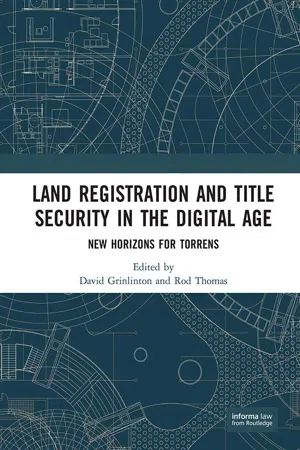
This book examines the current state of, and emerging issues in relation to, the Torrens and other systems of land registration, and the process of automation of land registration systems in jurisdictions where this is occurring worldwide. It analyses the impacts of advances in digital technology in this area and includes contributions from of a number of experts and leaders in this subject from a number of jurisdictions. While it has an Australasian bias, there are important chapters outlining current challenges and developments in Scotland, England and Wales, Ireland, and the Netherlands. The book will be relevant to those engaged in land registration and conveyancing processes, including, but not limited to, property law practitioners and conveyancers, academics in this field, government and public policy experts, law and property students, and IT and IP experts, especially those working on developing automated land registration systems.
eBook - ePub
Land Registration and Title Security in the Digital Age
New Horizons for Torrens
- 398 pages
- English
- ePUB (mobile friendly)
- Available on iOS & Android
eBook - ePub
Land Registration and Title Security in the Digital Age
New Horizons for Torrens
About this book
Information
PART I
LAND TITLE SECURITY: RECENT DEVELOPMENTS AND CURRENT ISSUES
CHAPTER 1
Title guarantee or title indefeasibility?*
Martin Dixon
1.1 Introduction
Land registration systems are intended to promote certainty and to be straightforward. They are about certainty of ownership, certainty of transactions and certainty of outcomes in cases of dispute.1 They are meant to be straightforward to understand and straightforward to use. Of course, there will be disputes; there will be incompetence; there will be innocent mistakes; and there will be fraud.2 Although those commentating on the systems in their respective jurisdictions sometimes pretend that the world is perfect, and naturally argue for their system to be perfect, it is salutary to remember that land, its use and its value, is about life. And life is messy. A land registration system seeks to impose order on something which is fundamentally incapable of being ordered in a way that is intellectually satisfying. This is not a bad thing. It just is. Perhaps the best that can be hoped for is that the system in each jurisdiction provides cogent, clear and consistent solutions to practical problems. So, in thinking about a land registration system and how it will operate, there should be a recognition that not everyone will be content with some of the outcomes.3 Not everyone can win; not everyone will agree. Choices have to be made.
The present author also struggles with academic lawyers’ need to conceptualise about land registration,4 despite not being entirely innocent of the charge. There is something unconvincing in thinking about land registration in terms of static and dynamic security,5 bijural ambiguity6 or immediate, deferred and qualified indefeasibility (or deferred indefeasibility plus, or conditional immediate indefeasibility, and so on), especially if the concepts are used prescriptively. As descriptions of what a jurisdiction’s system has achieved, or as markers identifying how systems differ from each other, or in order to illustrate how a system appears to be internally inconsistent,7 they can be valuable. But it is less certain that they are helpful as a template for shaping a new system, and even less certain that they are valuable when they are used as a prescription for reforming an existing system. Similarly, at least in the context of a title guarantee system like that found in England and Wales, the discussion of whether the same approach should be adopted as a matter of principle in an ‘A–B’ situation and an ‘A–B–C’ situation is largely unhelpful in identifying the essential features of a land registration system.8 Usually, the point of such a discussion is to establish that the same principles should not apply to an A–B–C situation as do to an A–B situation, and then deduce something about immediate or deferred indefeasibility as a guiding principle for every aspect of the legislation. However, that is to turn the question on its head. The key is, surely, to have a system that works in the social, economic and political climate that it governs, rather than one that cleaves to preconceived ‘principle’. More controversially, this author is not persuaded that it is essential for every aspect of a single land registration system to fit a predetermined conceptual template at all. It is not inconceivable, and certainly not legislatively impossible, that different aspects of the system should be directed towards different goals. The key, one might argue, is practical clarity and coherence, not theoretical consistency. For example, in England and Wales, a considerable part of the Land Registration Act 2002 (LRA 2002) is directed towards title by registration and its alleged sibling, the so-called mirror ‘principle’,9 but it is not self-evident (although many speak as if it is) that this means that everything in the LRA 2002 should be about these goals. Thus, if the law of adverse possession serves valuable economic and social goals, why does it need to be disembowelled (as it by the LRA 2002 in England and Wales)10 simply because it appears inconsistent with title by registration or the mirror principle? Certainly, it may not fit the theoretical template of ‘title by registration’ to allow off-register acquisition of title, but that does not necessarily compromise the working viability of land registration in England and Wales, provided it is known with a high degree of certainty when in practice adverse possession will succeed. The system in England and Wales is not robotic – and not yet depersonalised and electronic – and it is operated by people dealing with real situations. After all, from 1925 to 2003 in England and Wales, title registration and title by adverse possession operated in tandem and the sky did not fall in. Of course, it may be that policy-makers have decided that the law of adverse possession does not serve a useful social and economic purpose,11 or that its role has to give way in the face of allegedly greater social and economic advantages of title by registration and depersonalised e-conveyancing, but that needs to be explained and justified by more than the assertion that the very idea of adverse possession does not fit a predetermined conceptualisation. Principle is all very well, but policy driven by, and located in, reality is better.12
In similar vein, although the title of this chapter is ‘Title Guarantee or Title Indefeasibility?’, it is not proposed that there should be a beauty contest between different types of registration systems. Various configurations of ‘registration’ exist and the present author has never quite understood the need to champion one type of system over another. The key must be to choose, and adapt, the system that works with the heritage, the problems, the background law and the policy goals peculiar to each jurisdiction. Kenneth Reid in his seminal paper, ‘De-throning King Midas: The new law of land registration in Scotland’,13 explains why neither the title by registration system of England and Wales, nor a version of indefeasibility favoured by some Torrens jurisdictions, was right for Scotland. But that does not mean that those styles should be abandoned everywhere in favour of the Scots model.14 Either of the competing approaches – title by registration or Torrens indefeasibility15 – may well be a more comfortable fit elsewhere, and it is right to acknowledge that. The great merit of comparative scholarship is to learn from other jurisdictions what will not work, as well as what will. Of course, comparative scholarship also generates opportunities, but there are hidden perils in following the lead of other jurisdictions. It is a worry whether the Law Commission of England and Wales may have been overly swayed by the experience of Scotland and antipodean Torrens jurisdictions in respect of some of its recent proposals for the reform of the title guarantee system under the LRA 2002. One cannot grow bananas in England and Wales, even though other countries can, and that will not change, no matter how much we admire bananas.
* I am very grateful to Rod Thomas for helping me understand, in so far as I have, the scope of ‘indefeasibility’ in Torrens legislation.
1 Is it important that the New Zealand system is governed by the Land Transfer Act and the system in England and Wales by the Land Registration Act? Is one more concerned with certainty of transaction and one more with certainty of ownership – so-called dynamic versus static security?
2 It is difficult to gauge the level of actual fraud, as opposed to the level of the fear of fraud. The latter is very high. I am not suggesting, of course, that the possibility of fraud should be discounted. I am suggesting, however, that reforms should not be driven by the need to combat fraud unless there is evidence that its frequency is alarming.
3 A recent example in England and Wales is Rashid v Nasrullah [2018] EWCA Civ 2685, a decision that has the potential to make nearly everyone unhappy. It is a complex matter, but at its heart is the finding that a registered proprietor is confirmed in his title because he had completed adverse possession of his own registered title. This is not a typographical error.
4 ‘Land registration’ is used neutrally as a generic description.
5 In essence, dynamic security protects transactions, at least if made by purchasers; static security protects original owners who have lost their title non-consensually. It is not clear that the choice between these different forms of security should be driven by preconceived principle.
6 To this author, this is most puzzling. It may well be that under ‘ordinary’ principles of property law, or pre-registration principles of real property law, a void transaction does not confer a title. So what? The law has changed and there is no ambiguity. There is difference, but not ambiguity. In England and Wales, an oral contract for the sale of land once was valid; it is no longer. Similarly, other contracts are valid without writing. We would not call this bijural ambigui...
Table of contents
- Cover
- Half Title
- Dedication
- Title Page
- Copyright Page
- Outline Contents
- Detailed Contents
- List of Contributors
- Table of Cases
- Table of Legislation
- Foreword
- Introduction
- Part I Land Title Security: Recent Developments and Current Issues
- Part II Automation of Land Registration Systems
- Part III Cross-Cutting Issues and Emerging Challenges
- Index
Trusted by 375,005 students
Access to over 1.5 million titles for a fair monthly price.
Study more efficiently using our study tools.
Frequently asked questions
Yes, you can cancel anytime from the Subscription tab in your account settings on the Perlego website. Your subscription will stay active until the end of your current billing period. Learn how to cancel your subscription
No, books cannot be downloaded as external files, such as PDFs, for use outside of Perlego. However, you can download books within the Perlego app for offline reading on mobile or tablet. Learn how to download books offline
Perlego offers two plans: Essential and Complete
- Essential is ideal for learners and professionals who enjoy exploring a wide range of subjects. Access the Essential Library with 800,000+ trusted titles and best-sellers across business, personal growth, and the humanities. Includes unlimited reading time and Standard Read Aloud voice.
- Complete: Perfect for advanced learners and researchers needing full, unrestricted access. Unlock 1.5M+ books across hundreds of subjects, including academic and specialized titles. The Complete Plan also includes advanced features like Premium Read Aloud and Research Assistant.
We are an online textbook subscription service, where you can get access to an entire online library for less than the price of a single book per month. With over 1.5 million books across 990+ topics, we’ve got you covered! Learn about our mission
Look out for the read-aloud symbol on your next book to see if you can listen to it. The read-aloud tool reads text aloud for you, highlighting the text as it is being read. You can pause it, speed it up and slow it down. Learn more about Read Aloud
Yes! You can use the Perlego app on both iOS and Android devices to read anytime, anywhere — even offline. Perfect for commutes or when you’re on the go.
Please note we cannot support devices running on iOS 13 and Android 7 or earlier. Learn more about using the app
Please note we cannot support devices running on iOS 13 and Android 7 or earlier. Learn more about using the app
Yes, you can access Land Registration and Title Security in the Digital Age by David Grinlinton, Rod Thomas, David Grinlinton,Rod Thomas in PDF and/or ePUB format, as well as other popular books in Law & Commercial Law. We have over 1.5 million books available in our catalogue for you to explore.