This book analyses the role tourism plays for sustainable development in Southeast Asia. It seeks to assesses tourism's impact on residents and localities across the region by critically debating and offering new understandings of its dynamics on the global and local levels.
Offering a myriad of case studies from a range of different countries in the region, this book is interdisciplinary in nature, thereby presenting a comprehensive overview of tourism's current and future role in development. Divided into four parts, it discusses the nexus of tourism and development at both the regional and national levels, with a focus on theoretical and methodological foundations, protected areas, local communities, and broader issues of governance. Contributors from within and outside of Southeast Asia raise awareness of the local challenges, including issues of ownership or unequal power relations, and celebrate best-practice examples where tourism can be regarded as making a positive difference to residents' life.
The first edited volume to examine comprehensive analysis of tourism in Southeast Asia as both an economic and social phenomenon through the lens of development, this book will be useful to students and scholars of tourism, development, Southeast Asian culture and society and Asian Studies more generally.
1 Mapping tourism, sustainability, and development in Southeast Asia
Alexander Trupp, Claudia Dolezal and Huong T. Bui
Introduction
This book is aimed at understanding the contested role that tourism plays in achieving development in Southeast Asia. In this context, Southeast Asia represents a diverse region with different historical, political, and socioeconomic developments and a broad range of natural and cultural tourist attractions. These assets, along with favourable tourism policies, have meant that over the last three decades, international tourist arrivals in the region skyrocketed from 21.2 million in 1990 to 129 million in 2018 (UNWTO, 2019). While Southeast Asian countries feature diverse socioeconomic and political developments, all have – to different extents – embraced tourism as a vehicle for income generation and job creation (Trupp, 2018). Simultaneously, however, different forms of (mass) tourism development have led to unequal distribution of economic benefits, overexploitation of resources, and uncontrolled tourism development.
In putting together this book, we aim to create a forum for critical discussions on the ever-growing sector and social phenomenon of tourism, which is increasingly used as a tool for poverty alleviation, residents’ empowerment, and livelihood diversification across the region. Collections in this volume critically debate and deepen the understanding of the dynamics of tourism on both global and local levels and the impact it has on residents and localities in Southeast Asia. Arguably, tourism has not only contributed to economic growth but also caused increasing socioeconomic inequality and vast disruptions to local ecosystems, societies, and cultures. The expansion of an industry that often exceeds local carrying capacity limits, supported through injections of capital by external funding bodies with little room for local initiative has often led to residents’ marginalization and the widening of socioeconomic gaps within local communities. In reconsidering the relationship between tourism and development in this volume, we highlight several dimensions of this nexus.
First, tourism’s relationship with nature is contested. Erb (2001) argues that the environment is often perceived as a resource to be exploited, even though the kind of tourism under study here in the Indonesian context was aimed at sustainable development. In some cases, such as Boracay Island (Philippines) and Maya Bay (Thailand), problems of overtourism and the degradation of natural resources have led to government decisions to temporarily close popular island destinations (Koh & Fakfare, 2019). While such shutdowns can help the natural environment to recover, they also lead to the loss of jobs and revenue, strongly affecting small businesses and the badly protected informal sector. In addition to environmental impacts that compromise sustainability in Southeast Asia, tourism leads to changing socio-cultural dynamics, including transformations in gender relations (Trupp & Sunanta, 2017), cultural commodification (Cole, 2007), identity (Adams, 2006), inequalities within the resident population (Dolezal, 2015a), economic leakages (Lacher & Nepal, 2010), and the use of heritage for economic and political ends (Hitchcock, King, & Parnwell, 2010; Bui & Lee, 2015). All of these studies demonstrate that, after all, striking the balance between the various pillars of sustainable development still remains challenging.
Second, it is also acknowledged that tourism connects people (Dolezal, 2015b) – not only the Western tourist and their ‘hosts’, but also those local to the region, resulting in a rise in domestic and intra-regional travel. This domestic travel has the power to stimulate disadvantaged economies and slowly make changes to the travel patterns that have been dominating development of the region (Singh, 2009). Domestic tourism also has grown to be a driving force for developing economies, such as Vietnam (Bui & Jolliffe, 2011). Hence, although tourism’s repercussions are well known, it is often seen as a panacea for prevailing issues in developing countries.
Third, while the scale and scope of tourism development differ across Southeast Asia’s national boundaries, growing awareness of a more sustainable tourism exists, particularly of the value of grassroots tourism projects that are led by local communities and have the potential to diversify local incomes with the use of residents’ skills and available assets (Dolezal & Burns, 2014). It seems that politicians, activists, academics, local decision makers, and community members themselves increasingly discover ways of how to ‘do development correctly’ in terms of increasing local capacity, creating linkages to other sectors, or ‘empowering’ those that are affected most by tourism: locals themselves.
However, development itself remains a highly contested term and one that this book attempts to trace and critique particularly in Chapter 2 (by Bui & Dolezal). The notion of development has largely been influenced by capitalist thinking from the early beginnings onwards and while efforts of modernisation and neoliberal politics advancing Western interests soon faced critiques by dependency theorists and alternative development thinkers, many argue that there still is an inherently unhealthy power dynamic at play (Sciortino, 2017). In times of the Sustainable Development Goals (SDGs), which perpetuate a strong focus on a sustainable development that includes the Global North as much as South, it is argued that ‘the SDGs still centre contemporary capitalism as a mechanism to deal with persistent poverty, growing inequality and ecological ruin’ (Klein & Morreo, 2019, p. 3). Reaffirming Escobar’s early critiques of the development machinery, what is really needed therefore is not ‘development alternatives but alternatives to development’ (Escobar, 1995, p. 215). This book thus sheds light on the grassroots and realities on the ground not only to decolonize development in Southeast Asia but also to create a space to enable an alternative development discourse in line with post-development thinking.
The following sections provide an overview of the nature and development of tourism in Southeast Asia, followed by an outline of the status quo on tourism and development research in Southeast Asia through a systematic quantitative literature review which draws on the Scopus research journal article database, covering the years 2000–2019. The final section of this chapter will position the present collection in relation to other books, introduce the structure of this edited volume and give a synopsis of the individual contributions.
The development of tourism in Southeast Asia
Tourism in Southeast Asia traces back many years, with early forms of travel including pilgrimage, and travel for trade, land, resources, missions and warfare. Tourism is thus a long-established economic, religious, and social activity in the region though mass tourism is a rather recent phenomenon which largely began to expand in the 1970s (Hitchcock, King, & Parnwell, 2008).
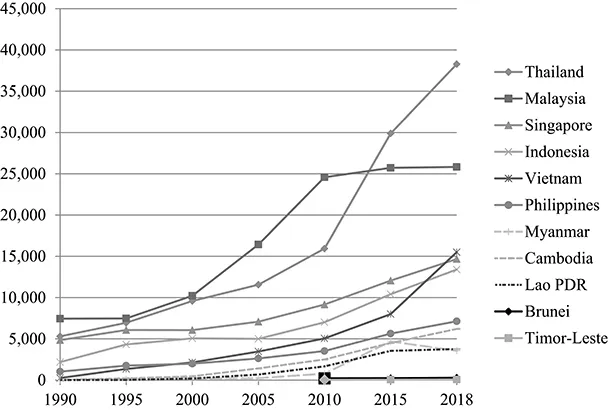
In the past decades, tourism in Southeast Asia has seen unprecedented growth (Figure 1.1), while the region has also undergone major changes in relation to markets, mobility and integration between countries in economic and political terms. The creation and expansion of the Association of Southeast Asian Nations (ASEAN) from a defence alliance to a political and economic relationship between member countries is significant in the formation of the Southeast Asian identity. Founded in 1967 as a non-communist block of East Asian countries, ASEAN plays a major role in the region’s economic, social and political development. In 1976, the organisation created a Sub-Committee on Tourism for the development of coordinated tourism projects and their enhanced marketing and, four years later, the ASEAN Tourism Forum was established as an annual event. Later, in 2015, the 10 members of ASEAN signed a declaration on the formal establishment of the ASEAN community, a broad framework of regional integration made up of three pillars: the ASEAN Economic Community (AEC), which focuses on economic integration; the Political-Security Community, which aims to link up regional foreign affairs and security interests; and the Socio-Cultural Community, which seeks to build people-to-people connections (Hall & Page, 2017).
Figure 1.1 International tourist arrivals in Southeast Asia (1990–2018) (in thousands)
Source: UNWTO 2016, 2019
Moreover, the opening of political systems and international borders accompanied by improvements in infrastructure led to further economic cooperation and mobility within the region and had substantial implications for tourism, both at the regional and international level. Tourism growth has also been spurred on by the birth of a range of regional low-cost airlines, spreading mass tourism beyond already established honeypots (Duval & Weaver, 2017). The recent financial crisis and economic instabilities have encouraged many Southeast Asian tourists previously travelling to North America and Europe to take their holidays in their own countries or the region, thereby driving regional tourism development.
As seen in Figure 1.1, the patterns of tourism development seem to concentrate on several ‘centres’ both in terms of the distribution of market and space. Thailand receives most international tourists within the region and has undergone a transformation in recent years as new source markets such as China, India, and Russia have boosted international arrivals dramatically (Trupp, 2017). Concurrent to this growth, tourism planners in Thailand have attempted to counter the growth of more conventional (4-S) forms of tourism by promoting alternative tourism, which is ‘more personalized, novel and authentic’ (Kontogeorgopoulos, 2017, p. 160). Malaysia’s strategy is to target high-yield tourists, including MICE participants and tourists from Middle Eastern countries; the country also promotes ecotourism, and medical tourism (Musa & Thirumoorthi, 2017). Vietnam has experienced significant growth in tourist arrivals in recent years and has also experienced diaspora tourism, with overseas Vietnamese returning to their former homes (Nguyen & King, 2002). Tourism development in Vietnam is state-led, demonstrating features such as an emphasis on quantity over quality and multiple barriers concerning product diversification and service quality (Truong & Le, 2017). Indonesian tourism is diverse in its nature owing to the country’s resource abundance, however, the economic revenue from tourism is highly concentrated in Bali (Connell, 2018) and natural disasters and terrorism in the past few years have affected tourism development in Indonesia (Hampton & Clifton, 2017). Having the highest ratio of tourists to residents in the region, Singapore’s key tourism plans have expanded from the emphasis on local culture and nature sites in the 1980s to a regional agenda in the 1990s, with global ambitions (Chang, 2017) and the introductio...
Table of contents
Cover
Half Title
Series Page
Title Page
Copyright Page
Table of Contents
List of illustrations
List of contributors
Foreword
PART I: Introduction: Theoretical and methodological foundations
PART II: Tourism and development in protected areas
PART III: Tourism, development, and local communities
PART IV: Tourism, development, and governance
Index
Trusted by 375,005 students
Access to over 1.5 million titles for a fair monthly price.
Study more efficiently using our study tools.
Frequently asked questions
Yes, you can cancel anytime from the Subscription tab in your account settings on the Perlego website. Your subscription will stay active until the end of your current billing period. Learn how to cancel your subscription
No, books cannot be downloaded as external files, such as PDFs, for use outside of Perlego. However, you can download books within the Perlego app for offline reading on mobile or tablet. Learn how to download books offline
Perlego offers two plans: Essential and Complete
Essential is ideal for learners and professionals who enjoy exploring a wide range of subjects. Access the Essential Library with 800,000+ trusted titles and best-sellers across business, personal growth, and the humanities. Includes unlimited reading time and Standard Read Aloud voice.
Complete: Perfect for advanced learners and researchers needing full, unrestricted access. Unlock 1.5M+ books across hundreds of subjects, including academic and specialized titles. The Complete Plan also includes advanced features like Premium Read Aloud and Research Assistant.
Both plans are available with monthly, semester, or annual billing cycles.
We are an online textbook subscription service, where you can get access to an entire online library for less than the price of a single book per month. With over 1.5 million books across 990+ topics, we’ve got you covered! Learn about our mission
Look out for the read-aloud symbol on your next book to see if you can listen to it. The read-aloud tool reads text aloud for you, highlighting the text as it is being read. You can pause it, speed it up and slow it down. Learn more about Read Aloud
Yes! You can use the Perlego app on both iOS and Android devices to read anytime, anywhere — even offline. Perfect for commutes or when you’re on the go. Please note we cannot support devices running on iOS 13 and Android 7 or earlier. Learn more about using the app
Yes, you can access Tourism and Development in Southeast Asia by Claudia Dolezal, Alexander Trupp, Huong T. Bui, Claudia Dolezal,Alexander Trupp,Huong T. Bui in PDF and/or ePUB format, as well as other popular books in Economics & Hospitality, Travel & Tourism Industry. We have over 1.5 million books available in our catalogue for you to explore.