Cities are centres of exciting events, flows, movements and contradictions that produce both opportunities and challenges. Evolved through the centuries, they display layers of spatial, cultural and socio-economic diversity and contestations, which are articulated in multiple ways. It is in this backdrop that the present volume addresses some of the myriad issues visible in the contemporary cities of the Global South. The volume is divided into three parts, each of them focusing on different dimension of contemporary urban challenges. Part I entitled 'The Concept of a City' contains five papers dealing with conceptual complexities of the urban. This part analyses as to what extent development intrudes on urban space and space in turn influences development. Part II 'City and Urban Space' contains six papers. These focus on the existing patterns, processes, and perspectives of urbanization and its consequent everyday manifestations across different cities. Part III 'Urban Policy, Planning and Governance' has six papers dealing with policy and planning.
In the wake of rapid urbanization and economic growth, the urban sector is swiftly changing towards being economic engines. Cities and towns being the centres of economic activities play a catalytic role in contributing to economic development and poverty reduction. However, there are layers of challenges that these cities face. This timely volume brings out these challenges and also analyses plausible solutions which can be brought about by the efficient and effective provision of essential urban services and infrastructure.
Please note: This title is co-published with Manohar Publishers, New Delhi. Taylor & Francis does not sell or distribute the Hardback in India, Pakistan, Nepal, Bhutan, Bangladesh and Sri Lanka.
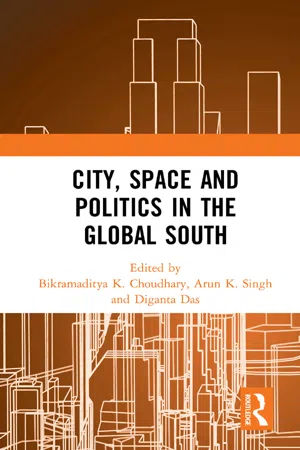
eBook - ePub
City, Space and Politics in the Global South
- 466 pages
- English
- ePUB (mobile friendly)
- Available on iOS & Android
eBook - ePub
City, Space and Politics in the Global South
About this book
Information
PART I
THE CONCEPT OF A CITY
CHAPTER 1
__________
Cities, Space and Development in India
In recent years, the role of space in development has come under increased scrutiny. How development intrudes the space and space in turn impacts development have been the questions of constant debates among social scientists, specifically among geographers. The cities remain thickly implicated in space and social relations, and have variously been described ‘as by-product of economic change’, ‘drivers of development/modernization’, ‘obstacle to development’, ‘accumulators’, ‘metropoles’ and so on. Despite attempts by geographers, the mainstream social theories for a long time have remained despatialized (Soja, 1989). Historicism has remained a main concern of socio-economic theories and space in everyday life remains speculative and even considered as a ‘noise’. The scalarity of space in the socio-economic process has been another issue that social scientists still grapple with to understand. This led Foucault (1980) to observe that a whole history remains to be written of spaces—which would at the same time be the history of powers (both of these terms in the plural)—from the great strategies of geopolitics to the little tactics of the habitat. Soja (1989) says, ‘the spatial order of human existence arises from the (social) production of space, the construction of human geographies that both reflect and configure being in the world’ (p. 25). With regard to economic development, it was Perroux (1955; 1970), who for the first time systematically put forward his conception about spatial development and explained that spatial equilibrium in economic development was difficult to realize. A similar conception led economists to coin terms like spatial ‘trickle down’ and ‘polarization’ (Hirschman, 1958) ‘backwash’ and ‘spread’ (Myrdal, 1957). Perroux’s idea of growth pole which related to propulsive industries was later translated by many into spatial growth poles and used in regional planning. In this framework, ‘towns and cities can be regional drivers of growth and change’ (Beall and Fox, 2009: 84), and this saw the emergence of literature which explained the organic relationship between cities and countryside (Gore, 1984). Cities got described as ‘geographical foundations of economic growth’ (Scott and Storper, 2003: 580) to ‘centre of gravity of economy’ and ‘logistic hearts of the economic activity’ (Braudel, 1984: 27). In fact, of late, many theories with regard to spatial dialectics and space relations have been formulated in specialized fields like sociology, psychology and economics, and geography remains their ultimate repository. This paper examines the space-development relationship and the role of cities in the same. We first discuss the theories regarding spatial development and its relationship with megacities followed by empirical evidence from India on the same.
CITIES, SPACE AND DEVELOPMENT
Today, more than 50 per cent of the world’s population live in cities and more than 70 per cent of the world’s income emerges from cities. Wirth defines cities as a ‘relatively large, dense and permanent settlement of socially heterogeneous individuals’ (Wirth, 1938: 8). In fact, as per Wirth, size, density and heterogeneity create a distinctive way of life that is specific to cities. Cities are also seen as ‘concentration and congregation of human energies’ (Beall and Fox, 2009: 3), demographic sinks, privileged spaces, and spaces of command and controls. They are also conceptualized as engines of economic growth and development, ‘as by-products of economic change, drivers of modernization’ (Beal and Fox, 2009: 19). Innovations in a society have been directly linked with the level of urbanization in that society (Bairoch, 1988: 323–5). Cities are also described as potential centres fuelling growth to their peripheries and used in planning as tools for spatial development (Friedmann and Alonso, 1975). The role of cities in the making of civilizations and economic transformations are also well acknowledged (Childe, 1950). Lewis Mumford says, ‘City is a geographical plexus, an economic organization, an institutional process, a theatre of social action, and an aesthetic symbol of collective unity’ (1937: 93–4). Urbanism as described by Louis Wirth in some other context, is now being used in New Economic Geography (NEG) to explain the economic power of cities. It is claimed that the density and diversity of economic activity in cities generate ‘external economies of scale.1 These external economies associated with cities are: (1) localization economies and (2) urbanization or Jacob economies. The spatial clustering of firms engaged in the production of similar goods produces localization economies. This concept is related to Alfred Marshall (1920) who observed that (a) proximity allows firms to share inputs, (b) a large pool of labour allows matching of skill of labour and need of firms, (c) density facilitates easy sharing of information and ideas, leading to effective learning, innovation and diffusion (Marshall, 1920: 267–77). The external economies of scale produced by diversity (of firms and individuals) are known as urbanization economies or Jacobs’ economies.
Edward W. Soja says that cities manifest the power of Synekism, that is socio-spatial force or stimulus unique to urban agglomerations.2 In this context, Jane Jacobs (1984: 32) argued that cities, not nations, should be salient units for understanding the economic process. She wrote,
Nations are political and military entities, and so are blocs of nations. But it does not necessarily follow from this that they are also the basic, salient entities of economic life or that they are particularly useful for probing the mysteries of economic structure, the reason for rise and decline of wealth.
(Jacobs, 1984: 31)
But, will the development of communication system lead to the death of cities? Will the interneted, distanciated (Giddens, 1984: 377) and networked society (Castells, 1996) create a condition where spatial density and proximity will not be a necessary condition for innovation? However, Storper and Venables (2004) argue the ‘face-to-face contact remains central to coordination of the economy’ (p. 352), and thus one cannot do away with ‘space’.
Cities are the primary source of iniquitous distribution of space. The fate of iniquitous spatial development has been conceptualized variously in economic theories. The neo-classical growth theorists like Kuznets and Williamson believed that ulti...
Table of contents
- Cover
- Half Title
- Title Page
- Copyright Page
- Table of Contents
- Introduction
- Part I: The Concept of a City
- Part II: City and Urban Space
- Part III: Urban Policy, Planning and Governance
- List of Contributors
- Index
Trusted by 375,005 students
Access to over 1.5 million titles for a fair monthly price.
Study more efficiently using our study tools.
Frequently asked questions
Yes, you can cancel anytime from the Subscription tab in your account settings on the Perlego website. Your subscription will stay active until the end of your current billing period. Learn how to cancel your subscription
No, books cannot be downloaded as external files, such as PDFs, for use outside of Perlego. However, you can download books within the Perlego app for offline reading on mobile or tablet. Learn how to download books offline
Perlego offers two plans: Essential and Complete
- Essential is ideal for learners and professionals who enjoy exploring a wide range of subjects. Access the Essential Library with 800,000+ trusted titles and best-sellers across business, personal growth, and the humanities. Includes unlimited reading time and Standard Read Aloud voice.
- Complete: Perfect for advanced learners and researchers needing full, unrestricted access. Unlock 1.5M+ books across hundreds of subjects, including academic and specialized titles. The Complete Plan also includes advanced features like Premium Read Aloud and Research Assistant.
We are an online textbook subscription service, where you can get access to an entire online library for less than the price of a single book per month. With over 1.5 million books across 990+ topics, we’ve got you covered! Learn about our mission
Look out for the read-aloud symbol on your next book to see if you can listen to it. The read-aloud tool reads text aloud for you, highlighting the text as it is being read. You can pause it, speed it up and slow it down. Learn more about Read Aloud
Yes! You can use the Perlego app on both iOS and Android devices to read anytime, anywhere — even offline. Perfect for commutes or when you’re on the go.
Please note we cannot support devices running on iOS 13 and Android 7 or earlier. Learn more about using the app
Please note we cannot support devices running on iOS 13 and Android 7 or earlier. Learn more about using the app
Yes, you can access City, Space and Politics in the Global South by Bikramaditya K. Choudhary,Arun K. Singh,Diganta Das in PDF and/or ePUB format, as well as other popular books in Social Sciences & Regional Studies. We have over 1.5 million books available in our catalogue for you to explore.