- 256 pages
- English
- ePUB (mobile friendly)
- Available on iOS & Android
eBook - ePub
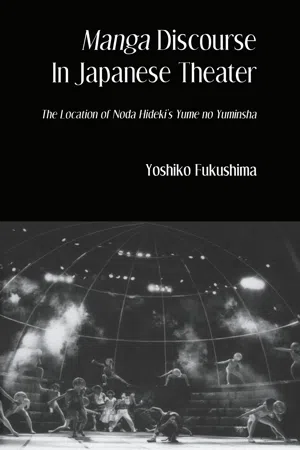
Manga Discourse in Japan Theatre
About this book
During the Japanese 'bubble' economy of the 1980's, the youth of Japan began to exert unprecedented influence on Japanese culture through their spirited patronage of certain art forms previously deemed subcultural or avant-garde. Among these were manga (Japanese comics or animation) and shogekijo (Japanese little theater). These art forms, while ve
Information
1 Manga Discourse and Japanese Postmodernism:
Why Shōgekijō and Manga?
AKAGAKI: Pickles, milk, ground pork, popsicles.
YAMAZAKI: Oh, sorry, that’s my list for shopping.
AKAGAKI: Money, mathematics, women, manga, parents.
YAMAZAKI: That’s my list for life. I put them together in that order.
AKAGAKI: So, you mean, if your parents die when you are reading manga, you’ll parents’ house and smile beside your parents remembering what you’ve just read, right?
YAMAZAKI: Yeah, you know if you give such an order according to the amount of love, you will never get lost. Noda Hideki, Akō rōshi, 19811
OLD WOMAN: Youth, love, disappointment, hope.
CHIEF WAITER: What are you talking about? (Picks up the manga magazine Shōjo Furendo and, as he throws it toward the OLD WOMAN, the cover rips.)
OLD WOMAN: Oh, no! (Cradles the torn magazine and looks at the CHIEF WAITER with bitter hatred.)
CHIEF WAITER: Go home, you old piece of cheese.
OLD WOMAN: ….
CHIEF WAITER: When you squeeze fat, it turns to cheese.
OLD WOMAN: My magazine cover, my magazine cover….
Kara Jūrō, Shōjo kamen, 19692
For the character Yamazaki in Noda’s Akō rōshi (Lordless Samurai of Ako) (1981), manga is more important than his own parents are. Yamazaki represents Noda’s generation in which manga was a vital part of their childhood. It is very difficult to find a Japanese child who has never read manga. When reference is made to manga in Noda’s plays, every young adult and most adults of any age know what he is talking about. The reference is understood by any Japanese who spent time in his/her childhood reading manga during breaks from their homework, sometimes hiding from their parents and fantasizing about an ideal male or female persona.
Eleven years before Noda wrote Akō rōshi, Kara Jūrō referred to a comic magazine for young girls, Shōjo furendo (The Girls’ Friend), in his play Shōjo kamen (The Girl’s Mask) (1969).3 He chose manga as a symbol of “youth, love, disappointment and hope” (267). The playwright/theater/director Takatori Ei, who studied under Terayama Shūji in his later years, describes how manga and shōgekijō, as the central elements of subculture, evolved together in the late 1960s:
When I was a high school student [in the late 1960s], the mass media said that college students had the comic magazine for boys Shōnen magajin (The Boys’ Magazine) in the right hand, and the left-leaning journal Asahi jānaru (The Asahi Journal) in the left hand.4 […] I believe it was the advent of the age when Japanese subculture (manga, film and pop music) attempted to surpass high culture (politics, literature and classical music). Naturally, in the world of theater, the underground theater by Terayama Shūji, Kara Jūrō, Suzuki Tadashi, and Satō Makoto emerged, opposing itself to shingeki. Among those four artists, the first two, Terayama and Kara went toward the subculture (Takatori 1996:124-125).
As early as the 1960s, scholars of cultural studies were already paying attention to the subcultural realm of the young.5 This subculture reflected young people’s everyday concerns, their social conditions and rapidly changing values. Shōgekijō has attracted a mostly young audience since the 1960s. Many audience members in the 1980s were college students, who were in their late teens and early twenties and had recently undergone a series of grueling entrance examinations but still lacked real life experience. The motifs and characters of manga have continued to be incorporated into the works of Shōgekijō as a mirror of Japanese society and thought.
The tie between Shōgekijō and manga was strengthened in the 1980s. For example, in Noda’s Kokusenya kassen and Gansaku, sakura no mori no mankai no shita, both staged in 1989, several motifs and characters were taken directly from Tezuka Osamu’s Hi no tori (Phoenix) (1954-86). Hi no tori was one of comic books that deeply moved Noda as a teenager. Originally Noda planned to dramatize Hi no tori, but he could not because Tezuka had just given permission to someone else to use it. In Kokusenya kassen, Noda, instead of dramatizing the whole piece of Hi no tori, borrowed the historical background of the ancient Japanese queen Himiko and the character Fushichō, whose name means “phoenix.” In Sakura no mori no mankai no shita, the face of Maitreya, carved by the one of three fighting artisans, Mimio, to win the first prize, was modeled after the gargoyle made by a mendicant priest Gaō in Tezuka’s Hi no tori. Hagio, co-writer with Noda of Hanshin (1986), is a cartoonist of shōjo manga (girls’ comics) under the strong influence of Tezuka. Hanshin shows strong ties with manga and uses a plot and borrowed directly from Hagio’s comic of the same title.
Many other contacts between Japanese theater and manga could be observed in the 1980s. For example, Takarazuka dramatized Ikeda Riyoko’s Berusaiyu no bara (The Rose of Versailles), which became a big hit. Watanabe Eriko received the Kishida Kunio Drama Award in the same year as did Noda for her shōgekijō work, Ge-Ge-Ge no Ge (Ge in Ge-Ge-Ge) (1982). The title was taken from Mizuki Shigeru’s Ge-Ge-Ge no Kitarō (Kitaro the Spooky), a children’s cartoon about ghosts and goblins. Takatori Ei, who formed his troupe Gesshoku Kagekidan in 1985, created works similar to the narratives of shōjo manga.6 Kawamura Takeshi and his Daisan Erochika (The Third Erotica) created Jō no monogatari – bokushingu purei (The Story of Jo: Boxing Play) (1989) based on the famous comics (later animated for television), Ashita no Jō (Jo of Tomorrow), serialized from 1968 to 1973 in the boys’ comic magazine Shōnen magajin.
Why this affinity of shōgekijō and manga? First, as I have just mentioned, these two genres can be put under the category of youth subculture. Second, many subcultural art forms were commercialized in the 1980s. The increasing numbers of young audiences for the 1980s shōgekijō proved that even experimental theater could be circulated as a cultural commodity. Third, shōgekijō, as John Fiske says, “cannot be adequately described in financial terms.[…] What is exchanged and circulated here is not wealth, but meanings, pleasures, and social identities” (Fiske 1987:311). We can also assume that the delivery of meanings, pleasures, and social identities in Japanese postmodern society existed behind the popularity of both manga and shōgekijō in the 1980s. They reflected the postmodern approach to popular art forms, its reaction against the cultural elitism of modernism, and the growing sense of closeness to mass-produced art, which characterize the nature of manga discourse that I am arguing in this book.
When I asked Noda about the influence of Japanese postmodern thought on his theater, he said, “I don’t think [Japanese postmodern thought] has influenced it, but since I live in the same time with Japanese postmodern critics, I can say that my theatrical practice makes use of some of their key words” (Noda, interview with author, August 26 1997). Noda admitted that he had read some of the works by Japanese postmodern critics like Karatani Kōjin and other writings introducing French postmodern thought to Japan.7 Knowing key features of the term “postmodern” in the Japanese context helps us clarify how Noda and other theater practitioners sought to redefine the avant-garde theater for their manga-trained generation of the 1980s.
What is Japanese Postmodernism?
Because of certain developments in mass communication it has become possible to disseminate information instantaneously from the West. Just as information now quickly travels to countries all over the world, theories also cross oceans quickly, especially in the form of books, journals and lectures by theorists invited from the West. Japanese postmodern theories owed much to Michel Foucault, Jacques Derrida, Jean-François Lyotard, Gilles Deleuze, Félix Guattari, and Jean Baudrillard. Many of their texts were translated into Japanese.
Among the earliest examples of French poststructuralist thought influencing Japanese postmodernism Japan were Hasumi Shigehiko’s interviews with French thinkers, including Foucault and Deleuze, published in Umi (Sea) (1972). In 1978 Hasumi published Foucault, Deleuze, and Derrida. From the late 1970s and throughout the 1980s other postmodern critics in Japan, such as Karatani Kōjin, Asada Akira, and Nakazawa Shinichi, demonstrated a strong interest in French poststructualism.8
Japanese postmodernism was not limited to the direct translations of Western postmodern theories. Japanese intellectuals interpreted what they got from the West developing their own views on the relationship of postmodern ideas to the unique Japanese situation.9 Japanese postmodernism was not limited to the above-mentioned writers, but included theorists from a variety of fields like economics, sociology, ethnology, religion, and anthropology. Some works became bestsellers like Asada’s Kōzō to chikara (Structure and Power) (1988). Many works by Karatani, for example, were published in the form of mass-market pocketsize paperbacks known as bunko-bon.
The easy access to these works encouraged changes in the manner of distributing “knowledge” by the Japanese intellectual avant-garde. The changes could be observed in their style of writing, their topics of discussion, and their overall methods. The media called the discussions by the younger Asada Akira and Nakazawa Shinichi as well as those of the economic anthropologist Kurimoto Shinichirō, the “New Academism” (sometimes fashionably abbreviated as nyū aka). Their works on French contemporary thought and criticism under the influence of poststructualist theories presented “the spectacle of a thoroughly commodified world of knowledge” (Ivy, in Miyoshi and Harootunian 1989:21-46).10 As Ivy sees it, through the practice of the New Academism, knowledge was commercialized as an “informational commodity” for educated Japanese readers in the 1980s (25). Koschmann describes the basic approach of the New Academism as a form of play:
Their work transgresses the established boundaries of academic specialization and affiliation, is light and playful in style in contrast to the high seriousness of faculty seminars and research groups, and appeals because of the authors’ personal charms as well as intellectual acumen (Gordon 1993:420).
Asada’s Kōzō to chikara, first published in 1983, sold a hundred thousand copies and caused a stir in Japanese society known as the “Asada Akira Phenomenon” (AA genshō). In the preface to his book, which Asada calls a “warm-up,” he discusses the possibility of the university in a light and breezy fashion. It is this preface that caused the stir. The remainder of the book contains difficult academic writings on French structuralist and post-structuralist thought. Ivy writes: “Office workers, university students, artists, musicians – everyone bought the book.[…] Many bought Asada’s text and read only the preface and the chart at the end of the book” (26-27).11
Karatani’s essay “Hihyō to posuto modan” (“Criticism and the Postmodern”), which criticizes the New Academism, states that the stormy condition of Japanese postmodern discourse established a “self-sufficient closed space” (Karatani 1989 [1985]: 10-57; see also Ivy, in Miyoshi and Harootunian 1989: 21-46). Karatani believes this discourse began to harbor nationalist feelings by defining such older Japanese thinkers like Nishida Kitarō and Moto’ori Norinaga as poststructuralists or postmodernist, at the same time giving the appearance of “worshipping the West” (seiyō kabure) in its reading of Western theories (30). Karatani says:
Japan’s postmodernism is a closed system of discourse. It does not have an exterior even though all kinds of thoughts are introduced from the outside. In that system, what Japan is thinking is everything. Japan forgets how it is.12 Of course, any person is aware how others are thinking of him, but that is only self-consciousness. As one who is sensitive to others often has no “other,” contemporary Japanese discourse space has no “exterior.” In other words, there is no “criticism” (30).
Japan’s closed system correlates with what Karatani calls an “anti-constructed construction” (hankōchikutekina kōchiku), which relies on Moto’ori Norinaga’s concept of “coming into being naturally,” a Japanese culturally specific system or construction that appears to reject any system or construction. Karatani finds the examples of the “anti-constructed construction” in Mori Ōgai’s history novels and Chikamatsu Monzaemon’s plays. Both authors reject the construction of a narrative style and describe “a situation established before one is aware of it” or “a situation without any particular opposition or struggle” (39-45). Karatani extends these examples to postmodern writers:
Japanese postmodern thinkers and writers are trying to hit a target that doesn’t even exist; regardless of their intentions, their deconstruction ends up being absorbed by Japan’s “anti- constructed construction.” This failure of deconstruction is not the fault of consumer society. It was the fault of Japanese consumer society (originally in Karatani 1989 [1985]:54).13
Here Karatani tries to clarify how Japanese “anti-constructed construction” is different from the Western postmoder...
Table of contents
- Cover
- Halftitle
- Title
- Copyright
- Dedication
- Contents
- Acknowledgements
- Figures
- Introduction
- 1 Manga Discourse and Japanese Postmodernism: Why Shōgekijō and Manga?
- 2 Transmission of Manga Discourse
- 3 Before the Appearance of Noda’s Yume no Yuminsha
- 4 Theater Must Sell! – Noda’s Yume no Yūminsha
- 5 Noda’s Performance Theory: Practice of Manga Discourse
- Conclusion: Noda’s World of Playing
- References
- Index
Trusted by 375,005 students
Access to over 1.5 million titles for a fair monthly price.
Study more efficiently using our study tools.
Frequently asked questions
Yes, you can cancel anytime from the Subscription tab in your account settings on the Perlego website. Your subscription will stay active until the end of your current billing period. Learn how to cancel your subscription
No, books cannot be downloaded as external files, such as PDFs, for use outside of Perlego. However, you can download books within the Perlego app for offline reading on mobile or tablet. Learn how to download books offline
Perlego offers two plans: Essential and Complete
- Essential is ideal for learners and professionals who enjoy exploring a wide range of subjects. Access the Essential Library with 800,000+ trusted titles and best-sellers across business, personal growth, and the humanities. Includes unlimited reading time and Standard Read Aloud voice.
- Complete: Perfect for advanced learners and researchers needing full, unrestricted access. Unlock 1.5M+ books across hundreds of subjects, including academic and specialized titles. The Complete Plan also includes advanced features like Premium Read Aloud and Research Assistant.
We are an online textbook subscription service, where you can get access to an entire online library for less than the price of a single book per month. With over 1.5 million books across 990+ topics, we’ve got you covered! Learn about our mission
Look out for the read-aloud symbol on your next book to see if you can listen to it. The read-aloud tool reads text aloud for you, highlighting the text as it is being read. You can pause it, speed it up and slow it down. Learn more about Read Aloud
Yes! You can use the Perlego app on both iOS and Android devices to read anytime, anywhere — even offline. Perfect for commutes or when you’re on the go.
Please note we cannot support devices running on iOS 13 and Android 7 or earlier. Learn more about using the app
Please note we cannot support devices running on iOS 13 and Android 7 or earlier. Learn more about using the app
Yes, you can access Manga Discourse in Japan Theatre by Yoshiko Fukushima in PDF and/or ePUB format, as well as other popular books in Social Sciences & Anthropology. We have over 1.5 million books available in our catalogue for you to explore.