![]()
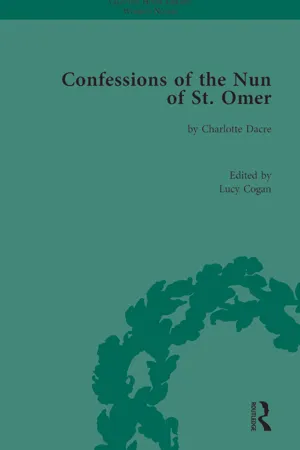
Confessions of the Nun of St. Omer.1
A TALE,
IN THREE VOLUMES.
BY
ROSA MATILDA.
VOLUME I.
Virtue is arbitrary, nor admits debate.
To doubt is treason in her rigid court.
But if we parly with the foe
We’re lost.
G. LILLO.2
— How many shake
With all the fiercer tortures of the mind –
Unbounded passion, madness, guilt, remorse!
THOMSON.3
LONDON:
Printed by D.N. SHURY, No. 7, Berwick-street, Soho;
For J. F. HUGHES, WIGMORE STREET,
CAVENDISH SQUARE.
1805.
To
M. G. LEWIS, ESQ.4
SIR,
Allow me to dedicate to you the following pages, written at eighteen;5 not from any similarity they can boast to the style or subject of your writings, but simply as a slight tribute for the pleasure I have experienced in perusing them, and the admiration I entertain for your very various and brilliant talents.
I have the honor to be, Sir,
Your humble servant,
ROSA MATILDA.
APOSTROPHE
TO
THE CRITICS.
’TIS unwillingly I emerge from seclusion to launch my bark on the broad ocean of the world, and battle against the tide of public opinion; for I write from the feelings of the heart.6 I have not culled my phrases, nor sought to deck this narrative in the poetic flowers of eloquence. – I confess I stand in awe of the critics, for I am diffident of myself – I fear they will lash the effervescence of its sentiments, and the enthusiasm of its fancy; but let them remember, I write not to palliate either, but to exemplify their fatal tendency.
Good Critics, I am young, therefore solicit your forbearance; revise, compare, and analyse if you will, but let your strictures be liberal and considerate.
ROSA MATILDA.
![]()
Introduction
THE following pages, and the Apostrophe to the Critics which precedes them, were written at the age of eighteen, chiefly as a resource against ennui and for want of better employment: soon after they were finished, I had occasion to leave this country, and I consigned them, along with some other papers, to a box till I returned.
They remained unnoticed for nearly three years, when shewing, some weeks since, several of my more recent productions to a friend, a few loose pages of this tale accidentally caught his eye; he requested permission to peruse it entire – this I granted, and the result of his arguments, after perusal, were such as to induce its present publication.
I mention these circumstances from a conviction, that much, which will now undergo the ordeal of critical examination, requires considerable palliation; whether or not such palliation as I have been enabled to offer may disarm severe scrutiny, I am not competent to ascertain; but this I feel, if it will not, to add more would be superfluous.
THE AUTHOR.
![]()
Chap. I.
The Fatal Encounter
DREADFUL conflict! – whether to acknowledge to a son, who reveres me, the melancholy errors of an unfortunate mother, or by suffering him to remain in ignorance of those sad truths it is my duty to inform him of, retain, only by an effort of duplicity, his unmerited respect and love!
And wilt thou then, dear boy – wilt thou indeed despise me? – if thou dost, thou art unlike St. Elmer. Wilt thou not draw a veil over my errors, and in lieu of keen contempt gaze on my grave with pity? – Yes, thou shalt know all, my Lindorf; and may it teach thee to consider, from the sorrows of thy parent, her unhappy sex as defenceless; and thus deriving a dearer claim on thy protection, rather than from the eminence of manhood, view them as the ready-formed victims for deceit and cruelty. Yes, though at the risk of losing the only joy that is left me, thy affection and respect, dear son of tears, I will make atonement (if such there can be) for my guilt, by inflicting on my lacerated heart the pain of unequivocal confession,7 and remembering that he who will peruse it is my only friend, the only being whose love I am desirous to retain. When I have surmounted the melancholy struggle, a ray of peace may faintly gild my bosom * * * * the severest philosophy and the conflicts of my whole life can extort no more than this – Lindorf, I will lay open to thy knowledge my agonizing tale * * * * * * * * * * * * * * * * * * Should the inclosed packet, as I trust, come sacred to the hands of Dorvil Lindorf, let him not, as he respects the memory of an ill-fated mother, peruse it till the cold and friendly grave hath damped for ever the warm flushed cheek of shame.8 * * * * * * * * * * * * * * * * * * * * * * * * My father was the Marquis Arieni; – making the tour of Europe, he became acquainted with an English family of distinction residing in England; and, probably imagining he beheld in my mother the woman he had ever desired as a wife, he made proposals to her parents, which were accepted, and they became united.
Arieni was an haughty Italian – daring, a great speculator, fond of pre-eminence and of strong abilities; – his person was short, yet graceful – and his manners, though reserved, insidious – a spirit of enterprise and shrewdness of imagination calculated him for the atchievement of events the most hazardous; and an eloquential flow of language, dazzling and sententious, made to him continual converts of the weak and wise.
My mother was his enthusiastic admirer – she contemplated his talents with the same awe-struck wonder as a child views the ascension of a sky-rocket:9– she was innocent, young, and romantic to a fault, easily swayed, and too soft to be energetic, or repel by dignified perseverance the influx of oppression.
After their marriage my parents launched into a splendour beyond their power to continue – eight years rolled on amid the vortex of folly, but at the expiration of that period, the embarrassments of the Marquis would suffer him no longer to remain with safety in the metropolis, and yielding to the suggestions of his friends he consented to fly, causing me to accompany him, who had ever been his favorite – unfortunate child! on whose innocent head Fate had already set her gloomy mark.
Now left wretched and forlorn with two children younger than myself, my mother retired into an obscure village – there, her heart breaking with despondency, she passed her hours in tears, in praying for her husband, in dreaming over his image, and in instructing her children.
For me, wild and careless as the breeze which wafted over me, I little dreamt the sorrows of my parents; and with the childish art of eight years endeavoured to awaken the attention of the Marquis.
Italy was the place of destination – some connexions he had there, with, perhaps, an involuntary desire to revisit his native country, had conspired in his choice of an abode. – We arrived after a long and fatiguing journey, when my father, desirous of resting as early as possible, alighted at the first Locanda (an inn) which presented itself – he was informed the apartments were all occupied either by families or individuals.
‘But could you not prevail on any individual, friend?’ inquired my father with an expressive smile, and accompanying the smile by a more expressive donation.
‘There is one apartment, Sinor,10 the best we have, in the possession of only one lady, but she is a lady of rank, Sinor, and perhaps might object.’
‘Go, friend, and use your influence; if you succeed – you understand me’ – and again my father smiled; the man bowed obsequiously and withdrew on his embassy – in about five minutes he returned.
‘The Sinora11 gives consent, Sinor,’ exclaimed the enraptured mercury.12
‘Lead on then,’ said my father, alighting and taking me in his arms.
We were ushered into a superb apartment, where a lady of elegant figure and shewy appearance had been evidently studying an attitude against our entrance, and now half rose from the sopha, on which, nymph-like, she reclined; the Marquis appeared struck, yet in a graceful manner apologized for his intrusion, and half hesitating, half presuming, seated himself near the reclining nymph.
They entered into conversation – sad and diabolical woman! – infamous source of all my errors and my woes! why did no kind presage, no instinctive emotion inform me of the sorrows thou wast fated to heap upon me? – playfully I hung around the syren13 smiler, and sportively amused myself with her resplendent ornaments.
The Countess Rosendorf was a German of noble extraction; but high birth, which might have reflected additional lustre on her virtues, seemed only tarnished by her crimes: one exalted vicious character, from whom the multitude take lead, is of more momentous danger to society than twenty of a common cast. She had been married in her youth to a man she could little appreciate, whose misplaced affection not allowing him to resent her infamous conduct, but whose heart, incapable of supporting it, burst beneath the variety of wretchedness she inflicted, and left her to pursue alone a life which had already become tainted with every vice. – She had two children, supposed to be Count Rosendorf’s; for several years after his death her conduct had given rise to various reports, as in its fullest extent she followed the motto of liberty,14 literally shunned and disdained by the noble family she had disgraced.15
She was artful, vivacious, and elegant – of an enterprising and atrocious spirit – a depraved heart, salacious disposition, and insensible soul; – she appeared to have determined the subjugation of my father; he appeared worthy of the task – her fortune, from the uncircumscribed course she had pursued, was more than shattered; but her spirit still remained unbroken, and she presumed to hope that his notions of independence accorded with her own. From this fateful period my doom assumed its cast; ’twas of gloomy black – my doom was ascertained, that of my unfortunate family, and, perhaps, it might have affected the future fate of myriads yet unborn; for have not the revolutions of empires depended on the influence of the moment, and the long chain of events which, still hidden in embryo, taken from it their subsequent casts * * * * * * * * * * * * * * * * * * * * * let me not dwell upon the maddening theme, but hasten on. – Fate now smiled gloomy upon my blasted days – a destructive and illicit union was gradually cemented between my father and the Rosendorf; and the fragment of a letter which I accidentally discovered, and by chance preserved, sufficiently evinces the unblushing turpitude of this female seducer.16 – It ran thus:
‘Arieni, you are a man to whom the prejudices of the world are as nothing; I confess, from the ideas I had conceived of you, I had not imagined this advance on my side would have been necessary. Arieni appeared to me to act from himself, not from others; is your mind big with any project, and do you fear to avow it? – Are not you and I above the common kind; have we not each been most preposterously mismatched by the idle prevalence of a political institution? – our minds are congenial and ought to be united; – of what consequence should be to us the world’ s opinion? – you are ruined, and will they assist you? – Of what consequence the ties of prejudice – reason and right evidently point out to man the path of happiness: – he is a fool – no philosopher, if he pursue it not.
My motto is liberty and independence! Arieni has called me dangerous, but wherefore if I convince him I am just? – if not, how can I be dangerous? – You tell me of your wife – fallacious obstacle! – trust to her affection for pardon, to her reason for toleration; if she love you as you say, she can never seek revenge – for her tenderness will yield to the arguments you will know so well how to adduce; if she prove refractory she has then no affection, and we are justified in peremptorily retaining our free agency: remember, that our fortunes are shattered; that together we may restore them, and that she who offers you her friendship and her person,17 is possest at once of spirit to conceive and promptness to execute.’
Was my young heart instructed then in the fateful net, weaving forever against its future happiness? – I know not, but I viewed the Rosendorf with increasing terror and dislike. A superb palace was hired in the heart of the Campania de Roma,18 and whatever were the speculations of ambition, for which so much had been sacrificed, they were by no means aerial. The palace Arieni became rapidly crouded with the first nobility of Italy, and festive mirth appeared to reign throughout.
![]()
Chap. II.
Juvenile Attachments
AMONG the various influx of society that visited the palace of the Marquis, was a young English Nobleman, called St. Elmer; dear and unfortunate being, whose lot was so deeply tinctured with the fatality of mine! St. Elmer was of the first order of human beings; his character was too fine fo...