![]()
Part I
Principles of target cost contracting
![]()
1 Fundamentals of target cost contracts
Introduction
The selection of procurement methods for construction projects is a critical factor in achieving project success (Chan and Yung, 2003). The construction industry keeps changing, resulting in more belief that it is essential that procurement methods are tailor-made in order to align the goals and aspirations of various key project stakeholders, agree on the risk allocation mechanism, and decide on what portion of the design and construction the client intends to be integrated. Chapter 1 sets out the basics of TCC and GMP in construction projects.
Definitions and characteristics of TCC
Target cost contracting (TCC) and guaranteed maximum price (GMP) are an incentive-based strategy for construction procurement. According to Masterman (2002), TCC and GMP award contractors for the cost savings against the target cost or guaranteed price, but penalise them when the cost exceeds the agreed amount due to their own faults in terms of management or negligence pursuant to the pre-agreed share ratio. The contractor usually includes a TCC and GMP allowance to cover future design development and unexpected risks (Gander and Hemsley, 1997).
Target cost contracting
TCC can be defined as follows:
(National Economic Development Office, 1982)
Trench (1991) also stated that under TCC, after evaluating and comparing the actual cost of the completion of construction with the target cost of the project, the client and contractor share the differences within a cost band. The Mass Transit Railway Corporation (MTRC, 2003) also commented that ‘the client and the contractor would share savings (gains) if the final account figure turns out to be less than the target. Should the final account exceed the target, they would share the excess (pain).’ This is different from a fixed-price contract due to the agreement and collective determination of the sharing ratio of risks.
Wong (2006) also explained that the builder will be paid the actual cost for the work completed throughout construction. When there is a difference between the initial contract target cost and the actual cost, the client and contractor will share the difference based on the pre-agreed gain-share/pain-share proportion. Hughes et al. (2011) also stated that TCC is often regarded as a gain-share/pain-share approach in which the contracting parties determine a target cost (estimated cost) and sharing ratio which is used when the estimated cost is higher or lower than the actual cost. They also suggested that TCC is suitable if: (1) the client is incentivised to become actively involved to help the contractor to develop cost-efficient solutions; and (2) the same contractor is deliberately chosen for recurrent business by the client.
Guaranteed maximum pricing
According to Boukendour and Bah (2001), GMP is regarded as a hybrid procurement method involving a call option for a fixed-price contract as well as a cost imbursement contract. The contractor guarantees that the project will be completed within the pre-agreed GMP at main contract award and within the contract period in consonance with the specifications and drawings.
Carty (1995) described GMP as follows:
Kerzner (1995) elaborated on Carty (1995)’s definition of GMP as follows:
(Kerzner, 1995, cited in Ferreira and Rogerson, 1999)
As mentioned by Perry and Thompson (1982), GMP could thus be regarded as a form of TCC where the shared proportion of GMP is restricted only to the gain.
Procurement route of TCC
Tendering method
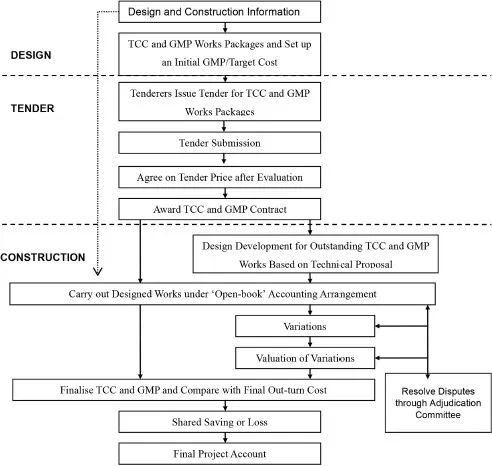
If a project is procured under TCC and GMP on a negotiated contract basis, a suitable builder will already have been selected by means of a corporate relationship between the companies. Especially in Hong Kong, most of the GMP contracts are awarded to a favourable contractor on a negotiated basis owing to a corporate business relationship – e.g. Hong Kong Land Ltd (developer) working with Gammon Construction Ltd (main contractor). On the other hand, in selective tendering, the client will invite the tenderers to pre-qualify by submitting a preliminary proposal including details of company strength, previous track record, related project experience, financial soundness, capability in alternative procurement methods, technical competence, partnering dedication, organisational structures and staff. Eventually, the employer and the employer’s team of consultants review the proposals. After a thorough evaluation, the client will shortlist and invite the pre-qualified contractors to submit a tender. Figure 1.1 demonstrates a typical procurement route under the TCC and GMP approaches.
If a two-stage tendering method is adopted, after pre-qualification, tenderers will be invited to submit tenders in accordance with the following preliminary materials provided by client and the client’s team of consultants:
1 cost plan;
2 base schematic/outline design drawings (e.g. ~20% of design complete);
3 performance specifications for works packages;
4 other accessible information.
After evaluating the tenders, the tenderers will be shortlisted, then requested to submit more detailed proposals in the second stage, consisting of:
1 a bill of quantities;
2 a more detailed set of design drawings;
3 performance specifications for works packages.
A negotiated tendering arrangement will not diminish the purposes of gaining a competitive tender, since an ‘open-book’ competitive tender approach is ultimately applied in most of the subcontract packages. Nevertheless, this information exchange demands a high level of mutual trust among the contracting stakeholders, particularly the main contractor. The amount of the competitive subcontract packages tendered may be 60–80% of the contract value.
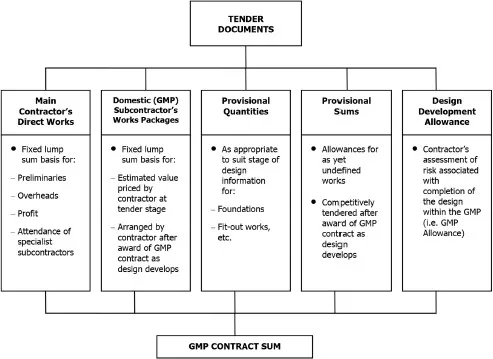
Regarding the materials required for the TCC and GMP contracts, the employer and team of consultants provide the preliminary design documentation for estimating both the target cost and GMP. Tender documents for GMP contracts usually consist of the following:
1 cost for main contractor’s direct works (e.g. substructure works, reinforced concrete superstructure works, finishes works, etc.);
2 domestic subcontractor’s works packages;
3 provisional quantities;
4 provisional sums;
5 design development allowance (Hong Kong Housing Authority, 2006).
Figure 1.2 lists the details of these documents. As the information stated in the tender documents may be insufficient to construct and complete the project, the builder is allowed to include a sum for design development in the tender price. After the target cost is agreed and conveyed to the contractor with the architect’s instructions, the employer and consultant team will provide more detailed design information to the contractor.
Generally, the tender documents for domestic subcontractors’ works packages (e.g. plumbing and drainage, electrical and mechanical installation, air conditioning installation, fire services installation, lift installation, specialist external works, etc.) are prepared by the main contractor with the team of consultants. The preferred or pre-qualified subcontractors will receive tender documents that dictate the quality and state the range of work. The main contractor needs to show any GMP variations that will require recalculating the GMP in the subcontract tender documents. After issuing the subcontract tender documents to the suitable tenderers, the scope of work stated in the tender document for the subcontractor’s works package will be deemed to have been accepted by the main contractor and involved in the allowances for future design development, which means that GMP will not be recalculated. The main contractor and the employer’s team of consultants will evaluate the tenders and give further advice to the employer for contract award on a competitive ‘open-book’ strategy, which should ensure that the subcontractors are evaluated fairly on the tender sum they provided.
The successful subcontractor will enter into a domestic subcontract with the main contractor. Such a procedure will eliminate the need for nominated subcontracts and the underlying liabilities. In addition, the main contractor can be assured that the subcontractor can only subcontract or assign works with the client’s approval. The savings, if any, acquired in the tendering of subcontractors are included in the final out-turn costs and become the basis for calculating the shared saving at completion stage.
Pricing mechanism
Similar to other standard cost-based procurement contracts, the main contractor’s tender pricing of subcontract packages should be available to the client in detail. This may be achieved through an ‘open-book’ accounting method. The employer may scrutinise the contractor’s account to ensure that a strong administrative team and the contractor’s accountant are involved on site. If the client is satisfied with the built facilities, it will pay these costs to the main contractor. According to the National Economic Development Office (1982), improved responsibility and quantification of risks can be achieved through using open-book accounting schemes.
Another feature of TCC and GMP contracts is that the completion will be within the target cost, as warranted or promised by the main contractor (Gander and Hemsley, 1997). Under GMP procurement, if the actual cost exceeds the negotiated GMP, the client may merely pay the GMP amount and the contractor will be liable for the excess costs (Cantirino and Fodor, 1999). Therefore, the client can moderate the financial risk by establishing this price ceiling (Boukendour and Bah, 2001).
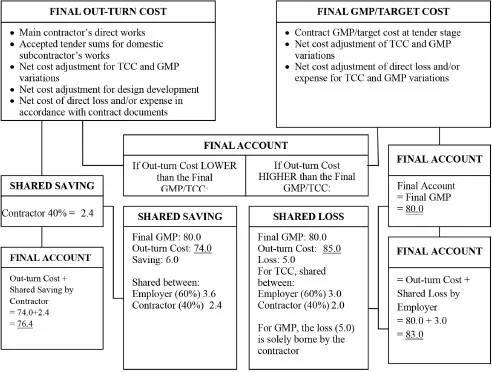
The unique character of TCC is the gain-share/pain-share mechanism (Trench, 1991). If the actual cost and the target cost are different, TCC enables the main contractor and the client to share the ‘gain/pain’. TCC thereby generates strong incentives for contractors to minimise costs by applying their own experience, expertise and innovations at both the design and construction stages. Figure 1.3 shows an example under this gain-share/pain-share regime for both TCC and GMP projects.
The open-book accounting approach conceives that the main contractor is required to furnish all the data and information involving:
• construction programmes, method statements and resource programmes;
• pricing of the preliminaries and contract conditions;
• details of pricing obtained for the domestic subcontractor’s works packages;
• details of attendance fo...