- 235 pages
- English
- ePUB (mobile friendly)
- Available on iOS & Android
eBook - ePub
About this book
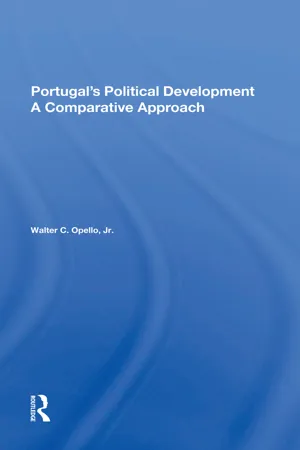
Portugal's early developmental experience created a highly centralized administrative state that continues to have a powerful influence on the nature and style of the country's government and politics. Emphasizing this theme, Dr. Opello shows that, contrary to the conclusions of scholars who have analyzed Portugal from Latin American or Third World perspectives, Portuguese political development is more comparable to the pattern of development of West European countries, especially France. He compares Portugal's political experience with that of other West European countries and concludes by speculating about the future of Portugal's fledgling democracy.
Information
1
Introduction: Why Portugal?
Political scientists who study West European politics have traditionally focused their attention on the major powers--Great Britain, France, West Germany, and Italy--and neglected the smaller countries of the region. Lately, however, some scholars have begun to turn their attention toward West Europe's smaller democracies.1 Of these, Portugal has been perhaps the most neglected. The.reasons for this neglect are several. First, of course, and perhaps foremost, Portugal was not a democracy until relatively recently when a military golpe de estado on April 25, 1974 put an end to one of the world's longest running authoritarian regimes. Second, although Portugal during the fifteenth and sixteenth centuries was a world power and spearheaded European expansion and discovery, the center of economic and political power in Europe has long since shifted northward leaving Portugal, situated on the southwestern most edge of the continent, far from the mainstream of events. Today, Portugal, Spain, Greece and southern Italy form the underdeveloped periphery of the continent and share a host of common economic, political and social problems.2 Third, until the collapse of authoritarianism in 1974, Portugal tended to be oriented economically and politically toward Africa where she had three colonies--Angola, Mozambique, and Guinea (Bissau) --and toward her former colony, Brazil. The African colonies, which were the subject of grandiose dreams of Portuguese policymakers during the authoritarian period, acted as a political and economic counterweight to Portugal's small size and meager natural resources and magnified her international importance and prestige. Finally, Portugal has been neglected because few political scientists possess competency in the Portuguese language. Those who do are usually concerned with Brazil or Portuguese-speaking Africa (Portugal's former colonies). Moreover, political scientists with an interest in Iberian politics are invariably drawn toward Portugal's neighbor, Spain.
It should be pointed out that this neglect of Portugal extends to the Portuguese academic community as well.3 Except front a historical perspective, Portuguese society and politics have not been studied to any significant degree by its own academy. There are several reasons for this state of affairs: first, the lack of political freedom during the authoritarian period meant that there was no academic freedom of inquiry as well. As social science research often raises difficult questions for authoritarian regimes, such research projects had to receive government approval. Few gained such approval, and those that did frequently had to disguise the real nature of the project.4 Second, the social sciences generally and political science particularly are in their infancy as recognized, legitimate academic disciplines in Portugal. Social science has not been encouraged because of the humanistic and legalistic orientation which predominates in Portuguese classical universities and the belief by much of the Portuguese-trained professoriat that the social sciences do not deal with moral, legal, and philosophical questions of sufficient significance to warrant their time and attention.5
Therefore, little is known of Portuguese society and politics from a social science point of view and Portugal has not been included to any significant degree in the comparative political research tradition on West Europe. It is vitally important that Portugal now be included in this tradition. First, as political scientists we are concerned with making broad generalizations about politics. Portugal is a political system and now has a very active.democratic political life. Like other political systems the experience of Portugal may serve to suggest new hypotheses and invalidate or support existing ones. Despite the arguments of some political scientists--namely, the corporatists, of which more below--the various approaches that have been used to study West European politics can be as fruitfully applied to Portugal as anywhere. The Portuguese political tradition, although no doubt different in important ways from that of the major powers, is as much West European as is that of France, West Germany or Italy. The inclusion of Portugal within the tradition of comparative scholarship adds one more case to the universe of pluralist democracies and can aid our understanding of the West European political experience generally.
Second, it is important to add Portugal to the body of comparative studies on Western Europe because it is highly relevant to a host of specialized theoretical problems of comparative politics, especially those having to do with the breakdown of authoritarianism and the instauration of democracy. How is it that a country with practically no democratic tradition almost overnight turned away from authoritarianism and established a pluralist democracy? The inclusion of Portugal in the tradition of comparative scholarship can shed additional light on this question as well as more "mundane" ones concerning nationstate formation, political party and party system development, electoral behavior, national-local linkages, political culture, and so on.
Third, and more practically, it can be argued that comparative scholarship, by virtue of the fact that it increases understanding of difficult and complex problems, can contribute, as it has in other countries, to the maintenance and betterment of democratic government itself.6 Such scholarship can help defeat the tendency of many Portuguese of all social classes to see their country's limited experience with democratic forms in a very negative light and to believe that this experience is the result of Portugal's lack of political sophistication or the cultural "immaturity" of its people. Comparative scholarship can show that Portuguese political history and development fits patterns found elsewhere, especially more advanced countries in Western Europe. In time such scholarship could make its way into Portuguese schools and contribute to the political socialization process itself.
For these reasons, this book is being written. Taken as a whole, it is a country study in the classic tradition because it covers topics normally found in such books: constitutions, parties, voting behavior, local government, and the like. It is different from many such works, however, because it seeks to shed additional theoretical light on several of what might be called the "perennial" problems of comparative politics using data from the Portuguese case: e.g., the relationship between party systems and electoral system, voting behavior and socio-economic cleavages, political culture and structure, and the like. The overall thrust will be to begin to fill the knowledge gap that exists about the organization and workings of one of Western Europe's newest democracies as well as to shed new light, where possible, on old theoretical issues.7
Analyzing the Portuguese Case
Although marginal to comparative political research on Western Europe, Portugal has received fairly extensive treatment in the context of scholarship on Latin America. In the late 1960s and early 1970s, before April 25, 1974 when the old regime appeared to be as firmly entrenched as ever, analyses of the Portuguese political system sought to understand this case by placing it within the context of the Latin American experience. The general thrust of these analyses was that Portugal, like countries in Latin America, could not be comprehended within the general framework of political development because its political processes and institutions were fundamentally different from those in the rest of the less developed world. It was also argued that Portugal, because of its authoritarian regime and underdevelopment, could not be comprehended through the perspective of "advanced industrial society";. that is, from the West European perspective.8
The central organizing concept of these analyses was "corporatism." It was argued that corporatism was a unique and distinctive feature of Iberian political systems which had been transferred to Latin America during the colonial epoch. Portugal, like Spain and the countries of Latin America, was viewed as uniquely elitist, authoritarian, bureaucratic, and patrimonial, qualities which set these political systems apart from all others.9
Within this body of scholarship two modes of analysis emerged. One mode, which has been dubbed "cultural ist,"10 stressed attitudinal variables, individual orientations, and a comprehensive view of Portuguese society, politics, and history.11 This mode of analysis assumed that the superstructure of political and social institutions found in Portugal during the authoritarian period depended upon the content of the Portuguese political culture in which they were embedded.12 The culturalists argued that corporatist values and attitudes form an immutable, procrustean bed in which the superstructure of Portuguese social and political institutions have been, ever since medieval times, securely anchored. Culturalists dismissed structural changes, such as those which followed April 25, 1974, as being superficial and not fundamentally affecting the supposed "stronger and more deeply-engrained corporative tradition characteristic of all Portuguese regimes regardless of their self-imposed labels."13
The second mode of corporative analysis has been called "structuralist."14 This mode viewed corporatism primarily in institutional and structural terms and as a specific elite response to the various problems associated with modernization. For structuralists, Portugal's authoritarian regime was considered to be a unique twentieth-century reaction to socioeconomic change such that Portugal seemed to be "treading water" or "swimming against the tide," isolated, idiosyncratic, and backward, having taken its own particular route to development and citizen participation.15
The golpe de estado of April 25, 1974, came like a bombshell to the corporatists, none of whom had the slightest notion that Portugal's "corporatist" regime was in a state of imminent collapse. The reason for this shortsightedness, as has been argued by one of the corporatist theorists himself, is that the "conceptual spectacles" through which Portugal was being observed were in need of "regrinding" and were better at "producing snapshots than motion pictures."16 The corporatist framework of both varieties distorted reality by exaggerating those aspects of the political system each believed to be the most important. The culturalist mode placed too much emphasis on culture as a determinant of political and social institutions. Moreover, the culturalist position was conceptually and methodologically weak. No precise definition of corporatism was offered with sufficient precision to distinguish it from other forms of authoritarian rule and subject political culture. The tendency was to define corporatism in non-unique terms and infer from the presence of a few governmental institutions, that later proved to be hollow and insignificant, and elite interviews the existence of an extensive corporatist state and culture. On the other hand, the structuralist mode of corporatist analysis tended to overemphasize the ideology and master plans of the elite and paid insufficient attention to the actual implementation of the corporatist apparatus and to the structures and policy process by which the old regime was governed. Structuralists tended to infer from ideology the presence of a well-entrenched, extensive and functioning corporatist system of "interest intermediation" 17 when the reality of the political system was quite different, about which more in Chapter 3.
Although the Portuguese case may have distinctive features, it is the underlying assumption of this book that corporatism per se is not one of them. No matter how exotic corporatists claim Portugal to be, what is the case for Portugal may be substantially the same as elsewhere in Western Europe. Of course, the only satisfactory way of knowing if Portugal is unique, or has distinctive attributes, is to compare it to other cases. This can be accomplished basically in two ways: first, one of the several general functional models of the political system which comprehend the process of development could be adopted as an organizing frame of reference. 18 This approach is not to be followed here, however, because the high level of abstraction of such frameworks makes them exceedingly difficult to apply to concrete cases. Second, comparisons could be made by examining Portugal's formal institutions and comparing them with similar ones in other cases. Such a purely institutional approach is also rejected because it cannot automatically be assumed that institutions bearing the same name in different cases perform the same function in each. Such an approach would also result in an analysis which would disregard important historical, social, economic, and cultural factors which affect the operation of the institutions under examination.
Therefore, to avoid the shortcomings that would result if behevioral or institutional approaches were chosen, an attempt will be made to walk the tightrope between the excessive abstraction of behavioral analysis and the excessive concreteness of institutionalism. The approach, in general, views behavior and organization as complementary, as establishing mutual limits for one another. Thus, an attempt will be made to understand the Portuguese case in terms of the interactions between the political organization of the regime and its behavioral and cultural aspects. Such an approach will avoid the assumption of uniqueness and determinism found in the corporatist approach and the opposite tendency of institutional analysis to assume that nothing else matters.19
Although this study seeks to steer a course between the Scylla of pure behavioralism and the Charybdis of pure institutionalism, it contains a certain bias toward the latter as well as toward history. This is because of the author's conviction that the Portuguese case cannot be fully understood without a certain amount of detail about the organizational aspects of the system and its historical development. This is necessary especially in this case because so little is generally known even of the basics. The bias toward institutionalism and historical analysis also stems from the author's belief that institutions in general and the rules that ...
Table of contents
- Cover
- Half Title
- Title
- Copyright
- Contents
- List of Tables and Figures
- 1 INTRODUCTION: WHY PORTUGAL?
- 2 HISTORICAL BACKGROUND: CRISES AND SEQUENCES IN THE EVOLUTION OF THE PORTUGUESE NATIONSTATE
- 3 THE NEW STATE: THE INSTAURATION AND COLLAPSE OF AUTHORITARIANISM
- 4 APRIL 25, 1974: THE GOLPE AND PERIOD OF EXCEPTION
- 5 THE PARTY SYSTEM: THE POLITICAL ARCHAEOLOGY OF PORTUGUESE PARTIES
- 6 ELECTIONS: SOCIO-ECONOMIC ECOLOGIES AND VOTING BEHAVIOR
- 7 THE 1976 CONSTITUTION: CYCLES IN PORTUGUESE CONSTITUTION MAKING
- 8 THE POLICY PROCESS: MAKING THE ADMINISTRATIVE STATE RESPONSIVE TO DEMOCRACY
- 9 LOCAL GOVERNMENT: POLITICAL CULTURE AND STRUCTURE
- 10 CONCLUSION: WHITHER PORTUGAL?
- ACRONYMS
- BIBLIOGRAPHY
- INDEX
Trusted by 375,005 students
Access to over 1.5 million titles for a fair monthly price.
Study more efficiently using our study tools.
Frequently asked questions
Yes, you can cancel anytime from the Subscription tab in your account settings on the Perlego website. Your subscription will stay active until the end of your current billing period. Learn how to cancel your subscription
No, books cannot be downloaded as external files, such as PDFs, for use outside of Perlego. However, you can download books within the Perlego app for offline reading on mobile or tablet. Learn how to download books offline
Perlego offers two plans: Essential and Complete
- Essential is ideal for learners and professionals who enjoy exploring a wide range of subjects. Access the Essential Library with 800,000+ trusted titles and best-sellers across business, personal growth, and the humanities. Includes unlimited reading time and Standard Read Aloud voice.
- Complete: Perfect for advanced learners and researchers needing full, unrestricted access. Unlock 1.5M+ books across hundreds of subjects, including academic and specialized titles. The Complete Plan also includes advanced features like Premium Read Aloud and Research Assistant.
We are an online textbook subscription service, where you can get access to an entire online library for less than the price of a single book per month. With over 1.5 million books across 990+ topics, we’ve got you covered! Learn about our mission
Look out for the read-aloud symbol on your next book to see if you can listen to it. The read-aloud tool reads text aloud for you, highlighting the text as it is being read. You can pause it, speed it up and slow it down. Learn more about Read Aloud
Yes! You can use the Perlego app on both iOS and Android devices to read anytime, anywhere — even offline. Perfect for commutes or when you’re on the go.
Please note we cannot support devices running on iOS 13 and Android 7 or earlier. Learn more about using the app
Please note we cannot support devices running on iOS 13 and Android 7 or earlier. Learn more about using the app
Yes, you can access Portugal's Political Development by Walter C Opello Jr in PDF and/or ePUB format, as well as other popular books in Politics & International Relations & International Relations. We have over 1.5 million books available in our catalogue for you to explore.