eBook - ePub
Rural Transport In Developing Countries
- 145 pages
- English
- ePUB (mobile friendly)
- Available on iOS & Android
eBook - ePub
Rural Transport In Developing Countries
About this book
For more than three decades investment in the transport sector has been a priority for developing country governments. With a few exceptions, roads have accounted for the major part of these investments. The explicit, and often articulated, assumption upon which the decision to allocate such large sums of money to road transport has been made is that road transport and development are inextricably linked. The implicit, and rarely articulated assumption is that the provision of suitable roads will lead to the operation of an adequate level of road transport services. If roads do not actually produce economic development, it has been argued, they certainly play a major role. This belief in the ben-eficial effects of roads is not wholly unsubstantiated. Clearly the provision of some form of access is vital for the development of the rural economy. Nevertheless, the studies carried out over the last 10-15 years on the impact of highway investment have sounded a cautionary note. George W. Wilson, writing in the concluding chapter of the Brookings Institution studies on transport and development, suggested that* 'A much more sceptical attitude towards transport appears essential and far more attention needs to be devoted to the set of circumstances surrounding expansion of transport capacity'. 1 The suggestion of a more restrained attitude reflected a growing concern that transport, and in particular roads, was only one factor amongst a large number that needed to be integrated for effective development. The concern to see road transport in a wider context partly explains the move towards the evaluation of the social, as well as strictly economic, benefits of road construction.
Information
Part I — Transport Patterns
Chapter 1
Smallholder Transport Requirements in Malaysia†
Introduction
Peninsular Malaysia has a relatively high per capita income. In 1981, GNP stood at US$1,840, compared with US$770 for Thailand and US$790 for the Philippines. Income is not equally distributed, however, and the problems of the rural areas of Malaysia are not dissimilar to those of other countries in the region.
The study on which this chapter is based focused on the transport requirements of smallholder agriculture. It was commissioned by the ILO and carried out by J.D. Smith at the Kedah State Economic Planning Unit. It examined the transport requirements of a particular sub-district of the State and provided some ideas on the ways in which the demand could be met.
The study was carried out in 1981. National level data were drawn from existing official publications. Local level data were based on interviews with 184 households and on surveys of traders and other relevant groups, complemented by the findings of previous socio-economic surveys in the study area.
Background
Although per capita incomes are relatively high in Peninsular Malaysia the statistics show that in many rural areas the majority of the Malay population are living at or near the poverty line. The Government’s socio-economic policies aim to eradicate this poverty and redistribute incomes.
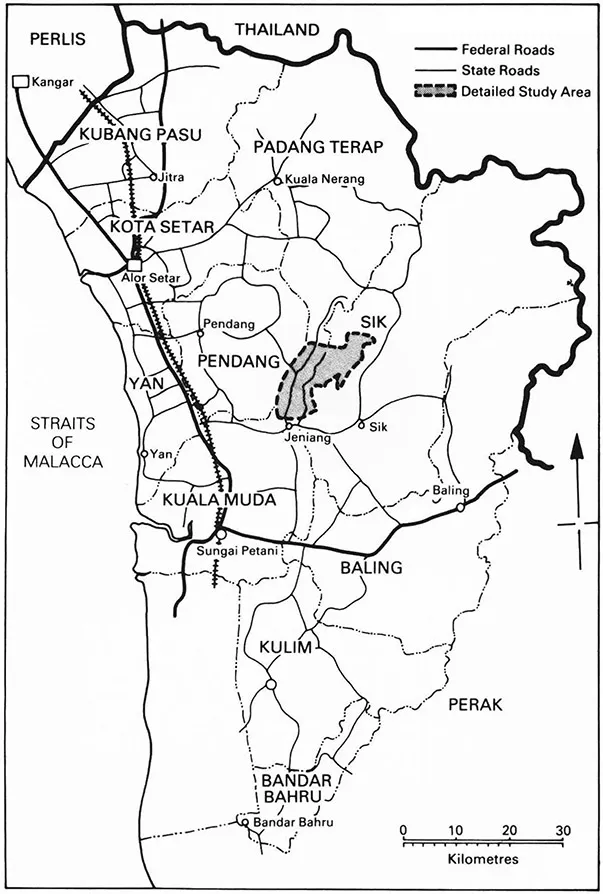
Fig. 1 Study Area Context
The sub-district of Jeneri in the State of Kedah was chosen for the detailed studies (Figure 1). Kedah has a population of about 1.1 million (the population of Peninsular Malaysia is 11,138,000 (1980 census)). Eighty-eight per cent of households in the State of Kedah are in the rural areas and are principally engaged in agricultural activities, 59 per cent of households in the State are considered to be living at or near the poverty line. Jeneri is a poor agricultural area which is less well developed in terms of infrastructure than other areas in the State of Kedah and the peninsula. The population of 9,500 people depend upon farming for their livelihood. Jeneri (Figure 2) lies in the ‘central belt’ of Kedah State, which represents the greater part of the land area lying between the developed coastal plain in the west and the steep forest areas along the eastern boundary. The main road transport corridor in Kedah State is Federal Highway Route 1 which runs north-south through the coastal plain. From this Highway, several roads run inland to serve the rest of the State. The road network in the inland areas is oriented towards providing access to the more developed coastal plain. The standard and quality of the roads making up the inland network vary significantly depending on various factors but mostly on the state of development of the area concerned. Piped water supply is rare in the inland areas. Apart from some small isolated systems and some small-scale gravity feed systems installed by the Ministry of Health, most rural areas rely on wells and watercourses.
The main crops grown in the Jeneri study area are, in order of importance, rubber, padi (rite) and fruit. At the national level these three crops also represent ‘the major share of agricultural production. This means that the study findings on the total transport demand related to these crops are certainly also relevant at the regional and peninsular level.
The Rural Transport System in Malaysia
Increasing emphasis is being placed on the development of the rural and village road network in Malaysia. Although the total budget allocation for roads has decreased over the period 1976-85, that for the construction and upgrading of rural and village roads has increased substantially. Under the village roads programme, existing tracks are being upgraded to facilitate marketing and processing of agricultural produce, and to provide better access to social amenities. Village roads are below official standards having only a 3 m wide unsurfaced pavement. They are passable by cars in dry weather but are more usually used by motorcycles and bicycles. Future programmes propose upgrading the roads to a bitu-. minized surface standard on the existing alignment and improving drainage. This will allow all-weather use by motorcycles, bicycles and other simple vehicles. The low standard of construction makes these roads less suitable for pick-ups and lorries unlike the rural
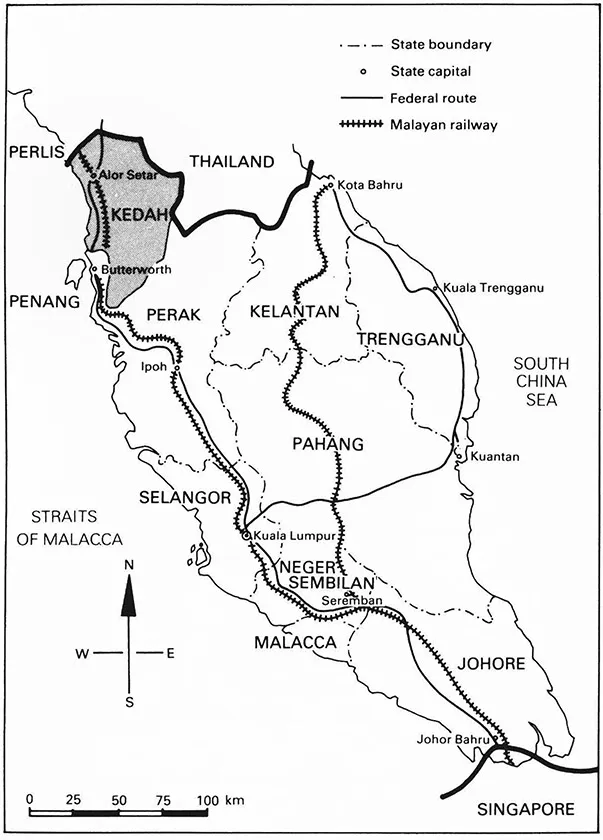
Fig. 2 Kedah and the Study Area
roads constructed by the Public Works Department. The latter are of a higher standard, in principle suitable for year-round use by heavy motorized transport.
Table 1 shows the distribution of vehicle ownership in Peninsular Malaysia.
The data indicate the relatively high level of motorization in Malaysia, and show the dominance of ‘conventional’ motor vehicles, in contrast to the locally developed modes (e.g. the jeepney) found in other Asian countries. They also indicate the limited range (bicycles and tricycles) of simple vehicles available for use by low-income households compared with other countries in the region.
Vehicle ownership and household income
Table 2 shows the level of vehicle ownership by households in the study area based on data from the sample interview survey.
Table 1 Peninsular Malaysia Road Transport
| No. of Vehicles | Vehicles per 100 population | |
| | ||
| Motorized: | ||
| Cars | 555,358 | 5.1 |
| Motorcycles | 1,079,020 | 9.9 |
| Buses | 11,589 | 0.1 |
| Trucks and vans | 122,543 | 1.1 |
| Taxis | 12,051 | 0.1 |
| Others1 | 49,397 | 0.5 |
| Sub-total | 1,829,958 | 16.8 |
| Non-motorized: | ||
| Bicycles | 1,416,000 | 13.0 |
| Tricycles2 | 12,608 | 0.1 |
Table of contents
- Cover
- Half Title
- Title
- Copyright
- CONTENTS
- ILO FOREWORD
- EDITORS’ INTRODUCTION
- PART I — TRANSPORT PATTERNS
- PART II — TRANSPORT MEANS
- PART III — TRANSPORT POLICIES
- PART IV — SUMMARY
- CHAPTER REFERENCES
- SELECTED BIBLIOGRAPHY
Trusted by 375,005 students
Access to over 1.5 million titles for a fair monthly price.
Study more efficiently using our study tools.
Frequently asked questions
Yes, you can cancel anytime from the Subscription tab in your account settings on the Perlego website. Your subscription will stay active until the end of your current billing period. Learn how to cancel your subscription
No, books cannot be downloaded as external files, such as PDFs, for use outside of Perlego. However, you can download books within the Perlego app for offline reading on mobile or tablet. Learn how to download books offline
Perlego offers two plans: Essential and Complete
- Essential is ideal for learners and professionals who enjoy exploring a wide range of subjects. Access the Essential Library with 800,000+ trusted titles and best-sellers across business, personal growth, and the humanities. Includes unlimited reading time and Standard Read Aloud voice.
- Complete: Perfect for advanced learners and researchers needing full, unrestricted access. Unlock 1.5M+ books across hundreds of subjects, including academic and specialized titles. The Complete Plan also includes advanced features like Premium Read Aloud and Research Assistant.
We are an online textbook subscription service, where you can get access to an entire online library for less than the price of a single book per month. With over 1.5 million books across 990+ topics, we’ve got you covered! Learn about our mission
Look out for the read-aloud symbol on your next book to see if you can listen to it. The read-aloud tool reads text aloud for you, highlighting the text as it is being read. You can pause it, speed it up and slow it down. Learn more about Read Aloud
Yes! You can use the Perlego app on both iOS and Android devices to read anytime, anywhere — even offline. Perfect for commutes or when you’re on the go.
Please note we cannot support devices running on iOS 13 and Android 7 or earlier. Learn more about using the app
Please note we cannot support devices running on iOS 13 and Android 7 or earlier. Learn more about using the app
Yes, you can access Rural Transport In Developing Countries by I. Barwell,G. A. Edmonds,J.D.G.F. Howe,J. De Veen in PDF and/or ePUB format, as well as other popular books in Social Sciences & Sociology. We have over 1.5 million books available in our catalogue for you to explore.