
- 2,056 pages
- English
- ePUB (mobile friendly)
- Available on iOS & Android
eBook - ePub
Varieties of Female Gothic Vol 6
About this book
This text offers scholarly and critical editions of significant novels of Gothic fiction from the Romantic period. It illustrates the various forms of female Gothic literature as a vehicle for representing the modern forms of subjectivity, or complex and authentic inward experience and identity.
Information
Sydney Owenson,
The Missionary (1811)
THE
MISSIONARY:
AN
INDIAN TALE.
BY
MISS OWENSON.
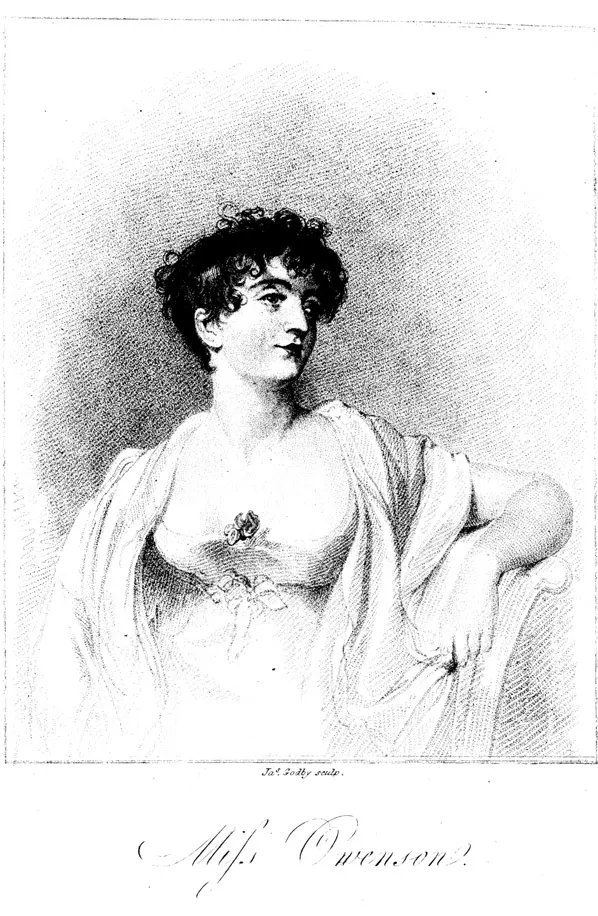
WITH A PORTRAIT OF THE AUTHOR.
IN THREE VOLUMES.
LONDON:
PRINTED FOR J. J. STOCKDALE,
NO. 41, PALL MALL.
1811.a
The Missionariesa
Volume 1.
CHAPTER I.
IN the beginning of the seventeenth century, Portugal, bereft of her natural sov-ereigns, had become an object of contention, to various powers in Europe. The houses of Braganza and of Parma, of Savoy and Medici, alike published their pretensions, and alike submitted to that decision, which the arms of Spain finally made in its own favour.1 Under the goading oppression of Philip the Sec-ond, and of his two immediate successors, the national independence of a brave people faded gradually away, and Portugal, wholly losing its rank in the scale of nations, sunk into a Spanish province. From the torpid dream of slavish dependence, the victims of a mild oppression were suddenly awakened, by the rapacious cruelties of Olivarez, the gloomy minister of Philip the Fourth; and the spring of national liberty, receiving its impulse from the very pressure of the tyranny which crushed it, already recovered something of that tone of force and elasticity which finally produced one of the most singular and perfect revolutions, which the history of nations has recorded. It was at this period, that Portugal became divided into two powerful factions, and the Spanish partizans, and Portuguese patriots, openly expressed their mutual abhorrence, and secretly planned their respective destruction. Even Religion forfeited her dove-like character of peace, and enrolled herself beneath the banners of civil discord and factious commotion. The Jesuits governed with the Spaniards; the Franciscans resisted with the Portuguese; and each accused the other of promulgating heretical tenets, in support of that cause, to which each was respectively attached. *
* The Jesuits,2 being charged with fraudulent practices, in endeavouring to persuade the Indians that the Brahminical and Christian doctrines differed not essentially, were openly condemned by the Franciscans;3 which laid the foundation of those long and violent contests, decided by Innocent the Tenth,4 in favour of the Franciscans.
It was in the midst of these religious and political feuds, that the Order of St. Francis became distinguished in Portugal, by the sanctity and genius of one of its members; and the monastery, into which the holy enthusiast had retired from the splendour of opulence and rank, from the pleasures of youth and the pursuits of life, became the shrine of pilgrimage, to many pious votarists, who sought Heaven through the mediation of him, who, on earth, had already obtained the title of ‘the man without a fault.’a
The monastery of St. Francis stands at the foot of that mighty chain of mountains, which partially divides the province of Alentejo from the sea-beat shores of Algarva. Excavated from a pile of rocks, its cells are little better than rude caverns; and its heavy portico, and gloomy chapel, are composed of the fragments of a Moorish castle, whose mouldering turrets mingle, in the haze of distance, with the lofty spires of the Christian sanctuary, while both are reflected, byb the bosom of one of those lakes so peculiar to Portugal, whose subterraneous thunder rolls with an incessant uproar, even when the waves of the ocean are still, and the air breathes of peace. Celebrated,c in the natural history of the country, for its absorbent and sanative qualities, Superstition had wrested the phænomenon to her own mystic purposes; and the roaring lake, which added so fine and awful a feature to the gloomy scenery of the convent, brought to its altars the grateful tributes of those, who piously believed that they obtained, from the consecrated waters, health in this world, and salvation in the world to come.
To the left of the monastery, some traces of a Roman fortress, similar to that of Coimbra, were still visible: to the north, the mighty hills of Alentejo terminated the prospect: while to the south, the view seemed extended to infinitude by the mightier ocean, beyond whose horizon fancy sought the coast of Carthage; and memory, awakening to her magic, dwelt on the altar of Hannibal, or hovered round the victor standard of Scipio Africanus.d5 The mountains; the ocean; the lake of subterraneous thunder; the ruins of Moorish splendour; the vestiges of Roman prowess; the pile of monastic gloom: – magnificent assem-blage of great and discordant images! What various epochas in time; what various states of human power and human intellect, did not ye blend and harmonize, in one great picture! What a powerful influence were not your wildness and your solemnity, your grandeur and your gloom, calculated to produce upon the mind of religious enthusiasm, upon the spirit of genius and melancholy; upon a character, formed of all the higher elements of human nature, upon such a mind, upon such a genius, upon such a character as thine, Hilarion! e6
Amidst the hanging woods which shaded the southern side of the mountains of Algarva, rose the turrets of the castle of Acugna; and the moon-beams which fell upon its ramparts, were reflected back by the glittering spires of St. Francis.
To this solitary and deserted castle, Hilarion, Count d’Acugna, had been sent, by his uncle and guardian, the Archbishop of Lisbon, in 1620. The young Hilarionf had scarcely attained his tenth year. His sole companion was his preceptor, an old brother of the order of St. Francis.g History attests the antiquity and splendour of the House d’Acugna. The royal blood of Portugal flowed in the veins of Hilarion, for his mother was a daughter of the House of Braganza. His elder, and only brother, Don Lewis, Duke d’Acugna, was one of the most powerful grandees in the state; his uncle, the Archbishop of Lisbon, was considered as the leader of the disaffected nobles, whom the Spanish tyranny had almost driven to desperation; and, while the Duke and the Prelate were involved in all the political commotions of the day, the young Hilarion, impressed by the grand solemnity of the images by which he was surrounded;a inflamed by the visionary nature of his religious studies; borne away by the complexional enthusiasm of his character, and influenced by the eloquence and example of his preceptor, emulatedb the ascetic life of his patron saint, sighed to retire to some boundless desert, to live superior to nature, and to nature’s laws, beyond the power of temptation, and the possibility of error; to subdue, alike, the human weakness and the human passion, and, wholly devoted to Heaven, to give himself up to such spiritual communions and celestial visions, as visit the souls of the pure in spirit, even during their probation on earth, until, his unregulated mind becoming the victim of his ardent imagination, he lost sight of the true object of human existence, a life acceptable to the Creator by being serviceable to his creatures.7 Endowed with that complexional enthusiasm, which disdains the ordinary business of life, with that profound sensibility which unfits for its pursuits, wrapt in holy dreams and pious ecstacies, all external circumstances gradually faded from his view, and, in his eighteenth year, believing himself, by the sudden death of his preceptor, to be the ‘inheritor of his sacred mantle,’ he offered up the sacrifice of his worldly honours, of his human possessions, to Heaven, and became a monk of the order of St. Francis. c
The Archbishop, and the Duke d’Acugna, received the intelligence of his profession with less emotion than surprise. Absence had loosened the tie of natural affection. The political state of Portugal rendered an adequate provision for the younger brother of so illustrious an house, difficult and precarious; and the Patriarch of Lisbon well knew that, to enter the portals of the church was not to close, for ever, the gate of temporal preferment. The uncle and the brother wrote to felicitate the young monk on his heavenly vocation, presented a considerable donation to the monastery of St. Francis, and soon lost sight of their enthusiast-relative in the public commotions and private factions of the day.
CHAPTER II.
THERE is a dear and precious period in the life of man, which, brief as sweet, is best appreciated in recollection; when but to exist is to enjoy; when the rapid pulse throbs, wildly, with the vague delight which fills the careless heart, and when it may be truly said, ‘that nothing is, but what is not.’ a8
While this rainbow hour lasted, the thorny wreath, which faith had plaited round Hilarion’s brow, was worn as cheerily, as if the rose of pleasure had glowed upon his temple. The vows he had made were ever present to his mind. The ceremonies of his religion occupied his imagination; and its forms, no less than its spirit, engaged his whole existence. He had taken holy orders, and was frequently engaged in the interesting offices of the priesthood. He studied, with unwearied ardour, the sacred legends and records of the convent library, and, during six years of monastic seclusion, his pure and sinless life had been so distinguished by religious discipline and pious austerity; by devotional zeal and fervid enthusiasm; by charitable exertion and rigid self-denial; and by an eloquence in the cause of religion, so profound, so brilliant, and so touching, that, even envy, which, in a cloister’s gloom, survives the death of better passions, flung not its venom on his sacred character; and the celebrity of the man without a fault had extended far beyond the confines of his own secluded monastery.
The monks conceived, that his illustrious birth, not less than his eminent genius and unrivalled piety, threw a splendour on their order, and they daily looked forward to the hour when the Father Hilarion should wave the banner of successful controversy over the prostrate necks of the fallen Jesuits. Yet the brotherhood had hitherto but remotely hinted their wishes, or suggested their expectations. The familiar ease of the novice had faded away with the purple bloom of the youth; and the reserved dignity of the man threw, at an hopeless distance, those whom the monk, indeed, in the meekness of religious phraseol-ogy, called his superiors; but whom the saint and the nobleman equally felt unworthy to be classed with him, as beings of the same species; he stood alone, lofty and aspiring, self-wrapt and dignified; and no external discipline, no internal humiliation, had so crucified the human weakness in his bosom, as wholly to exclude the leaven of mortality from the perfection of religious excellence.
Hitherto the life of the young monk resembled the pure and holy dream of saintly slumbers, for it was still a dream; splendid indeed, but visionary; pure, but useless; bright, but unsubstantial. Dead to all those ties, which, at once, constitute the charm and the anxiety of existence, which agitate while they bless the life of man, the spring of human affection lay untouched within his bosom, and the faculty of human reason unused within his mind. Hitherto, his genius had alone betrayed its powers, in deceiving others, or himself, by those imposing creations, by which faith was secured through the medium of imagination; and the ardour of his tender feelings wasted, in visions of holy illusion, or dreams of pious fraud. Yet these feelings, though unexercised, were not extinct; they betrayed their existence even in the torpid life he had chosen; for the true source of his religion, enveloped as it was in mysteries and dogmas, was but a divine and tender impulse of gratitude towards the First Cause; and his benevolent charity, which he coldly called his duty, but the extension of that impulse towards his fellow-creature! His habits, though they had tended to calm the impetuosity of his complexional character, and to purify and strengthen his moral principles, had added to his enthusiasm, what they had subtracted from his passions, and had given to his zeal, all that they had taken from his heart: but when the animated fervour of adolescence subsided in the dignified tranquillity of manhood, when the reiteration of the same images denied the same vivacity of sensation as had distinguished their original impression, then the visions, which had entranced his dreaming youth, ceased to people and to cheer his unbroken solitude; then, even Religion, though she lost nothing of her influence, lost much of her charm. While the faith which occupied his soul was not sufficient, in its pure but passive effects, to engage his life; the active vital principle, which dictates to man, the sphere for which he was created, preyed on its own existence, and he turned upon himself those exertions, which were intended to benefit the species to which he belonged: his religious discipline became more severe; his mortifications more numerous; his prayers and penance more rigid and more frequent; and that which was but the result of the weakness of human nature, conscious of its frailty, added new lustre to the reputation of the saint, and excited a warmer reverence for the virtues of the man. Accustomed to pursue the bold wanderings of the human mind, upon subjects whose awful mystery escapes all human research, intense study finally gave place to ceaseless meditation. Connecting, or endeavouring to connect, his incongruous ideas, by abstract principles, he lost sight of fact, in pursuit of inference; and, excluded from all social intercourse, from all active engagement, his ardent imagination became his ruling faculty, while the wild magnificence of the scenes by which he was surrounded, threw its correspondent influence on his disordered mind; and all within, and all without his monastery, contributed to cherish and to perpetuate the religious melancholy and gloomy enthusiasm of his character. More zealous in his faith at twenty-six than he had been at eight-een, it yet no longer opened to his view the heaven which smiled upon his head; but, beneath his feet, an abyss which seemed ready to ingulf him. He sometimes wildly talked of evil deeds which crossed his brain; of evil passions which shook his frame; and doubted if the mercy of his Redeemer extended to him, whose sinless life was not a sufficient propitiation for sinful thoughts: and this sensitive delicacy of a morbid conscience plunged him into habitual sadness, while it added to his holy fame, an...
Table of contents
- Cover
- Half Title
- Title Page
- Copyright Page
- CONTENTS
- Introduction
- Bibliography
- Chronology
- Note on the text
- SYDNEY OWENSON, LADY MORGAN
- Explanatory notes
- Textual notes
Trusted by 375,005 students
Access to over 1.5 million titles for a fair monthly price.
Study more efficiently using our study tools.
Frequently asked questions
Yes, you can cancel anytime from the Subscription tab in your account settings on the Perlego website. Your subscription will stay active until the end of your current billing period. Learn how to cancel your subscription
No, books cannot be downloaded as external files, such as PDFs, for use outside of Perlego. However, you can download books within the Perlego app for offline reading on mobile or tablet. Learn how to download books offline
Perlego offers two plans: Essential and Complete
- Essential is ideal for learners and professionals who enjoy exploring a wide range of subjects. Access the Essential Library with 800,000+ trusted titles and best-sellers across business, personal growth, and the humanities. Includes unlimited reading time and Standard Read Aloud voice.
- Complete: Perfect for advanced learners and researchers needing full, unrestricted access. Unlock 1.5M+ books across hundreds of subjects, including academic and specialized titles. The Complete Plan also includes advanced features like Premium Read Aloud and Research Assistant.
We are an online textbook subscription service, where you can get access to an entire online library for less than the price of a single book per month. With over 1.5 million books across 990+ topics, we’ve got you covered! Learn about our mission
Look out for the read-aloud symbol on your next book to see if you can listen to it. The read-aloud tool reads text aloud for you, highlighting the text as it is being read. You can pause it, speed it up and slow it down. Learn more about Read Aloud
Yes! You can use the Perlego app on both iOS and Android devices to read anytime, anywhere — even offline. Perfect for commutes or when you’re on the go.
Please note we cannot support devices running on iOS 13 and Android 7 or earlier. Learn more about using the app
Please note we cannot support devices running on iOS 13 and Android 7 or earlier. Learn more about using the app
Yes, you can access Varieties of Female Gothic Vol 6 by Gary Kelly in PDF and/or ePUB format, as well as other popular books in Languages & Linguistics & Linguistics. We have over 1.5 million books available in our catalogue for you to explore.