- 542 pages
- English
- ePUB (mobile friendly)
- Available on iOS & Android
eBook - ePub
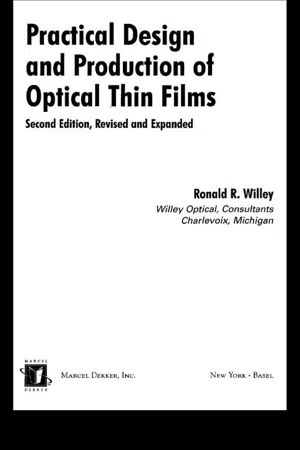
Practical Design and Production of Optical Thin Films
About this book
Providing insider viewpoints and perspectives unavailable in any other text, this book presents useful guidelines and tools to produce effective coatings and films. Covering subjects ranging from materials selection and process development to successful system construction and optimization, it contains expanded discussions on design visualization, dense wavelength division multiplexing, new coating equipment, electrochromic and chemically active coatings, ion-assisted deposition, and optical monitoring sensitivity. Furnishing real-world examples and know-how, the book introduces Fourier analysis and synthesis without difficult mathematical concepts and equations.
Information
Topic
Physical SciencesSubtopic
Optics & Light1 Fundamentals of Thin Film Optics and the Use of Graphical Methods in Thin Film Design
1.1. INTRODUCTION
Getting started is often the most difficult part of a new task, and it is always the first thing to do. The goal supported by this book is to produce a practical thin film optical coating which meets whatever particular requirements are presented to the reader within the limitations of the technology. We will give a brief overview of what is needed to do this and how one might proceed.
The first thing needed is a clear statement of the requirements and/or goals of the coating such as spectral reflectance versus wavelength, spectral range of concern, substrate characteristics, environment to be encountered (and survived), etc. Often it is necessary to work with the end user or customer to establish these requirements and desires within the framework of what is possible and practical. Chapter 2 provides some assistance in estimating what can be done at this first stage.
The second thing needed by the coating developer is a basic understanding of the underlying principles of optical thin film performance and design. These are set forth in Chapters 1 and 3 from several viewpoints to give a more global perspective of the optical thin film design task. The possibilities, limitations, and options in various types of thin film coating designs are discussed in Chapter 2. This leads to a choice of the type of design to use to meet the requirements and an estimate of the number of layers and materials needed.
The third stage is to select materials which will have the desired properties over the required spectral range and which will perform in the required environmental conditions. These conditions often include temperature, humidity, abrasion, adhesion, salt fog, cleaning solutions, etc. Chapter 5 discusses the more commonly used materials and the processes by which they may be deposited. The equipment to be used in the production of a coating will affect the design and material choices. Chapter 4 reviews the typical equipment currently used for thin film production.
The fourth step is to perform the detail design of the coating to meet the optical performance requirements. If the index of refraction versus wavelength in the region of concern of the chosen materials is well known and stable, and the control of film thicknesses in the deposition process is adequate, the final optical coating product can be expected to be the same as predicted by the detail design. A computer evaluation and optimization program is used for the detail design process. The preliminary or starting design, derived typically from the choices made from Chapters 2 and 5, is evaluated and then the layer thicknesses are optimized with respect to the spectral requirements of the product. Sometimes a few more layers may need to be added to meet some requirement. It is our practice also to try to remove layers from a near-final design and reoptimize to determine if fewer layers might still meet the requirements. The fewest number of layers is generally desirable as long as there is enough margin in the design to allow for expected process variability and still meet the requirements.
The fifth phase of the process is to test the design in actual deposition. The first part of this should be to verify that the indices of the deposited materials are the same as expected and used in the design. If this is true, this phase is simple and short. If significant differences are found, the material processes may need refinement and greater control. This may require extensive effort. Chapter 6 discusses process development to reduce variability and characterize material properties. This can feed back improved information for the material and process know-how covered in Chapter 5.
The sixth stage which leads to the successful production of the required optical thin film is to gain adequate control of the layer thicknesses. The actual strategy for thickness control should be considered at the fourth or design step and influenced by the equipment to be used (Chapter 4). Chapter 7 deals with the many ways that film thickness might be monitored and controlled. It also discusses monitoring strategies, where the different strategies might best be used, and their strengths and weaknesses. When a monitoring process is established with sufficient repeatability, then the only task is to set the film thicknesses to produce the required results. This is typically a “Kentucky windage” process. That is to say that the actual resulting film thickness is usually somewhat different from that given as a parameter to the monitoring system. As long as the difference is the same from run to run, the difference can be subtracted from what is given as a parameter to the system so that the resulting thickness deposited meets the requirements. Section 7.7.3 gives a detailed example of how this was done in a specific case.
The application of the above six steps and the information in the chapters mentioned should lead to a successful coating in the great majority of optical thin films used in the world today.
We would like to mention a few key things which may be helpful to keep in mind when starting a new coating development. These are discussed in more detail in the chapters. They are usually true, but we will not state that there are no exceptions.
It is best to view all optical thin film coatings as affecting the reflectance of a surface as discussed in Chapters 1, 2, and 3. This may be to reduce the reflectance in a given spectral range or to increase it. Transmittance, optical density, etc., are all derivatives of reflectance.
More layers and thereby a thicker coating in a design give more control over fine details of the spectral reflectance profile as shown in Chapter 2. However, the improvements with increasing thickness seem to be asymptotic. For example, more than eight (8) layers in a broadband antireflection coating, where the optical thickness is about one wavelength in the band, typically gives limited reduction in the reflection over the band. It requires an order of magnitude thicker coating to reduce the reflectance to half that of eight layer.
We also show in Chapter 2 that it is desirable to use high and low index materials in a design where the difference in index is as great as practical. There is more reflectance produced at each interface, and therefore fewer layers are needed to produce a given result:
It has further been shown in Chapter 2 that the lowest practical index should be used for the last layer in an antireflection coating.
The fewest layers practical in a design is most desirable from a production point of view. It also has been shown in broadband antireflection coatings that a minimum number of layers is optimum for given designs and more layers cannot produce as good a result.
The simplest solutions which can meet the requirements are usually the most elegant and the most successfully produced.
Absolute values of deposition parameters such as pressure, temperature, etc., are difficult to obtain and may be unnecessary. The most beneficial characteristic of almost any process is its stability or reproducibility. With stable indices of refraction and material distribution in a process, the parameters of a design and process can be adjusted by “Kentucky windage” to meet the requirements.
The design of experiments methodology discussed in Chapter 6 can often minimize the number of experiments necessary to optimize and stabilize a deposition process.
In recent years, “Concurrent Engineering” has been a topic of some interest in the indus...
Table of contents
- COVER PAGE
- TITLE PAGE
- COPYRIGHT PAGE
- PREFACE TO THE SECOND EDITION
- PREFACE TO THE FIRST EDITION
- 1. FUNDAMENTALS OF THIN FILM OPTICS AND THE USE OF GRAPHICAL METHODS IN THIN FILM DESIGN
- 2. ESTIMATING WHAT CAN BE DONE BEFORE DESIGNING
- 3. FOURIER VIEWPOINT OF OPTICAL COATINGS
- 4. TYPICAL EQUIPMENT FOR OPTICAL COATING PRODUCTION
- 5. MATERIALS AND PROCESS KNOW-HOW
- 6. PROCESS DEVELOPMENT
- 7. MONITORING AND CONTROL OF THIN FILM GROWTH
- APPENDIX: METALLIC AND SEMICONDUCTOR MATERIAL GRAPHS
Trusted by 375,005 students
Access to over 1.5 million titles for a fair monthly price.
Study more efficiently using our study tools.
Frequently asked questions
Yes, you can cancel anytime from the Subscription tab in your account settings on the Perlego website. Your subscription will stay active until the end of your current billing period. Learn how to cancel your subscription
No, books cannot be downloaded as external files, such as PDFs, for use outside of Perlego. However, you can download books within the Perlego app for offline reading on mobile or tablet. Learn how to download books offline
Perlego offers two plans: Essential and Complete
- Essential is ideal for learners and professionals who enjoy exploring a wide range of subjects. Access the Essential Library with 800,000+ trusted titles and best-sellers across business, personal growth, and the humanities. Includes unlimited reading time and Standard Read Aloud voice.
- Complete: Perfect for advanced learners and researchers needing full, unrestricted access. Unlock 1.5M+ books across hundreds of subjects, including academic and specialized titles. The Complete Plan also includes advanced features like Premium Read Aloud and Research Assistant.
We are an online textbook subscription service, where you can get access to an entire online library for less than the price of a single book per month. With over 1.5 million books across 990+ topics, we’ve got you covered! Learn about our mission
Look out for the read-aloud symbol on your next book to see if you can listen to it. The read-aloud tool reads text aloud for you, highlighting the text as it is being read. You can pause it, speed it up and slow it down. Learn more about Read Aloud
Yes! You can use the Perlego app on both iOS and Android devices to read anytime, anywhere — even offline. Perfect for commutes or when you’re on the go.
Please note we cannot support devices running on iOS 13 and Android 7 or earlier. Learn more about using the app
Please note we cannot support devices running on iOS 13 and Android 7 or earlier. Learn more about using the app
Yes, you can access Practical Design and Production of Optical Thin Films by Ronald R. Willey in PDF and/or ePUB format, as well as other popular books in Physical Sciences & Optics & Light. We have over 1.5 million books available in our catalogue for you to explore.