Embattled Reason constitutes an intellectual profile of one of America's preeminent sociologists. This collection of essays, published over the course of thirty years, embodies a series of intellectual choices in response to current concerns and to debates of the past, affording a coherent and unified view of Bendix's work as a whole.
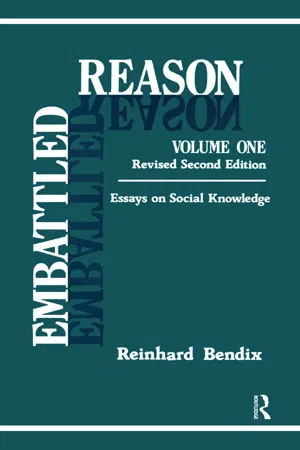
- 378 pages
- English
- ePUB (mobile friendly)
- Available on iOS & Android
eBook - ePub
About this book
Information
PART I
Conditions of Knowledge
Introduction to Part I
All human achievements are conditioned, even the simplest or most elementary. All men need food, clothing and shelter, but the conditions of satisfying these needs change and so does the meaning of “need.” The methods and materials are altered as time goes by, and so are the judgments as to how much is enough and what kinds of food, clothing and shelter are good for our well-being. Even at any one time, human wants are clouded by ambiguity. How much and what kind of our basic means of subsistence do we need or want—really?! The question is impossible to answer definitively, because the answer depends on the kind of people we have in mind and their particular circumstances. Also, even food, clothing and shelter can be used for purposes other than the commonly accepted ones. Some children play with their food instead of eating it, even grownups do. Some people use clothing to appear different from anyone else, like a clown in a department store, or a wealthy man in rags at a fancy dinner party. Or a house may be used to store arms and as a hideout for terrorists. Recent political terminology in German has introduced an untranslatable term for this anti-ordinary or counter-cultural or criminal manipulation of ordinary objects: umfunktionieren. In the case of ordinary objects and activities such manipulation is the exception rather than the rule. Exceptions can increase, of course, but too many clowns in department stores or too many terrorist hideaways begin to alarm us.
The need for knowledge is not as evident to large masses of people as is the need for food, clothing and shelter. The question of how much and what kind of knowledge we need has become more troubling and unanswerable, as knowledge has expanded. The people who make it their business to advance knowledge cannot count on as much consent from the general public as can peasants, garment workers, and masons, and even these basic trades are beset by controversy.
The quest for knowledge is elitist. People at large feel only intermittently that they need knowledge when they consult a doctor, lawyer or architect. They want applied knowledge. They are not really concerned with the experiments and theories on which that knowledge rests. Also, people often want a kind of knowledge which the minority of scholars and scientists cannot, or do not want to, provide. I belong to the minority of knowledge-seekers. My background may have made me more aware than others just how conditioned and conditional the quest for knowledge is. In due course I will describe that background in these essays in Vol. II, Part One. My first task is to explain the phrase “conditions of knowledge” and how I came to explore them.
My motto is this sentence from the autobiography by J.R. von Salis, the Swiss historian and political commentator during World War II. “Man muss zuerst die Dinge kennenlernen, ehe man anfangen kann zu erforschen, was hinter den Dingen ist.”1 One should get to know things first, before one can begin to investigate what lies behind them. It took me a long while to get to that point.
Before I did, I had to work my way through Marx’s assertion that “a portion of the bourgeois ideologists… have raised themselves to the level of comprehending theoretically the historical movement as a whole.” This statement of the Communist Manifesto implies that historical truth (and by vulgar extension: any truth) is class-bound. Knowing the truth depends on a solid, if sometimes devious or manipulative interest in it. Since according to Marx the workers are the wave of the future, they possess the truth, whether they know it or not, just as in the late medieval period the rising bourgeoisie had possessed the truth. Identification with the proletariat put one in possession of the truth about the future and hence (!) in possession of the future—a heady incentive for certain kinds of knowledge-seekers.
I also had to work my way through the complexities of Karl Mannheim to whom my father introduced me at an early age. In the midst of the Weimar Republic I learned a lot from Mannheim’s adaptation of Marx’s views. While I was struggling with Mannheim, the daily papers were reporting on thirty-five political parties contending for power, each with a Weltanschauung of its own. In effect, Mannheim was writing about political philosophies, not about knowledge in the broader sense of that term. In Ideology and Utopia (1929) there is hardly a reference to the natural sciences and precious few to serious humanistic and social studies. These represent knowledge as ordinarily understood. So, Mannheim’s program of a sociology of knowledge was not in the end persuasive, because it ignored the knowledge which is most clearly identifiable as such.
Louis Wirth, my teacher at the University of Chicago, used to teach a challenging course on the “Sociology of Intellectual Life.” He had translated Mannheim’s book (together with Edward Shils), but covered much material that went beyond Mannheim’s theoretical concerns. Two points from that course belong in this context. Wirth used to say, there is not a fact in the social sciences, however well established, which is not controversial from someone’s point of view. He was also adamant that no amount of inquiry into the conditions of knowledge can either validate or invalidate a proposition. This is quite similar to Karl Popper’s view that scientific objectivity results from adherence to the norms of scholarly research and communication, not from a scholar’s identification with an interest group, or from his lack of such identification. I find both points persuasive, but they do not invalidate a concern with the conditions of knowledge, properly conceived.
Like other human activities, the quest for knowledge has all kinds of conditions worth investigating. Max Weber’s “Science as a Vocation” represents a classic statement of these conditions and remains a source of inspiration and research projects. For my own work in this field I have found two of his remarks of special importance. He writes that “truth is only that which claims to be valid for all those who want truth.” The statement points up that all knowledge is provisional, subject to correction as more becomes known, that the quest for knowledge is elitist because it is confined to those who want truth, and that it requires of all knowledge-seekers a personal commitment to the search for truth. Weber adds that this commitment “chains [us] to the idea of progress.”
It is not self-evident that something subordinate to such a law [of progress] is sensible and meaningful in itself. Why does one engage in doing something that in reality never comes, and never can come, to an end?2
I shall have occasion to refer to this passage again. It is cited here to convey the sense in which I shall use the phrase “purposes of knowledge.” The people who make food, clothing and shelter have straightforward purposes. As long as their products are wanted, it makes little sense to ask them why they work at what they do; the question would be redundant. But this is not so in the case of knowledge-seekers. Quite often, they are challenged about what they do. When they are, they try to explain what their kind of knowledge is all about. And to explain their activities is tantamount to defending them, because it is not obvious that the knowledge they seek is “needed.”
For men to be scholars, they must believe in the value of knowledge, even when the need for it is obscure. Usually, they go on evidence from the past that apparently useless knowledge proved constructive in the end. This absence of a self-evident and widely acknowledged need puts knowledge-seekers in an awkward position. They cannot pursue knowledge on the condition that their results will only be applied in humane ways the way a cook can be sure that the food he prepares will be eaten. Efforts to determine how the results of knowledge-seeking will be used always founder on the impossibility of knowing in advance what can be known and how knowledge will be used once it is available. The pursuit of knowledge wherever it may lead, and hence the suspension of specific guidelines, can be justified by this unpredictability of scholarly work. The use of food, clothing and shelter is not that unpredictable, even though counter-cultural manipulation remains possible. The ordinary purposes of scholarly knowledge are much more difficult to specify. In the face of that uncertainty most scholars pursue their work in the general belief that it will enhance the vague goals shared by thinking men of good will. Such commitments to scholarly work only make sense if there is the hope or expectation that in the long run the constructive uses of knowledge will prevail. Scholarship presupposes a belief in progress through knowledge and in the perfectibility of man. It does not flourish where men become preoccupied with the potential evil of knowledge and, therefore, doubt that knowledge will have value in the long run.3
For these reasons the following essays deal specifically with the faith needed to pursue knowledge. They do not deal except incidentally with all the other conditions which make the quest for knowledge possible.
NOTES
1 J.R. von Salis, Grenzüberschreitungen, Ein Lebensbericht (Zürich: Orell Füssli Verlag, 1975), I, 126.
2 Max Weber, Gesammelte Aufsätze zur Wissenschaftslehre (Tubingen: J.C.B. Mohr (Paul Siebeck), 1968), 184.
3 The preceding wording is taken from Reinhard Bendix, “Changing Foundations of Scholarly Detachment,” in Embattled Reason (New York: Oxford University Press, 1970), 70. The article has been omitted from this volume of selected essays.
1
SOCIAL SCIENCE AND THE IMAGE OF MAN
Introductory Note
In 1938 I arrived at the University of Chicago to begin my college training, an aging freshman of twenty-two and a refugee from Hitler’s Germany. My earlier reading in Marx and Mannheim was part of the intellectual baggage with which I entered the university. As an enemy alien I was ineligible for the draft when America entered the war in 1941. When I did become eligible through naturalization, I was barred for reasons of health from joining the war against Hitler in which I wanted to participate. Destined to stay on the sidelines, I remained puzzled and concerned, as I had been under the Hitler regime, with the relation between knowledge and action. Then, in 1945, shortly before the end of the war, the problem was brought to world-wide attention through use of the atomic bomb over Hiroshima and Nagasaki. In one of my first publications I wrote:
We fear the forces which science has unleashed, but we admire its ability to do so. And while we ‘monopolize the secret’ for a little while with a bad conscience, we indulge in fantasies about its future benefit to mankind.1
Re-reading that statement after forty years I notice the unconscious ambiguity which had slipped in, perhaps because of my uncertain command of written English. For the bad conscience I had in mind referred to the scientists who had developed the bomb as a patriotic service and now found themselves appalled at the use to which their discoveries were put. But “bad conscience’’ could also refer to keeping their discoveries a secret, when the whole ethos of science demanded prompt disclosure and open discussion. In any case, I proceeded to discuss the “ethical implications of scientific pursuits’’ in historical perspective, well aware that I came to no definite conclusions and rather uncomfortable at the thought that my competence concerned the social sciences, which had ethical implications of their own.
The questions I had raised did not let me rest. For my Master’s Thesis I had struggled (on far too many pages) with the development of German sociology. On the working assumption that sociology stood for a rational study of society, I wanted to know how scholars had come to favor such an approach and, just as important, how ruling groups within German society had come to support academic studies which were bound to be critical of that society. My findings were inconclusive, I was dissatisfied with my work, but the question would not go away. At the Chicago Sociology Department I had observed how my teachers seemed to be at one in their “scientific approach” to sociology, but sharply divided among themselves over the interest in occupational sub-cultures studied by participant observation and the interest in methodological rigor through the analysis of opinion questionnaires. When I joined the Department of Sociology and Social Institutions at the University of California (Berkeley) in 1947, I encountered an analogous conflict, though in a different field. Frederick Teggart, the retired head of my new Department, had left the History Department some years earlier, because he was dissatisfied with the idea of history as narrative. He wanted to put the study of history on a scientific basis by a systematic analysis of dated events. Later on, I discovered that many other academic disciplines were split along similar lines, putting the burden of knowing both approaches on the students in each case. I did not like this imposition on the students, there was something to be said for both sides, and I did not want to make my intellectual choices in terms of such alternatives. The result was my essay “Social Science and the Distrust of Reason” (1951), of which this chapter and the next are later and better written versions.
These essays deal with the idea that knowledge-seekers do not start with an empty slate. Any quest for knowledge starts with tacit assumptions about the prospect of increased knowledge “for the benefit and use of life,” as Francis Bacon put it in the early seventeenth century. Since the outcome of research is uncertain and the results will be known only in the future, the proper attitude is one of hope and fear, with hope prevailing. If fear prevailed we would not make the attempt; if hope alone prevailed we would be foolish. Consequently, the pursuit of knowledge must be undertaken, whether this is acknowledged or not, with some image of man in mind which gives us courage to venture into the unknown. That image is not the result of research, but one of its conditions.2
LEGACIES OF THE ENLIGHTENMENT
Some two hundred years ago, in his Philosophical Dictionary, Voltaire declared that God had to create man with self-esteem, but that self-esteem misleads him most of the time. Passions are necessary, for mankind cannot propagate itself without desire. But passions also lead to quarrels and wars. Still, Voltaire thought his time the “most enlightened century that ever was.” God or natur...
Table of contents
- Cover
- Half Title
- Title Page
- Copyright Page
- Dedication Page
- Contents
- Preface
- Acknowledgments
- Part I: Conditions of Knowledge
- Part II: Theoretical Perspectives
- Part III: Studies of Modernization
- Index
Trusted by 375,005 students
Access to over 1.5 million titles for a fair monthly price.
Study more efficiently using our study tools.
Frequently asked questions
Yes, you can cancel anytime from the Subscription tab in your account settings on the Perlego website. Your subscription will stay active until the end of your current billing period. Learn how to cancel your subscription
No, books cannot be downloaded as external files, such as PDFs, for use outside of Perlego. However, you can download books within the Perlego app for offline reading on mobile or tablet. Learn how to download books offline
Perlego offers two plans: Essential and Complete
- Essential is ideal for learners and professionals who enjoy exploring a wide range of subjects. Access the Essential Library with 800,000+ trusted titles and best-sellers across business, personal growth, and the humanities. Includes unlimited reading time and Standard Read Aloud voice.
- Complete: Perfect for advanced learners and researchers needing full, unrestricted access. Unlock 1.5M+ books across hundreds of subjects, including academic and specialized titles. The Complete Plan also includes advanced features like Premium Read Aloud and Research Assistant.
We are an online textbook subscription service, where you can get access to an entire online library for less than the price of a single book per month. With over 1.5 million books across 990+ topics, we’ve got you covered! Learn about our mission
Look out for the read-aloud symbol on your next book to see if you can listen to it. The read-aloud tool reads text aloud for you, highlighting the text as it is being read. You can pause it, speed it up and slow it down. Learn more about Read Aloud
Yes! You can use the Perlego app on both iOS and Android devices to read anytime, anywhere — even offline. Perfect for commutes or when you’re on the go.
Please note we cannot support devices running on iOS 13 and Android 7 or earlier. Learn more about using the app
Please note we cannot support devices running on iOS 13 and Android 7 or earlier. Learn more about using the app
Yes, you can access Embattled Reason by Reinhard Bendix in PDF and/or ePUB format, as well as other popular books in Social Sciences & Sociology. We have over 1.5 million books available in our catalogue for you to explore.