eBook - ePub
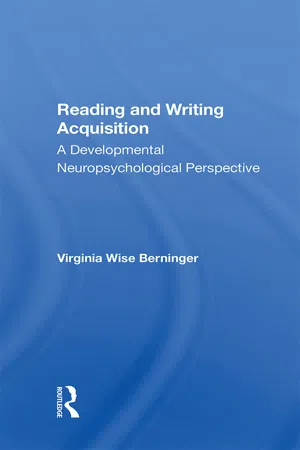
Reading And Writing Acquisition
A Developmental Neuropsychological Perspective
- 240 pages
- English
- ePUB (mobile friendly)
- Available on iOS & Android
eBook - ePub
About this book
This book discusses the theoretical rationale for the research on reading and writing from a developmental neuropsychological perspective. It reviews current research on the structural and functional development of the brain with respect to reading and writing acquisition.
Information
Part II
Research on Reading and Writing Acquisition from the Developmental Neuropsychological Perspective
Chapter 4
Introduction to Part II and Multiple Connections and Multiple Procedures for Reading and Spelling Single Words
Many psychologists dream of describing minds so economically that psychology would become as simple and precise as physics. But one must not confuse reality with dreams. It was not the ambitions of the physicists that made it possible to describe so much of the world in terms of so few and simple principles; that was because of the nature of our universe. But the operations of our mind do not depend on similarly few and simple laws, because our brains have accumulated many different mechanisms over aeons of evolution. This means that psychology can never be as simple as physics, and any simple theory of mind would be bound to miss most of the 'big picture.' The science of psychology will be handicapped until we develop an overview with room for a great many smaller theories.
–Marvin Minsky (1986, p. 322)
Outline
- Introduction to Part II
- Limitations of Dual Route Theory for Explaining Beginning Reading
- Limitations of Boder's Model for Explaining Reading Disability
- Limitations of Connectionism for Educational Practice
- Reconceptualizing the Reading Acquisition Process With in the Framework of a Heterarchy of Functional Systems
- Developing Crosstalk Between the Visible Language and Oral Language Systems
- Foundations in Developmental Psychobiology
- Evidence for Multiple Orthographic Codes in the Hierarchical Orthographic System of Beginning Readers and Writers
- Evidence for Multiple Phonological Codes in the Hierarchical Phonological System of Beginning Readers and Writers
- Evidence for Multiple Orthographic-Phonological Code Connections from the Cognitive Literature
- Evidence for Multiple Orthographic-Phonological Code Connections from the Clinical Neuropsychological Literature
- Evidence for Multiple Orthographic-Phonological Code Connections from the Developmental Neuropsychological Perspective
- Evidence for Heterarchical Organization of Functional Reading and Spelling Systems for Single Words
- Evidence for Multiple Procedures for Processing and Producing Single Words
- Comparison of Dual Route Theory, Boder's Model, Connectionism, and Multiple Connections/Multiple Procedures
- Summary
Introduction toPart II
A major purpose of the research reported in chapters 4 through 6 was to add to current knowledge of the phenotypes for component reading and writing skills and developmental skills related to reading and writing acquisition; as discussed in chapter 2, better understanding of the phenotypes may lead to better understanding of the genotypes for reading and writing disabilities. The concepts of normal variation, levels of analysis, and multiple constraints introduced in chapter 1 and elaborated upon in chapter 2 are fundamental to this research. The model of reading acquisition in chapter 4 and the model of writing acquisition in chapter 6 reflect the perspective of the developing rather than skilled reader or writer. Just as children are not merely little adults, reading and writing acquisition are not simply scaled-down versions of skilled reading and writing.
None of the theories underlying this research are simple in the sense of being based on a single variable. Rather, the intent was to focus on developing a few smaller, but somewhat complex, theories within the context of a broader multivariate framework. Psychologists have been told for many years that parsimony (the simplest explanation) is a virtue. This research was equally concerned with not making nature simpler than it really is (see quotation at beginning of this chapter). The basic research discussed in chapters 4 through 6 has practical significance and can be applied to theory-based assessment, prevention, and remediation of reading and writing disabilities, as discussed in chapter 7. As with part I, the reader is encouraged to make ample use of the Glossary, which defines the numerous technical terms from linguistics, psychology, and education.
Limitations of Dual Route Theory for Explaining Beginning Reading
According to the dual route theory (e.g., Coltheart, 1978), there are two independent and noninteractive routes for reading single words: the direct route, which is used to read phonically irregular words, and the indirect route, which is used to read phonically regular words. The direct route is thought to involve a path between the visual code and the semantic code without intervening phonological recoding; the indirect route is thought to involve a path between the visual code and the phonological code, followed by a path from the phonological code to the semantic code (Barron, 1986). The direct route is a lexical or whole word path and is based on word-specific representations, whereas the indirect route is a sublexical or subword path based on rule-governed mechanisms (Carr & Pollatsek, 1985). The direct route is often characterized as visual, in contrast to the indirect route, which is often characterized as phonological (Doctor & Coltheart, 1980). Some have claimed that beginning readers rely on the indirect route, and skilled readers rely on the direct route (Doctor & Coltheart, 1980). This claim reflects the perspective of adult skilled readers who have the phenomenological experience of recognizing the meaning of words automatically on the basis of their visual patterns without having to consciously decode them into sound. However, Barron (1986) showed that both routes may be used in beginning reading, and Van Orden (1987) showed that the indirect, phonological route is also used in skilled reading.
There are four major problems with dual route theory in explaining beginning reading from the perspective of the developing child. First, the assumption that readers rely on a visual or phonological path represents disjunctive either/or logic analogous to the zebra syndrome pervading thinking about teaching methods (see chapter 3). More realistic is a both/and conjunctive logic, in which both visual and phonological representations of words play a role in how printed words become represented in memory (Berninger, Abbott, & Shurtleff, 1990). Also, considering the evidence that visual and orthographic processes are not identical (see chapter 2), an orthographic and not a visual path is involved in reading single words.
Second, the assumption that beginning readers use only an indirect, phonological route does not mesh with the well-known fact that many beginning readers readily acquire a set of sight vocabulary. This fact led Gough and Hillinger (1980) to propose that the first stage of reading acquisition is paired associate learning between distinctive visual features in the word and the word's name. Likewise, Frith (1985) proposed that the first stage of reading is logographic, in which salient graphic features are matched with a word's name.
Third, dual route theory does not take into account the multiple orthographic units on which phonological units might operate—syllables and short words (Shallice & Warrington, 1980); graphemes, consonant clusters, subsyllabic units, syllables, and morphemes (Shallice, Warrington, & McCarthy, 1983); or letter, letter cluster, and whole word units (Barron, 1986).
Fourth, it is unlikely that there are separate mechanisms for regular and irregular words. (See Berninger, 1990, for discussion of the two ways regularity/irregularity are defined: in terms of phonics rules of grapheme-phoneme correspondence or in terms of letter cluster-rime analogies to known words). Rather, degree of irregularity affects ease of pronunciation of written words—mildly irregular words with a single exception to letter-sound correspondence are read better than highly irregular words with several exceptions to letter-sound correspondence (Shallice, Warrington, & McCarthy, 1983). Few words are completely phonically irregular—onset phonemes (the first sound or sound blend of a syllable) are usually regular even if rimes (the remaining part of the syllable) are not, and rimes may be orthographically regular even if not phonologically regular (Berninger, 1990). For example, consider the "h" in house, which is phonically regular, and the "ouse" in house, which is phonically irregular (the silent "e" does not make the preceding vowels long vowels) but is orthographically regular ("ouse" is a permissible letter sequence and occurs in other words such as mouse). Brain damage does not selectively eliminate either the lexical route for irregular words or the sublexical route for regular words (Humphreys & Evett, 1985). There is no evidence that the brain sorts words into regular or irregular bins before applying a word recognition mechanism (Berninger & Abbott, 1992b).
Limitations of Boder’s Model for Explaining Reading Disability
Boder (1973) proposed a system for diagnosing three kinds of dyslexia based on the kind of spelling errors made. Dysphonetic dyslexics read globally by visual gestalts because an auditory deficit interferes with learning letter-sound relationships. Dyseidetic dyslexics read analytically because a visual memory deficit interferes with processing the gestalt of the whole word. Mixed dyslexics show evidence of both dysphonetic and dyseidetic strategies. Moats (in press) reviewed the reliability and validity of the Boder classification system and concluded that they were not sufficiently adequate to use the Boder subtypes for research purposes. By analogy, these subtypes should not be used for clinical diagnosis, either.
Boder (1973, p. 682) made this strong claim: "One of these three patterns is found in all severely retarded readers . . . and none are found among children who read and spell normally." Two studies cast doubt on this claim and the model in general. Brack (1988) showed that reading-disabled and reading-abled children do not differ in the processes they use to read and spell words, but do differ in the degree to which they have mastered those processes. Thalberg and Corker-Free (unpublished data, 1988) tested but did not confirm the hypothesis that students with a strong auditory memory rely on an auditory spelling strategy and that students with a strong visual memory rely on a visual spelling strategy. None of the four schemes they applied to analysis of error patterns supported the validity of Boder's conceptual scheme.
Furthermore, it is not always possible, as Boder claims, to categorize errors as purely visual or purely auditory. For example, a child might produce "b" for "d" because of (a) confusion of a visually similar letter form or (b) confusion of an auditorially similar phonemic sound. Context effects may be more important than visual or auditory modality in generating errors. Liberman, Shankweiler, Orlando, Harris, and Berti (1971) showed that reversals are more likely in than outside the context of a word. Reversals are most likely due to problems in orthographic symbol-sound association rather than to orthographic symbol or sound alone (Vogel, 1989).
Boder's diagnostic scheme, which is widely used by neuropsychologists, may also be on shaky grounds in inferring processing strategy on the basis of error analysis. Errors may not be reliable or valid indicators of processing strategies, and may reflect normal developmental trends rather than individual differences in processing strategies. For example, Berninger and Alsdorf (1989) found that specific kinds of visual errors tended not to be stable constructs across different standardized measures, and only certain auditory/language errors involving phonemic or morphophonemic codes had concurrent validity for spelling errors. Reliability of spelling-error patterns depended on the informational properties of stimulus words and on reading level. Errors of high and average achievers were more influenced by the informational properties of stimulus words than were the errors of low achievers. These investigators concluded that clinicians should be cautious in inferring processing strategies from error analysis unless they use (a) converging evidence of the same error type on multiple measures and (b) age-norms for error types, because errors reflected normal developmental trends as well as individual differences.
In sum, Boder's scheme suffers from the same conceptual problems as does dual route theory: (a) disjunctive logic of attributing reading problems primarily to visual or linguistic problems (although her mixed category does acknowledge, unlike dual route theory, the possibility of both visual and auditory problems), and (b) failing to consider the multiple orthographic units on which phonological processes might operate. In addition, Boder's scheme does not make a clear distinction between orthographic and visual processes or between phonological and auditory processes, which Petersen et al. (1989) for example, (see chapter 2), have shown is important. Also, it is based on error analysis, which may not be a reliable or valid way to infer processing strategies.
Limitations of Connectionism for Educational Practice
The paradigm of connectionism, which is increasingly influential in cognitive psychology, has led to computer simulations in which a single computational procedure is applied to all words, regular or irregular, and real words or nonwords (e.g., Seidenberg & McClelland, 1989). Words are not represented as entries in a lexicon, but rather in terms of weights or connections between the orthographic input unit and hidden units (between input and output units), and between hidden units and phonological output units in a distributed memory network. Learning occurs through modification o...
Table of contents
- Cover
- Half Title
- Title
- Copyright
- Dedication
- Contents
- Preface
- PARTI THEORETICAL FOUNDATIONS
- PART II RESEARCH ON READING AND WRITING ACQUISITION FROM THE DEVELOPMENTAL NEUROPSYCHOLOGICAL PERSPECTIVE
- Glossary
- References
- Index
Trusted by 375,005 students
Access to over 1.5 million titles for a fair monthly price.
Study more efficiently using our study tools.
Frequently asked questions
Yes, you can cancel anytime from the Subscription tab in your account settings on the Perlego website. Your subscription will stay active until the end of your current billing period. Learn how to cancel your subscription
No, books cannot be downloaded as external files, such as PDFs, for use outside of Perlego. However, you can download books within the Perlego app for offline reading on mobile or tablet. Learn how to download books offline
Perlego offers two plans: Essential and Complete
- Essential is ideal for learners and professionals who enjoy exploring a wide range of subjects. Access the Essential Library with 800,000+ trusted titles and best-sellers across business, personal growth, and the humanities. Includes unlimited reading time and Standard Read Aloud voice.
- Complete: Perfect for advanced learners and researchers needing full, unrestricted access. Unlock 1.5M+ books across hundreds of subjects, including academic and specialized titles. The Complete Plan also includes advanced features like Premium Read Aloud and Research Assistant.
We are an online textbook subscription service, where you can get access to an entire online library for less than the price of a single book per month. With over 1.5 million books across 990+ topics, we’ve got you covered! Learn about our mission
Look out for the read-aloud symbol on your next book to see if you can listen to it. The read-aloud tool reads text aloud for you, highlighting the text as it is being read. You can pause it, speed it up and slow it down. Learn more about Read Aloud
Yes! You can use the Perlego app on both iOS and Android devices to read anytime, anywhere — even offline. Perfect for commutes or when you’re on the go.
Please note we cannot support devices running on iOS 13 and Android 7 or earlier. Learn more about using the app
Please note we cannot support devices running on iOS 13 and Android 7 or earlier. Learn more about using the app
Yes, you can access Reading And Writing Acquisition by Virginia W Berninger in PDF and/or ePUB format, as well as other popular books in Psychology & History & Theory in Psychology. We have over 1.5 million books available in our catalogue for you to explore.