
eBook - ePub
Information Sources on Islamic Banking and Economics
1980-1990
- 362 pages
- English
- ePUB (mobile friendly)
- Available on iOS & Android
eBook - ePub
About this book
Islamic banking and economics (IBE) is a fast-growing subject of vital interest in both East and West as Muslims change their attitudes towards investments and find ways to invest their funds according to the Islamic faith. Along with the rapid developments in Islamic banking there has been a concomitant increase in the quantity of relevant IBE mat
Information
Chapter 1
INFORMATION ON ISLAMIC BANKING AND ECONOMICS:
an overview
an overview
The interest in Islamic Banking is becoming popular, as evidenced by the articles published in the latest issue of Newsweek magazine (special issue April 26, 1993). The success behind these banks is the demand and the attitude of Muslims towards investments and finding ways to invest their funds according to the Islamic faith. As a result of their religious beliefs, there are over two hundred Islamic banks and Islamic funds now being operated successfully throughout the world. Persons interested in Islamic Banking have the opportunity of consulting several Islamic Bank directories like Presley (1988); IRTI (1992); AMBD (1993). Besides the Islamic Development Bank (IDB) which includes members from 45 countries, there are three large Islamic finance groups: Dar Al-Maal Al-Islami (DMI), Dallah Albaraka Group, and Al-Rajhi Banking and Investment Corporation. By and large, these groups are the major share holders of many Islamic banks in the Middle East. The terminology used in Islamic banking and financial transaction are different from those used in conventional banks (Khuri 1987, Newsweek 1993, Khan 1990). The detailed article by Imtiaz Pervez in Chapter 2 of this book will provide the structure of Islamic banking and finance as well as various issues facing these banks.
Along with the two decades of rapid development in Islamic banking and finance, there has been an increase in the quantity of published information in this area. Since there isn’t any specialised indexing service exclusively for this discipline, it is difficult for any researcher or practitioner to locate or obtain information on these areas without having to go through various secondary sources. Due to these reasons, only a few bibliographies have been compiled on Islamic Economics and Banking. These bibliographies include published and unpublished material including mimeographs in different languages and their time coverage was limited to the early 1980’s. Upon examining these previously compiled bibliographies, there is an overlap in their coverage of materials.
Among the earlier studies, one of the first work was by Muhammad Akram Khan (1973) when he produced an annotated bibliography along with a glossary of terms used in Islamic economics. This same work was updated and published as a monograph in 1983. The 1983 work contains a total of 749 items (629 in the main bibliography and 120 in the supplement section of the bibliography). Since the work has been carried over the period of 10 years, the author has added a supplement in the same monograph representing contemporary items up to 1983. A majority of the items in this bibliography are from Urdu language with transliteration. The annotation for all items regardless of languages were written in English. The importance of this bibliography lies in its annotations.
Another serious work in the field of Islamic Economics was Muhammad Nejatullah Siddiqi’s (1974) survey of contemporary literature. According to the author, this survey was carried out in December 1974. It contains 700 items covering different languages, mostly English, Arabic and Urdu. This bibliography is included as a chapter in the monograph, entitled: Studies in Islamic Economics (a selection of conference papers of the First International Conference on Islamic Economics held in Makkah, Saudi Arabia, from February 21 to 26, 1976.)
Volker Nienhaus (1982) of Germany compiled a bibliography entitled, Literature on Islamic Economics in English and German. The intention of his work is to help users interested in Islamic economics and the items included in this work are articles, memorandums, monographs, reports, etc. It has 941 items covering material both in the English and German languages from 1911 to 1981.
Tariqullah Khan’s (1984) bibliography sponsored and published by the Islamic Development Bank, has included items from 1955 to 1984; out of which 256 items are from 1980 to 1984. A majority of them do not have proper bibliographic information.
Mohammed A. Mannan (1984) has also compiled an annotated bibliography of all published material by the International Centre for Research in Islamic Economics (ICRIC), King Abdulaziz University. This work is of a special nature containing only the items of ICRIC.
There have been a few more compilations i.e. Attiyah, 1974; Popovich, 1987; Sabzwari, 1986; and Siddiqui 1985. However, one of the recent compilations on this subject was by John R. Presley’s (1988) work entitled Directory of Islamic Financial Institutions. His work has listed 506 items and its coverage starts mostly from the 1950s.
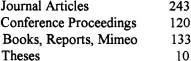
A quick look at the above mentioned bibliographies will show a degree of overlap of material among these compilations. It appears that most of the included material is from unpublished conference papers, reports, mimeographs, pamphlets, etc. Published papers in journals and published conference proceedings have also been included. A majority of items are pre-1970s. For example an analysis of Presley’s work which is a recent one among the bibliographies published so far, revealed the following breakdown:

The type of material included in Presley’s bibliography is as follows:
As can be seen from the aforementioned literature review, there is a need for a bibliography covering the literature from 1980 onwards. Chapter 5 of this book is a bibliographic compilation covering the period from 1980 onwards. Data from 1991 and 1992, in many cases, are not complete The concentration of this bibliography was from 1980 to 1990. The analysis of data reveals that there are 1576 unique items published on IBE since 1980. These 1576 items have been divided into five major categories: Monographs, Articles, Conferences, News and Notes, and Dissertations and Theses. The breakdown of these items by year along with the type of material (categories) are reported in Table 1 and Figure 1. Articles in the Arabic language are not included because of the unavailability of indexing and abstracting services and it is difficult to locate individual journals for reviewing purposes. Only Arabic monographs are included in the transliterated form adopted by the Library of Congress.
Table 1: Master Data Sheet of Total Output of Records by Year
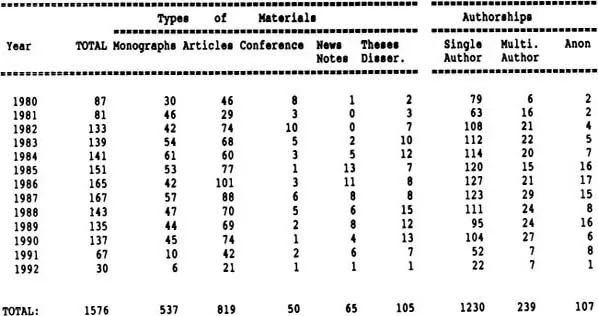
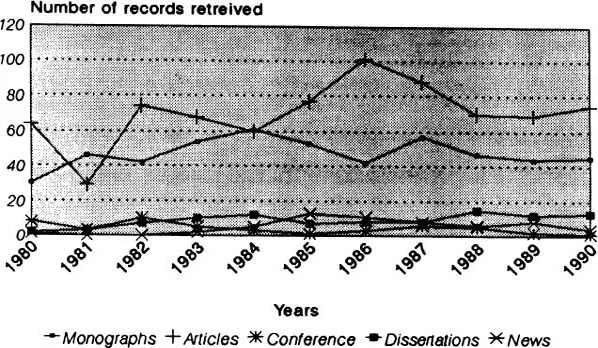
Fig 1: Output by Types of Materials Between Year 1980 to 1990
OUTPUT BY TYPES OF MATERIALS/AUTHORSHIP
BETWEEN YEAR 1980-1992
Fig.2 AUTHORSHIP
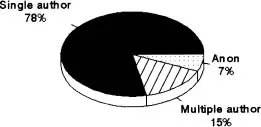
Fig.3 MATERIALS
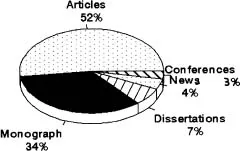
The total output of material shown in Figure 2 indicates that 52 percent were articles, 34 percent were monographs or reports; 7 percent were news items and conferences, and the remaining 7 percent were doctoral dissertations and theses accepted in the U.S. and the U.K. Most monographs reported are published by institutions or societies in Third World Countries in several languages, such as Arabic, Persian, Turkish and Urdu. This is in addition to the monographs published in English and other European languages, such as French and German. A few monographs were published by international publishers of a U.S. and U.K. origin and these are indexed by Books in Print (BIP), Whitaker’s Bookbank (WB), and Public Affairs Information Services (PAIS). Journal literature analysis are reported in Chapter 3.
As can be seen from the Table 1 and Figure 1, in the early 1980s more monographic literature dominated the scene of IBE; however, this trend changed in 1985. Since 1985, journal articles have been the major source of information. This indicates that more research is being conducted in the areas of IBE and that researchers are using the journals as a medium for communicating their research findings. This coincides with the fact that the year 1986 and 1987 were the most productive years in terms of the total output on IBE according to the data presented in Table 1. The detailed report of journal literature on IBE is presented in Chapter 3.
Figure 3 depicts the extent of authorship of records included in Chapter 5. Most of the articles and monographs are written by single authors; only 239 are written by two or more authors. One hundred and seven items of news and notes are without any author “ANON”.
One hundred and five or 7 percent are from doctoral dissertations and theses accepted for higher academic degrees in the U.S. and U.K. A total of 71 doctoral dissertations were accepted from 48 universities in United States: Temple University (7), University of Wisconsin-Madison (5) and Claremont University (4) were the highest among all in accepting doctoral dissertations on IBE. In the U.K. 31 theses were accepted by 28 universities and polytechnics. Exeter and Heriot-Watt universities accepted 5 and 3 theses respectively. The remaining three theses were from Sweden and Germany. These 105 dissertations and theses constitute an important part of theoretical studies on IBE.
REFERENCES
AMBD Arab Money and Banking Directory 1993. Dubai, U.A.E.: Al-Ittissad Wal-Aamal, 1993 (in press)
Atiyyah, Jamal al-Din (1974). Dalil al-bahith fi’l-iqtisad al-Islami (A Guide to Researcher in Islamic Economics). Al-Muslim al-Mu’asir (Beirut), pp. 142-151.
IRTI Islamic Research Training Institute. Directory of Islamic Banking and Financial Institutes. Jeddah: IRTI, Islamic Development Bank, 1992.
Khan, Muhammad A (1973). Annotated Bibliography of Contemporary Economic Thought in Islam and Glossary of Economic Terms in Islamic, Islamic Education. Lahore: All Pakistan Education Congress.
Khan, Muhammad A (1983). Islamic Economics: annotated sources in English and Urdu. Leicester: The Islamic Foundation.
Khan, Muhammad A (1990). Glossary of Islamic Economics. London: Mansell, 1990.
Khan, Tariqullah (1984). Islamic Economics: a bibliography. Jeddah: Islamic Research and Training Institute, Islamic Development Bank.
Khuri, Rami G. (1987). Islamic banking: knotting a new network. Aramco World Magazine, 38 (3), pp. 15-26
Mannan, Mohammed A. (1984) Abstracts of Research in Islamic Economics. Jedd...
Table of contents
- Cover
- Halftitle
- Title
- Copyright
- Contents
- Figures, Tables and Appendices
- Preface
- Chapter 1 Information on Islamic banking and economics: an overview
- Chapter 2 Islamic Banking and Finance Imtiaz Pervez
- Chapter 3 Journal literature on Islamic banking and economics
- Chapter 4 Electronic databases and on-line services: the key to finding information on Islamic banking and economics
- Chapter 5 Information sources on Islamic banking and economics
- Author Index
- Keyword Subject Index
Trusted by 375,005 students
Access to over 1.5 million titles for a fair monthly price.
Study more efficiently using our study tools.
Frequently asked questions
Yes, you can cancel anytime from the Subscription tab in your account settings on the Perlego website. Your subscription will stay active until the end of your current billing period. Learn how to cancel your subscription
No, books cannot be downloaded as external files, such as PDFs, for use outside of Perlego. However, you can download books within the Perlego app for offline reading on mobile or tablet. Learn how to download books offline
We are an online textbook subscription service, where you can get access to an entire online library for less than the price of a single book per month. With over 1.5 million books across 990+ topics, we’ve got you covered! Learn about our mission
Look out for the read-aloud symbol on your next book to see if you can listen to it. The read-aloud tool reads text aloud for you, highlighting the text as it is being read. You can pause it, speed it up and slow it down. Learn more about Read Aloud
Yes! You can use the Perlego app on both iOS and Android devices to read anytime, anywhere — even offline. Perfect for commutes or when you’re on the go.
Please note we cannot support devices running on iOS 13 and Android 7 or earlier. Learn more about using the app
Please note we cannot support devices running on iOS 13 and Android 7 or earlier. Learn more about using the app
Yes, you can access Information Sources on Islamic Banking and Economics by S. Nazim Ali,Naseem N. Ali in PDF and/or ePUB format, as well as other popular books in Social Sciences & Anthropology. We have over 1.5 million books available in our catalogue for you to explore.