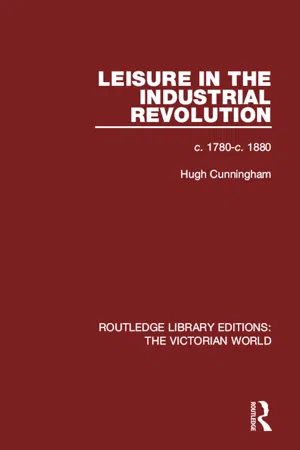
First published in 1980. This book is a study of what different classes of society understood by leisure and how they enjoyed it. It argues that many of the assumptions which have underlain the history of leisure are misleading, and in particular the notions that there was a vacuum in popular leisure in the early Industrial Revolution; that with industrialisation there was sharp discontinuity with the past; that cultural forms diffuse themselves only down the social scale, and that leisure helped ease class distinctions. An alternative interpretation is suggested in which popular culture can be seen as an active agent as well as a victim. This title will be of interest to students of history.
- 220 pages
- English
- ePUB (mobile friendly)
- Available on iOS & Android
eBook - ePub
1 THE GROWTH OF LEISURE IN THE EARLY INDUSTRIAL REVOLUTION, c. 1780–c. 1840
DOI: 10.4324/9781315637679-2
Decline and decay are the themes which have impressed most historians who have examined the history of leisure in the early Industrial Revolution. Growth for ‘the leisured’ is admitted, but few doubt that there was a radical curtailment of leisure opportunities and leisure time for the mass of the people. That there is much truth in this traditional viewpoint I do not wish to deny: in the latter part of this chapter and in the following two I shall present some of the evidence in support of it. But first I wish to emphasise the opposite case, to argue that there was an increase in leisure opportunities not only for the leisured class but also for many of their social inferiors; and that it was this dual growth which provided the context and set the tone for the often bitter conflict about leisure which marks the period. The outcome of that conflict, I shall argue, was much less of an outright victory for those who attacked popular leisure than friends, enemies and historians of that campaign have made out.
Growth and conflict, as themes in the history of leisure, are not unique to the era of the Industrial Revolution. On the contrary the experience of leisure in the centuries before the Industrial Revolution was by no means unchanging. Conflict was perhaps the most marked characteristic. Thus if such a phenomenon as a ‘traditional’ world of leisure ever existed, which may be doubted, it was destroyed in the sixteenth century by the celebrated combination of capitalism and Puritanism. Popular drama, for example, disappeared in Elizabeth’s reign, in Norwich and Worcester in the 1560s, in York, Wakefield, Chester and Chelmsford in the 1570s, in Coventry in about 1590. This was no mere falling away of some picturesque but outworn custom of the past. Rather, as Charles Pythian-Adams describes the process in Coventry, ‘not only were specific customs and institutions brusquely changed or abolished, but a whole vigorous and variegated popular culture, the matrix of everyday life, was eroded and began to perish’. Similarly in rural areas the alehouse’s role in the provision of recreation for the poor became increasingly central in the later sixteenth and early seventeenth centuries owing to the erosion of alternative facilities, and in particular of the communal festivities and sports which had flourished in many late-medieval parishes.1
The seventeenth century witnessed an on-going and fluctuating argument between the Puritans, anxious to do away with Whitales, maypoles, Plough Mondays and other expressions of pre-capitalist communal life, and those traditionalists, centred on the Court, who saw in such activities a buttress of the social order.2 Much of the argument turned on the use of the Sabbath, and on no issue was the intertwining of the religious and economic arguments so apparent. As Christopher Hill has written, ‘the fight for Sabbatarianism and against rural sports was an attempt to extend the concern for labour discipline from the South and East of England into the dark corners of the North and West’. The outcome after the Restoration was a victory for the Sabbatarians, and the English Sunday appeared in its characteristic garb.3
The opposite side of this coin was growth, exemplified in the contemporaneous emergence of a leisure class. The flocking of the gentry to London in the sixteenth and early seventeenth centuries, and the emergence of a clearly defined London season with its attendant entertainment facilities, was a clear indication of a broadening of the demand for leisure.4 The same was true of the steady growth of the spas from the mid-sixteenth century, and the speeding up of that growth in the second half of the seventeenth century. In 1697 Misson wrote of Bath, ‘Mille gens vont passer là quelques semaines, sans se soucier ni des Bains, ni des eaux à boire, mais seulement pour se divertir avec la bonne compagnie. On a Musique, Jeu, Promenade, Bals, & petite Foire perpétuelle.’ Bath, it is clear, was a well-established leisure centre before the days of Beau Nash.5
In the later seventeenth century, aspects both of the London season and of the spas began to be imitated in provincial towns. Assembly rooms were built, bowling greens and walks laid out, and the town gentry (people with independent incomes but without land) began to impose their mark on provincial culture. Theatrical and musical life began to flourish. New and imposing theatres, blessed by royal patents, sprang up in the provinces in the decade 1755–65, but long before that the provincial theatre, indeed whole areas of provincial towns, were being appropriated for the exclusive use and display of the wealthy. The thrust for leisure-class exclusivity was undisguised. As the promoter of a new mid-eighteenth-century theatre in Bath put it, ‘nothing can be more disagreeable, than for Persons of the first Quality, and those of the lowest Rank, to be seated in the same Bench together …’ A new provincial urban culture for the wealthy began to flourish, and not only in major centres like Preston or Norwich, but even in a small town like Loughborough which in the reign of George III could support an elaborate round of balls, assemblies, concerts, lectures, card parties and florists’ feasts with a population of only 3,000. Based on the new wealth created by capitalism, a new and more numerous leisure class was emerging, and with it new institutions and new social arrangements.6
This leisure class was rural as well as urban. From the late seventeenth century, and particularly in the eighteenth century, the gentry created rural sports specifically for themselves. Although some of these sports, like horse-racing, allowed a degree of popular participation this was incidental and often resisted; the thrust of development was towards class-specific sports. Consider three of these sports: shooting, hunting and racing. Shooting began to acquire its modern class associations in the seventeenth century. In 1671 an Act had disqualified all except the landed classes from game hunting, and under another Act in 1692 it was further stipulated that ‘inferior Tradesmen, Apprentices, and other dissolute Persons neglecting their Trades and Employments’ should not ‘presume to hunt, hawk, fish or fowl’. As Chester Kirby has argued, the country gentlemen thus broke the royal monopoly and at the same time secured themselves against competition from below. Technical transformations, in particular the introduction of shooting on the wing in the late seventeenth century, universally adopted by 1750, reinforced the existing trend to tighten up the game laws. The introduction of the battue in the early nineteenth century made game preservation even more important. The era of big bags and competitive shooting had arrived. Performances like those of John Mytton and a friend, who once killed a head of game every three minutes for five hours, began to be recorded and admired. Such exploits were possible only with strict game preservation, and the confinement of the sport to those who were socially qualified. In 1796 an attempt to remove the qualifications failed, the Prime Minister, William Pitt, defending exclusive amusements for ‘the higher orders of the state’. He was prepared to admit, however, that ‘the second class, to whom a participation of this right might properly be given, were the occupiers of land, but in a more limited degree, and only on their own grounds; lest by too liberal an indulgence in this amusement, they might be diverted from more serious and useful occupations.’ There could be no clearer indication of the class-specific nature of this part of the gentry’s leisure life. As F.M.L. Thompson concluded ‘shooting emphasised the solidarity of aristocracy and gentry, sitting together as magistrates trying poaching offences, and standing together at the butts. It also stirred the resentment of farmers and labourers and was a notable hindrance to rural harmony.’7
Fox-hunting, too, was becoming a crucial part of the life of the rural leisure class by the end of the eighteenth century. In the seventeenth century and for much of the eighteenth century English country gentlemen probably regarded hunting the hare as the supreme test of skill. They began to hunt the formerly despised fox at the same time as aristocrats deserted the deer for the fox. Hugo Meynell as Master of the Quorn from 1753 to 1800 bred hounds which could provide fast runs, and by the 1780s fox-hunting was becoming fashionable and spreading rapidly. Commentators insisted on its social respectability. Peter Beckford, in the first treatise on the sport in 1781, declared: ‘Fox-hunting is now become the amusement of gentlemen: nor need any gentleman be ashamed of it.’ The British Sportsman in 1792 thought fox-hunting ‘the only chace in England worthy of the taste or attention of a high bred sportsman’. By the 1790s the Prince of Wales was patronising the sport.8
Fox-hunting has frequently been defended precisely because it is not class specific, and by the 1820s the notion that it linked the classes together had become a commonplace. The grain of truth within it was that tenant farmers and professional men from the towns could and did participate in a way they could not in shooting. Occasionally there was a well-publicised example of someone from lower down the social scale enjoying the sport – the best example was the chimney sweep who hunted with the Duke of Beaufort in the 1830s. But this was exceptional. Fox-hunting was dominated by the aristocracy and country gentlemen. Farmers and to a lesser extent professional men hunted, but they knew that their place in the sport was a subordinate one, just as it was in economic and social terms. The best hunting was dependent on the aggregation of land; as Raymond Carr has rightly insisted, it is a sport which cannot be carried on in peasant communities.9 Its development owed much to the enclosure movement, and socially, not surprisingly, it reflected the post-enclosure rural balance of power. There was only one way the poorer sections of the community could hope to participate, and that was as followers on foot. They were rarely welcome. Squire Osbaldeston, Master of the Quorn in the 1820s, had constant difficulties with
the stocking-makers and weavers, who used to assemble in crowds at the covert-side. It seemed impossible to keep them together in the right place in order to let the fox go away. At first we could not manage them at all; we tried persuasion and kind words, without any success. Then we tried force; but being totally unsupported by any of the Meltonians that method also failed. At last we had recourse to bribery; we used to give every village two sovereigns a year for drink, and this plan had a far better effect, though on occasions the people were still unruly.
On Sundays the stocking-makers organised their own form of hunting, invading the precious coverts with their terriers and curs.10 It was of course illegal, a desecration of the Sabbath as well as an invasion of property rights. Hunting depended on the willingness of farmers to allow landlords but not labourers to do what they would with their land. It was necessarily a socially exclusive sport.
By 1833 the Quarterly Review was condemning shooting and foxhunting which ‘is every day becoming more and more a piece of exclusive luxury, instead of furnishing the lord, the squire, and the yeoman, with a common recreation, and promoting mutual goodwill among all the inhabitants of the rural districts’. In this it was, according to the Quarterly Review, to be distinguished from racing for ‘the owner of race-horses cannot gratify his passion for the turf without affording delight to thousands upon thousands of the less fortunate of his countrymen’.11 Perhaps so, but there had been attempts to prevent the less fortunate from attending. The Act of 1740 ‘to restrain and prevent the excessive Increase of Horse Races …’ was passed, amongst other reasons, because ‘the great Number of Horse Races for small Plates, Prizes, or Sums of Money, have contributed very much to the Encouragement of Idleness, to the Impoverishment of many of the meaner Sort of the Subjects of this Kingdom’. The Act hoped to achieve its end by insisting that every race should have prize money of at least £50; it was a clear attempt to make racing more exclusive. The Act also confined matches (as opposed to races) to two locations, Newmarket and Black Hambleton in Yorkshire, exclusive venues for the rich.12 Whatever the intention of the Act, developments in racing in the second half of the century vastly increased the spectator appeal of the sport. The typical four-mile heat was replaced by the short dash for the new young thoroughbreds. The English classics, all for three-year-olds, became established: the St Leger in 1776, the Oaks in 1779, the Derby in 1780, the 2,000 Guineas in 1809, the 1,000 Guineas in 1814. Most racing at this time, however, was an annual event for a local community; in 1823 87 out of 95 race-courses had only one meeting a year. Although these annual events were undoubtedly the occasion for a local holiday, the gentry continued to regard the races almost as their property. The spectators were tolerated provided they kept in their place. If not, there might be a pitched battle – as there was between the irascible Osbaldeston’s cavalry and the infantry of Northampton shoemakers. In general the gentry and their womenfolk obtained seclusion in the stands, which were first built in the 1770s.13
Both in rural and in urban society, therefore, there had developed a leisure class with pursuits which were more and more exclusive to themselves. It is...
Table of contents
- Cover Page
- Half Title Page
- Title Page
- Copyright Page
- Title Original Page
- Copyright Original Page
- Table of Contents
- Acknowledgements
- Introduction
- 1 The Growth of Leisure in the Early Industrial Revolution, c. 1780–c. 1840
- 2 The Defence of Custom: Work and Leisure in the Early Industrial Revolution
- 3 Public Leisure and Private Leisure
- 4 Class and Leisure in Mid-Victorian England
- 5 The Making of Leisure, c. 1850–c. 1880
- 6 Conclusion
- Further Reading
- Index
Trusted by 375,005 students
Access to over 1.5 million titles for a fair monthly price.
Study more efficiently using our study tools.
Frequently asked questions
Yes, you can cancel anytime from the Subscription tab in your account settings on the Perlego website. Your subscription will stay active until the end of your current billing period. Learn how to cancel your subscription
No, books cannot be downloaded as external files, such as PDFs, for use outside of Perlego. However, you can download books within the Perlego app for offline reading on mobile or tablet. Learn how to download books offline
Perlego offers two plans: Essential and Complete
- Essential is ideal for learners and professionals who enjoy exploring a wide range of subjects. Access the Essential Library with 800,000+ trusted titles and best-sellers across business, personal growth, and the humanities. Includes unlimited reading time and Standard Read Aloud voice.
- Complete: Perfect for advanced learners and researchers needing full, unrestricted access. Unlock 1.5M+ books across hundreds of subjects, including academic and specialized titles. The Complete Plan also includes advanced features like Premium Read Aloud and Research Assistant.
We are an online textbook subscription service, where you can get access to an entire online library for less than the price of a single book per month. With over 1.5 million books across 990+ topics, we’ve got you covered! Learn about our mission
Look out for the read-aloud symbol on your next book to see if you can listen to it. The read-aloud tool reads text aloud for you, highlighting the text as it is being read. You can pause it, speed it up and slow it down. Learn more about Read Aloud
Yes! You can use the Perlego app on both iOS and Android devices to read anytime, anywhere — even offline. Perfect for commutes or when you’re on the go.
Please note we cannot support devices running on iOS 13 and Android 7 or earlier. Learn more about using the app
Please note we cannot support devices running on iOS 13 and Android 7 or earlier. Learn more about using the app
Yes, you can access Leisure in the Industrial Revolution by Hugh Cunningham in PDF and/or ePUB format, as well as other popular books in History & 19th Century History. We have over 1.5 million books available in our catalogue for you to explore.