First published in 1983. This anthology of sixty-nine essays drawn from fourteen different journals was assembled in order to reproduce in convenient form some of the more important articles on British painting published from 1849 to 1860 in Great Britain. Reviews of major exhibitions form a large part of the collection, but essays treating individual artists, discussions of the effect of state patronage of the arts and attempts to assess the uniqueness of the English tradition of painting are also included. This title will be of great interest to students of Art History.
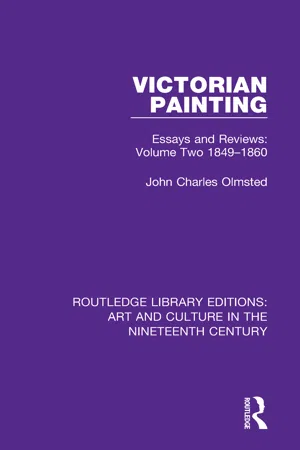
- 804 pages
- English
- ePUB (mobile friendly)
- Available on iOS & Android
eBook - ePub
“The Subject in Art. (No. 1)”
The Germ No. 1 (January 1850), 11–18
The Subject in Art
(No. 1.)
IF Painting and Sculpture delight us like other works of ingenuity, merely from the difficulties they surmount; like an ‘egg in a bottle,’ a tree made out of stone, or a face made of pigment ; and the pleasure we receive, is our wonder at the achievement ; then, to such as so believe, this treatise is not written. But if, as the writer conceives, works of Fine Art delight us by the interest the objects they depict excite in the beholder, just as those objects in nature would excite his interest ; if by any association of ideas in the one case, by the same in the other, without reference to the representations being other than the objects they represent :—then, to such as so believe, the following upon ‘SUBJECT’ is addressed. Whilst, at the same time, it is not disallowed that a subsequent pleasure may and does result, upon reflecting that the objects contemplated were the work of human ingenuity.
Now the subject to be treated, is the ‘subject’ of Painter and Sculptor ; what ought to be the nature of that ‘subject,’ how far that subject may be drawn from past or present time with advantage, how far the subject may tend to confer upon its embodiment the title, ‘High Art,’ how far the subject may tend to confer upon its embodiment the title ‘Low Art;’ what is ‘High Art,’ what is ‘Low Art’?
To begin then (at the end) with ‘High Art.’ However we may differ as to facts, the principle will be readily granted, that ‘High Art,’ i. e. Art, par excellence, Art, in its most exalted character, addressee pre-eminently the highest attributes of man, viz. : his mental and his moral faculties.
‘Low Art,’ or Art in its less exalted character, is that which addresses the less exalted attributes of man, viz. : his mere sensory faculties, without affecting the mind or heart, excepting through the volitional agency of the observer.
These definitions are too general and simple to be disputed ; but before we endeavour to define more particularly, let us analyze the subject, and see what it will yield.
All the works which remain to us of the Ancients, and this appears somewhat remarkable, are, with the exception of those by incompetent artists, universally admitted to be ‘High Art.’ Now do we afford them this high title, because all remnants of the antique world, by tempting a comparison between what was, and is, will set the mental faculties at work, and thus address the highest attributes of man ? Or, as this is owing to the agency of the observer, and not to the subject represented, are we to seek for the cause in the subjects themselves !
Let us examine the subjects. They are mostly in sculpture ; but this cannot be the cause, unless all modern sculpture be considered ‘High Art.’ This is leaving out of the question in both ages, all works badly executed, and obviously incorrect, of which there are numerous examples both ancient and modern.
The subjects we find in sculpture are, in “the round,” mostly men or women in thoughtful or impassioned action : sometimes they are indeed acting physically ; but then, as in the Jason adjusting his Sandal, acting by mechanical impulse, and thinking or looking in another direction. In relievo we have an historical combat, such as that between the Centaurs and Lapithæ ; sometimes a group in conversation, sometimes a recitation of verses to the Lyre ; a dance, or religious procession.
As to the first class in “the round,” as they seem to appeal to the intellectual, and often to the moral faculties, they are naturally, and according to the broad definition, works of ‘High Art,’ Of the relievo, the historical combat appeals to the passions ; and, being historical, probably to the intellect. The like may be said of the conversational groups, and lyrical recitation which follow. The dance appeals to the passions and the intellect ; since the intellect recognises therein an order and design, her own planning ; while the solemn, modest demeanour in the religious procession speaks to the heart and the mind. The same remarks will apply to the few ancient paintings we possess, always excluding such merely decorative works as are not fine art at all.
Thus it appears that all these works of the ancients might rationally have been denominated works of ‘High Art;’ and here we remark the difference between the hypothetical or rational, and the historical account of facts ; for though here is reason enough why ancient art might have been denominated ‘High Art,’ that it was so denominated on this account, is a position not capable of proof : whereas, in all probability, the true account of the matter runs thus—The works of antiquity awe us by their time-hallowed presence ; the mind is sent into a serious contemplation of things ; and, the subject itself in nowise contravening, we attribute all this potent effect to the agency of the subject before us, and ‘High Art,’ it becomes then and for ever, with all such as “follow its cut.” But then as this was so named, not from the abstract cause, but from a result and effect ; when a new work is produced in a similar spirit, but clothed in a dissimilar matter, and the critics have to settle to what class of art it belongs,—then is the new work dragged up to fight with the old one, like the poor beggar Irus in front of Ulysses ; then are they turned over and applied, each to each, like the two triangles in Euclid ; and then, if they square, fit and tally in every quarter—with the nude to the draped in the one, as the nude to the draped in the other—with the standing to the sitting in the one, as the standing to the sitting in the other—with the fat to the lean in the one, as the fat to the lean in the other—with the young to the old in the one, as the young to the old in the other—with head to body, as head to body ; and nose to knee, as nose to knee, &c. &c., (and the critics have done a great deal)—then is the work oracularly pronounced one of “High Art,’ and the obsequious artist is pleased to consider it is.
But if, per contra, as in the former case, the works are not to be literally reconciled, though wrought in the self-same spirit ; then this unfortunate creature of genius is degraded into a lower rank of art ; and the artist, if he have faith in the learned, despairs ; or, if he have none, he swears. But listen, an artist speaks : “If I have genius to produce a work in the true spirit of high art, and yet am so ignorant of its principles, that I scarce know whereon the success of the work depends, and scarcely whether I have succeeded or no ; with this ignorance and this power, what needs your knowledge or your reasoning, seeing that nature is all-sufficient, and produces a painter as she produces a plant?” To the artist (the last of his race), who spoke thus, it is answered, that science is not meant for him, if he like it not, seeing he can do without it, and seeing, moreover, that with it alone he can never do. Science here does not make ; it unmakes, wonderingly to find the making of what God has made,—of what God has made through the poet, leading him blindly by a path which he has not known ; this path science follows slowly and in wonder. But though science is not to make the artist, there is no reason in nature that the artist reject it. Still, science is properly the birthright of the critic ; ’tis his all in all. It shows him poets, painters, sculptors, his fellow men, often his inferiors in their want of it, his superiors in the ability to do what he cannot do ; it teaches him to love them as angels bringing him food which he cannot attain, and to venerate their works as a gift from the Creator.
But to return to the critical errors relating to ‘High Art,’ While the constituents of high art were unknown, whilst its abstract principles were unsought, and whilst it was only recognized in the concrete, the critics, certainly guilty of the most unpardonable blindness, blundered up to the masses of ‘High Art,’ left by antiquity, saying, “there let us fix our observatory,” and here came out perspective glass, and callipers and compasses ; and here they made squares and triangles, and circles, and ellipses, for, said they, “this is ‘High Art,’ and this hath certain proportions then in the logic of their hearts, they continued, “all these proportions we know by admeasurement, whatsoever hath these is ‘High Art,’ whatsoever hath not, is ‘Low Art.’ This was as certain as the fact that the sun is a globe of glowing charcoal, because forsooth they both yield light and heat. Now if the phantom of a then embryon-electrician had arisen and told them that their “high art marbles possessed an electric influence, which, acting in the brain of the observer, would awake in him emotions of so exalted a character, that he forthwith, inevitably nodding at them, must utter the tremendous syllables ‘High Art;”’ he, the then embryon-electrician, from that age withheld to bless and irradiate the physiology of ours, would have done something more to the purpose than all the critics and the compasses.
Thus then we see, that the antique, however successfully it may have wrought, is not our model ; for, according to that faith demanded at setting out, fine art delights us from its being the semblance of what in nature delights. Now, as the artist does not work by the instrumentality of rule and science, but mainly by an instinctive impulse ; if he copy the antique, unable as he is to segregate the merely delectable matter, he must needs copy the whole, and thereby multiply models, which the casting-man can do equally well ; whereas if he copy nature, with a like inability to distinguish that delectable attribute which allures him to copy her, and under the same necessity of copying the whole, to make sure of this “tenant of nowhere;” we then have the artist, the instructed of nature, fulfilling his natural capacity, while his works we have as manifold yet various as nature’s own thoughts for her children.
But reverting to the subject, it was stated at the beginning that ‘Fine Art’ delights, by presenting us with objects, which in nature delight us ; and ‘High Art’ was defined, that which addresses the intellect ; and hence it might appear, as delight is an emotion of the mind, that ‘Low Art,’ which addresses the senses, is not Fine Art at all. But then it must be remembered, that it was neither stated of ‘Fine Art,’ nor of ‘High Art,’ that it always delights ; and again, that delight is not entirely mental. To point out the confines of high and low art, where the one terminates and the other commences, would be difficult, if not impracticable without sub-defining or circumscribing the import of the terms, pain, pleasure, delight, sensory, mental, psychical, intellectual, objective, subjective, &c. &c. ; and then, as little or nothing would be gained mainly pertinent to the subject, it must be content to receive no better definitions than those broad ones already laid down, with their latitude somewhat corrected by practical examples. Yet before proceeding to give these examples, it might be remarked of ‘High Art,’ that it always might, if it do not always excite some portion of delight, irrespective of that subsequent delight consequent upon the examination of a curiosity ; that its function is sometimes, with this portion of delight, to commingle grief or distress, and that it may, (though this is not its function,) excite mental anguish, and by a reflex action, actual bodily pain. Now then to particularize, by example ; let us suppose a perfect and correct painting of a stone, a common stone such as we walk over. Now although this subject might to a religious man, suggest a text of scripture ; and to the geologist a theory of scientific interest ; yet its general effect upon the average number of observers will be readily allowed to be more that of wonder or admiration at a triumph over the apparently impossible (to make a round stone upon a flat piece of canvass) than at aught else the subject possesses. Now a subject such as this belongs to such very low art, that it narrowly illudes precipitation over the confines of Fine Art ; yet, that it is Fine Art is indisputable, since no mere mechanic artisan, or other than one specially gifted by nature, could produce it. This then shall introduce us to “Subject.” This subject then, standing where fine art gradually confines with mechanic art, and almost midway between them ; of no use nor beauty ; but to be wondered at as a curiosity ; is a subject of scandalous import to the artist, to the artist thus gifted by nature with a talent to reproduce her fleeting and wondrous forms. But if, as the writer doubts, nature could afford a monster so qualified for a poet, yet destitute of poetical genius ; then the scandal attaches if he attempt a step in advance, or neglect to join himself to those, a most useful class of mechanic artists, who illustrate the sciences by drawing and diagram.
But as the subject supposed is one never treated in painting ; only instanced, in fact, to exemplify an extreme ; let us consider the merits of a subject really practical, such as ‘dead game,’ or ‘a basket of fruit;’ and the first general idea such a subject will excite is simply that of food, ‘something to eat,’ For though fruit on the tree, or a pheasant in the air, is a portion of nature and properly belongs to the section, ‘Landscape,’ a division of art intellectual enough ; yet gather the fruit or bring down the pheasant, and you presently bring down the poetry with it ; and although Sterne could sentimentalize upon a dead ass ; and though a dead pheasant in the larder, or a dead sheep at a butcher’s, may excite feelings akin to anything but good living ; and though they may there be the excitive causes of poetical, nay, of moral reflexion ; yet, see them on the canvass, and the first and uppermost idea will be that of ‘Food,’ and how, in the name of decency, they ever came there. It will be vain to argue that gathered fruit is only nature under a certain phase, and that a dead sheep or a dead pheasant is only a dead animal like a dead ass—it will be pitiably vain and miserable sophistry, since we know that the dead pheasant in a picture will always be as food, while the same at the poulterer’s will be but a dead pheasant.
For we have not one only, but numerous general ideas annexed to every object in nature. Thus one of the series may be that that object is matter, one that it is individual matter, one that it is animal matter, one that it is a bird, one that it is a pheasant, one that it is a dead pheasant, and one that it is food. Now, our general ideas or notions are not evoked in this order as each new object addresses the mind ; but that general idea is first elicited which accords with the first or principal destination of the object : thus the first general idea of a cowry, to the Indian, is that of money, not of a shell ; and our first general idea of a dead pheasant is that of food, whereas to a zoologist it might have a different effect : but this is the exception. But it was said, that a dead pheasant in a picture would always be as food, while the same at the poulterer’s would be but a dead pheasant : what then becomes of the first general idea ? It seems to be disposed of thus : at the first sight of the shop, the idea is that of food, and next (if you are not hungry, and poets never are), the mind will be attracted to the species of animal, and (unless hunger presses) you may be led on to moralize like Sterne : but, amongst pictures, where there is nothing else to excite the general ideas of food, this, whenever adverted to, must ever re-excite that idea ; and hence it appears that these esculent subjects might be poetical enough if exhibited all together, i.e., they must be surrounded with eatables, like a possibly-poetical-pheasant in a poulterer’s shop.
Longer stress has been laid upon this subject, “Still Life,” than would seem justified by its insignificance, but as this is a branch of art which has never aspired to be ‘High Art,’it contains something definite in its character which makes it better worth the analysis than might appear at first sight ; but still, as a latitude has been taken in the investigation which is ever unavoidable in the handling of such mercurial matter as poetry (where one must spread out a broad definition to catch it wherever it runs), and as this is ever incomprehensible to such as are unaccustomed to abstract thinking, from the difficulty of educing a rule amidst an infinite array of exceptions, and of recognising a principle shrouded in the obscurity of conflicting details ; it appears expedient, before pursuing the question, to reinforce the first broad elementary principles with what definite modification they may have acquired in their progress to this point in the argument, together with the additional data which may have resulted from analytic reference to other correlative matter.
First then, as Fine Art delights in proportion to the delectating interest of the objects it depicts, and, as subseqently stated, grieves or distresses in proportion as the objects are grievous or distressing, we have this resultant : “Fine Art excites in proportion to the excitor influence of the object;” and then, that “fine art excites either the sensory or the mental faculties, in a like proportion to the excitor properties of the objects respectively.” Thus then we have, definitely stated, the powers or capabilities of Fine Art, as regulated and governed by the objects it selects, and the objects it selects making its subject. Now the question in hand is, “what the nature of that subject should be,” but the subject must be according to what Fine Art proposes to effect ; all then must depend upon this proposition. For if you propose that Fine Art shall excite sensual pleasure, then such objects as excite sensual pleasure should form the subject of Fine Art ; and those which excite sensual pleasure in the highest degree, will form the highest subject—‘High Art.’ Or if you propose that Fine Art shall excite a physical energetic activity, by addressing the sensory organism, which is a phase of the former proposition, (for what are popularly called sensual pleasures, are only particular sensory excitements sought by a physical appetite, while this sensory-organic activity is physically appetent also,) then the subjects of art ought to be drawn from such objects as excite a general activity, such as field-sports, bull-fights, battles, executions, court pageants, conflagrations, murders ; and those which most intensely excite this sensory-organic activity, by expressing most of physical human power or suffering, such as battles, executions, regality, murder, would afford the highest subject of Fine Art, and consequently these would be ‘High Art.’ But if you propose (with the writer) that Fine Art shall regard the general happiness of man, by addressing those attributes which are peculiarly human, by exciting the activity of his rational and benevolent powers (and the writer would add, man’s religious aspirations, but omits it as sufficiently evolvable from the proposition, and since some well-willing men cannot at present recognize man as a religious animal), then the subject of Fine Art should be drawn from objects which address and excite the activity of man’s rational and benevolent powers, such as :—acts of justice—of mercy—good government—order—acts of intellect—men obviously speaking or thinking abstract thoughts, as evinced by one speaking to another, and looking at, or indicating, a flower, or a picture, or a star, or by looking on the wall while speaking—or, if the scene be from a good play, or story, or other beneficent work, then not only of men in abstract thought or meditation, but, it may be, in simple conversation, or in passion—or a simple representation of a person in a play or ...
Table of contents
- Cover
- Half Title
- Title Page
- Copyright Page
- Original Title Page
- Original Copyright Page
- Dedication
- Table of Contents
- Preface
- Introduction
- Checklist
- “Royal Academy.” Athenaeum (May 12, 1849), 494–95; (May 19, 1849), 520–21; (May 26, 1849), 547–49; (June 2, 1849), 575–76; (June 9, 1849), 601–03
- “The Frescoes of the New Houses of Parliament.” Art-Journal 12 (January 1850), 16
- John L. Tupper: “The Subject in Art. (No. 1).” The Germ No. 1 (January 1850), 11–18
- Ford Madox Brown: “On the Mechanism of a Historical Picture. Part I. The Design.” The Germ No. 2 (February 1850), 70–73
- Frederic G. Stephens: “The Purpose and Tendency of Early Italian Art.” The Germ No. 2 (February 1850), 58–64
- John Tupper: “The Subject in Art. No. II.” The Germ No. 3 (March 1850), 118–25
- C. R. Leslie: “Lecture on the Works of the late W. Etty, Esq. R.A., by Professor Leslie.” Athenaeum (March 30, 1850), 349–52
- “Modern Giants.” The Germ No. 4 (May 1850), 169–73
- John Orchard: “A Dialogue on Art.” The Germ No. 4 (May 1850), 146–67
- “Royal Academy.” Athenaeum (June 1, 1850), 590–91
- Charles Dickens: “Old Lamps for New Ones.” Household Words 1 (June 15, 1850), 265–67
- R.N. Wornum: “Modern Moves in Art.” Art-Journal 12 (September 1850), 269–71
- “National Institution of Fine Arts.” Athenaeum (April 19, 1851), 434–35
- “The Royal Academy.” Westminster Review 55 (July 1851), 394–429
- John Ballantyne: “The Pre-Raffaellites.” Art-Journal 13 (July 1851), 185–86
- Review of John Ruskin’s Pre-Raphaelitism. Athenaeum (August 23, 1851), 908–09
- Review of John Ruskin’s Pre-Raphaelitism. Art-Journal 13 (November 1851), 285–86
- “J.M.W. Turner, R.A.” Athenaeum (December 27, 1851), 1382–83; (January 3, 1852), 23–24
- “Obituary. Mr. J.M.W. Turner, R.A.” Art-Journal 14 (February 1852), 46–48
- Cyrus Redding: “The Late Joseph Mallord William Turner.” Fraser’s Magazine 45 (February 1852), 150–56
- “Royal Academy.” Athenaeum (May 8, 1852), 518–20; (May 22, 1852), 581–83; (May 29, 1852), 607–08
- David Masson: “Pre-Raphaelitism in Art and Literature.” British Quarterly Review 16 (August 1852), 197–220
- “The Exhibition Season.” Art-Journal 14 (September 1852), 270
- “The Old Water-Colour Society.” Art-Journal 14 (November 1852), 331–32
- “The Royal Academy Exhibition.” Fraser’s Magazine 47 (June 1853), 707–13
- John Eagles: “The Fine Arts and the Public Taste in 1853.” Blackwood’s Edinburgh Magazine 74 (July 1853), 89–104
- “Royal Academy.” Athenaeum (May 6, 1854), 559–61
- “The Royal Academy. The Eighty-seventh Exhibition, 1855.” Art Journal 17 (June 1855), 169–70
- “French Criticism on British Art.” Art-Journal 17 (August 1855), 229–32; (September 1855), 250–52; (October 1855), 281–83; (November 1855), 297–300
- “Mr. Ruskin’s ‘Notes’ on ‘The Exhibition.’” Art-Journal 17 (August 1855), 2–37-39
- “The English Pre-Raphaelites.” Eclectic Review 11 (January 1856), 1–20
- O.: “Subjects for Painters.” Athenaeum (February 2, 1856), 142
- “French Criticism on British Art. M. Maxime Du Camp.” Art Journal 18 (March 1856), 77–79
- Elizabeth Eastlake: “Modern Painters.” Quarterly Review 98 (March 1856), 384–433
- Review of John Ruskin’s Modern Painters, Vol. III. Art-Journal 18 (April 1856), 113–15; (May 1856), 148–49
- H.F. Chorley: “Ruskinism.” Edinburgh Review 103 (April 1856), 535–57
- “Royal Academy.” Athenaeum (May 10, 1856), 589–91
- “The Royal Academy. Exhibition The Eighty-eighth: 1856.” Art Journal 18 (June 1856), 161–62
- William Morris and Edward Burne-Jones: “Ruskin and the Quarterly Oxford and Cambridge Magazine 1 (June 1856), 353–61
- George Richmond: “Pictures and Picture-Criticism.” National Review 3 (July 1856), 80–106
- “The Art Season of 1856.” Art-Journal 18 (September 1856), 276–77
- “Turner’s Pictures at Marlborough House.” Athenaeum (November 15, 1856), 1406–07; (November 29, 1856), 1469–70; (December 13, 1856), 1540
- “The National Gallery. The Turner Collection.” Art-Journal 19 (January 1857), 1–4
- “Turner’s Water-Colour Drawings.” Athenaeum (February 7, 1857), 185
- “Royal Academy.” Athenaeum (May 9, 1857), 601–03
- “The Exhibition of the Royal Academy.” Art-Journal 19 (June 1857), 165
- “Society of Female Artists.” Athenaeum (June 27, 1857), 825
- “The Society of Female Artists.” Art-Journal 19 (July 1857), 215–16
- “The Art-Treasures Exhibition. The English School.” Art-Journal 19 (September 1857), 279–83
- “The Water-Colour Department of the Art-Treasures Exhibition.” Art-Journal 19 (November 1857), 344–45
- “The Society of Female Artists.” Art-Journal 20 (May 1858), 143–44
- “Royal Academy.” Athenaeum (May 1, 1858), 565–67; (May 8, 1858), 596–98
- “The Royal Academy.” Art-Journal 20 (June 1858), 161, 165
- William Purton: “Correspondence. Mr. Ruskin and Constable.” Art-Journal 20 (July 1858), 198–200
- J.B. Atkinson: “London Exhibitions and London Critics.” Blackwood’s Edinburgh Magazine 84 (August 1858), 181–200
- “Society of Female Artists.” Athenaeum (February 19, 1859), 257–58
- “The Royal Academy Exhibition. The Ninety-first, 1859.” Art Journal 21 (June 1859), 161
- “The Exhibitions of 1859.” Fraser’s Magazine 59 (June 1859), 662–72
- J.B. Atkinson: “London Exhibitions—Conflict of the Schools.” Blackwood’s Edinburgh Magazine 86 (August 1859), 127–42
- E. V. Rippingille: “Personal Recollections of Artists. No. 7—J.M.W. Turner.” Art-Journal 22 (January 1860), 10–11
- “Society of Female Artists.” Athenaeum (February 11, 1860), 211
- “The British Institution.” Art-Journal 22 (March 1860), 77
- “‘Finding of Our Saviour in the Temple.’” Athenaeum (April 21, 1860), 549–50
- “Water-Colour Paintings at South Kensington.” Athenaeum (April 28, 1860), 587–88
- F. T. Palgrave: “The ‘Finding of Christ in the Temple,’ by Mr. Holman Hunt.” Fraser’s Magazine 61 (May 1860), 643–47
- F.G. Stephens: “Mr. Holman Hunt’s Picture, ‘The Finding of Christ in the Temple.’” Macmillan’s Magazine 2 (May 1860), 34–39
- “The Exhibitions of 1860.” Fraser’s Magazine 61 (June 1860), 874–82
- F.G. Stephens: “The Royal Academy.” Macmillan’s Magazine 2 (June 1860), 155–64
- J.B. Atkinson: “The Royal Academy and Other Exhibitions.” Blackwood’s Edinburgh Magazine 88 (July 1860), 65–84
Trusted by 375,005 students
Access to over 1.5 million titles for a fair monthly price.
Study more efficiently using our study tools.
Frequently asked questions
Yes, you can cancel anytime from the Subscription tab in your account settings on the Perlego website. Your subscription will stay active until the end of your current billing period. Learn how to cancel your subscription
No, books cannot be downloaded as external files, such as PDFs, for use outside of Perlego. However, you can download books within the Perlego app for offline reading on mobile or tablet. Learn how to download books offline
Perlego offers two plans: Essential and Complete
- Essential is ideal for learners and professionals who enjoy exploring a wide range of subjects. Access the Essential Library with 800,000+ trusted titles and best-sellers across business, personal growth, and the humanities. Includes unlimited reading time and Standard Read Aloud voice.
- Complete: Perfect for advanced learners and researchers needing full, unrestricted access. Unlock 1.5M+ books across hundreds of subjects, including academic and specialized titles. The Complete Plan also includes advanced features like Premium Read Aloud and Research Assistant.
We are an online textbook subscription service, where you can get access to an entire online library for less than the price of a single book per month. With over 1.5 million books across 990+ topics, we’ve got you covered! Learn about our mission
Look out for the read-aloud symbol on your next book to see if you can listen to it. The read-aloud tool reads text aloud for you, highlighting the text as it is being read. You can pause it, speed it up and slow it down. Learn more about Read Aloud
Yes! You can use the Perlego app on both iOS and Android devices to read anytime, anywhere — even offline. Perfect for commutes or when you’re on the go.
Please note we cannot support devices running on iOS 13 and Android 7 or earlier. Learn more about using the app
Please note we cannot support devices running on iOS 13 and Android 7 or earlier. Learn more about using the app
Yes, you can access Victorian Painting by John Charles Olmsted in PDF and/or ePUB format, as well as other popular books in History & World History. We have over 1.5 million books available in our catalogue for you to explore.