eBook - ePub
Risks, Concerns, And Social Legislation
Forces That Led To Laws On Health, Safety, And The Environment
- 204 pages
- English
- ePUB (mobile friendly)
- Available on iOS & Android
eBook - ePub
Risks, Concerns, And Social Legislation
Forces That Led To Laws On Health, Safety, And The Environment
About this book
This book provides historical documentation of the social forces that lead to legislation and reviews values that have been important in shaping government's role as mediator between individual, family, community and industry.
Information
1
Introduction
Purpose
It has become easy to lose sight of the social forces that led to regulatory legislation during the late 60's and early 70's. As early as the Carter administration there had been a distinct shift in concern away from the original human concerns to the costs of regulation and by the Reagan administration hardly any vestige of the original concerns was left whatsoever.
These changes in political emphasis have obscured not only the generating forces but the goals of health, safety and environmental legislation. Regulatory impact analysis by its very nature is a value that competes with those that prompted such legislation. For example, while the Occupational and Safety Health Act mandates "safe and healthful working conditions for working men and women," the implementation of the legislation required cost-based definitions of "too much safety and health" and "adequate safety and health." The analytical tools available to the federal government and its contractors, moreover, could not measure the values that were contained within this act and others like it Some government bodies, such as the Consumer Product Safety Commission, found themselves trying to justify control of hazards on the basis only of hospital costs and some arbitrary numeric representation of pain and suffering, a practice which consistently underestimated the impact of the injury on the person or family. In this way, during the 70's government analysts and economists placed monetary values on everything from chronic disease to loss of life. Regulatory impact analysis rationalized this process by focussing on secondary costs and issues and government agencies embraced it in order to justify their regulatory decisions.
These bureaucratic restraints on the goals of regulatory legislation have been accentuated by the current administration's championing of other competing values: market expansion and a severely curtailed role for government as protector of the public from industry-related hazards.
This book serves two major aims. First it provides historical documentation of the social forces that lead to legislation and reviews values that have been important in shaping government's role as mediator between individual, family, community and industry. Second, the historical analysis verifies a prescriptive values framework. This verified values framework can inform future discussions, debates and legislation regarding not only health, safety, and environmental law and regulation but also the broad area of health policy.
Scope of the Research
The first part of our research identified "expressions of concern" about the issues and period in question. The second part sifted these remarks to derive the underlying values and "value phrases."
In order to survey a broad range of evaluative criteria, we studied legislation from five areas:
- Air Pollution -- Including the Air Quality Act of 1967
- Aviation Safety -- A series of laws from the 1920's to the present
- Consumer Product Safety -- Including the Consumer Product Safety Act of 1972
- Occupational Health and Safety -- Including the Occupational Health and Safety Act of 1970
- Pesticide Control -- Including the Federal Insecticide, Fungicide, and Rodenticide Act of 1947, amended 1972
To document the social forces leading to legislation in these fields, we consulted:
- Secondary Literature and Interviews
- Content Analysis of five major indexes of popular and professional articles
- Content Analysis of congressional hearings proceeding the enactment of legislation
The values framework presented in this bode culminates twelve years of development at the MIT Center for Policy Alternatives. This framework was developed by a multidisciplinary group of professionals including lawyers, scientists, management scientists, economists, philosophers, and anthropologists who participated in the drafting of legislation. The group also developed trade-off analysis for analyzing proposed regulations and reviewed literature from the fields of philosophy, management and decision science, economics, sociology, socio-medical indicators, and others.
Organization of the Presentation
This book is divided into three major sections. The first section (2.1) discusses the methods used to glean information from our sources. The second section (2.2-2.6) presents our findings in each of the five areas of legislation -- air pollution, aviation safety, consumer products, occupational health & safety, and pesticides. In the third section (3.), we present a value framework for risks and concerns in the areas covered by such legislation and compare this framework with the values underlying the social forces we studied.
The historical record was consonant with a value framework that has been developed at our Center during the last decade. We have found it useful to add to the framework a few "critical distinctions" (see Section 3.1.5). In Section 3.2 (Values as Found in the Historical Review), we provide a map of the values found in the review.
2
Historical Review
The historical review covers the period from 1900 to 1973, by which date, legislation was in place covering the five areas in our study. The review stretches back to 1900 because social concerns about a number of these areas (especially Air Pollution and Occupational Health & Safety), date back at least to the beginning of the century.
2.1 Approach and Methods Applied in the Review
In contrast to anecdotal approaches to the history of social legislation, the approach here emphasizes structure and quantification. The use of techniques such as content analysis and an analytical framework for understanding human values helps make the process more explicit and reduces editorial bias.
2.1.1 Approach
Overview of Social Forces
The late sixties and early seventies proved to be important years for the passage of health and safety legislation. Robert B. Reich writing in The New York Times viewed the passage of regulatory legislation as occurring in peaks which he calls the "waves of regulation" (Figure 2.1.1-1). The health and safety legislation we studied is part of a wave occuring from 1965 to 1978. Like ocean waves, the waves of regulation develop momentum gradually.
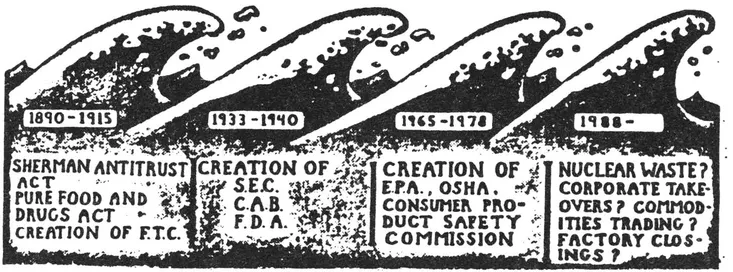
The Waves of Regulation
Figure 2.1.1-1
Source: Robert B. Reich, 1981
Figure 2.1.1-1
Source: Robert B. Reich, 1981
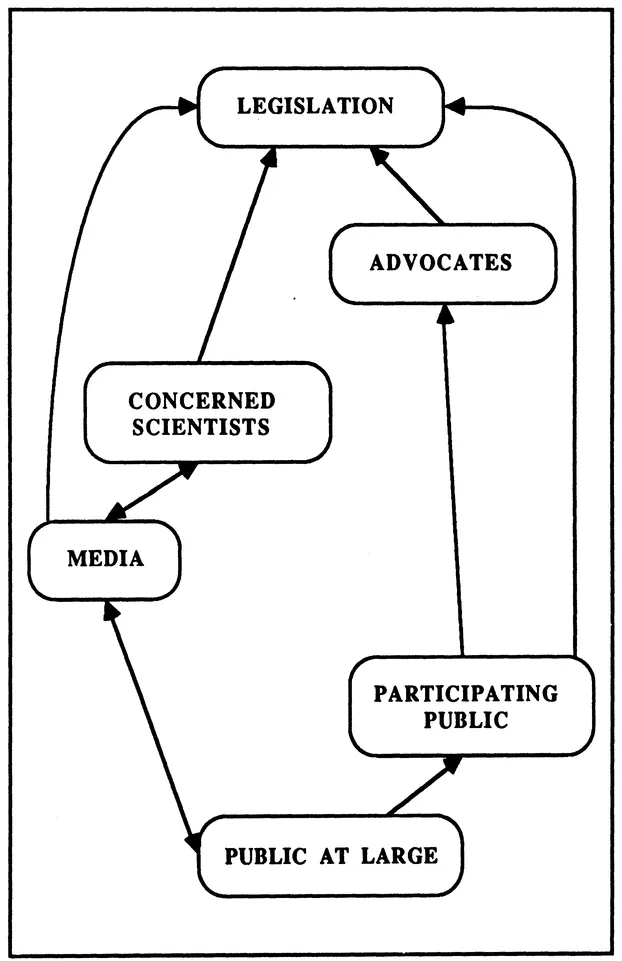
Several primary groups influence the process leading to the enactment of legislation. The chart in Figure 2.1.1-2 diagrams the dominant interactions of these groups.
The public at large, made up of all the individuals in the country, includes a small sector that is active in the political process. James N. Rosenau describes this group as those who can be mobilized to give specific support, such as time or money, to an issue [Rosenau, 1972]. These people, the "participating public", write to congressmen, seek the help of advocates, or submit letters to the editor. They have input to the process through relationships with legislators, advocates or media representatives.
The public at large has a two-way relationship with the media (television, periodicals and radio). The media derive their material partially from what the public is doing and is concerned about For professional and commercial reasons, it also covers what it believes is or will be of interest to the public. In this, media coverage is inflected by the discussions and rhetoric of politicians who not only reflect but try to anticipate or shape public opinion, sometimes seeking to meld it to the agendas of diverse and often hidden interest groups. These multiple inputs to media discourse are, for example, built into the practice of opinion polls. Thus, what the public knows and cares about is affected by the media through the amount and style of coverage and these are diversely shaped in ways whose details are beyond the scope of our study.
The media directly effects legislation by providing information to legislators and covering congressional events, such as hearings. Other effects come through the information it provides to advocates and concerned professionals, as well as the coverage it gives both of these groups.
Concerned professionals include the general groups of concerned scientists, concerned academics, and other professionals. They contribute through the media as described above, through advocates to whom they provide information, and directly to legislators through hearings, government reports, and studies.
Advocates (as regards the passage of legislation) are non-governmental professionals who represent a certain group or press for a certain issue. Besides trying to get media coverage for their cause and gaining information through media and concerned professionals, advocates gain input from the participating public. They have direct influence on the passage of legislation and sometimes provide specialized information to legislators.
it is interesting to contrast the process of social forces depicted in Figure 2.1.1-2 with a recent perspective presented in Chemical Week (Figure 2.1.1-3 [Chemical Week. 1981, p. 37]). The clear difference between the two is the "origins" of social laws. The Stanford Research International figure shows the forces beginning with "visionaries," proceeding to "radicals," then to academia, and then to the media. This perspective suggests that the origins are the imaginations of visionaries. In contrast,
Social Groups' Input to Legislation
Figure 2.1.1-2
Source: MIT Center for Policy Alternatives, 1984
Figure 2.1.1-2
Source: MIT Center for Policy Alternatives, 1984
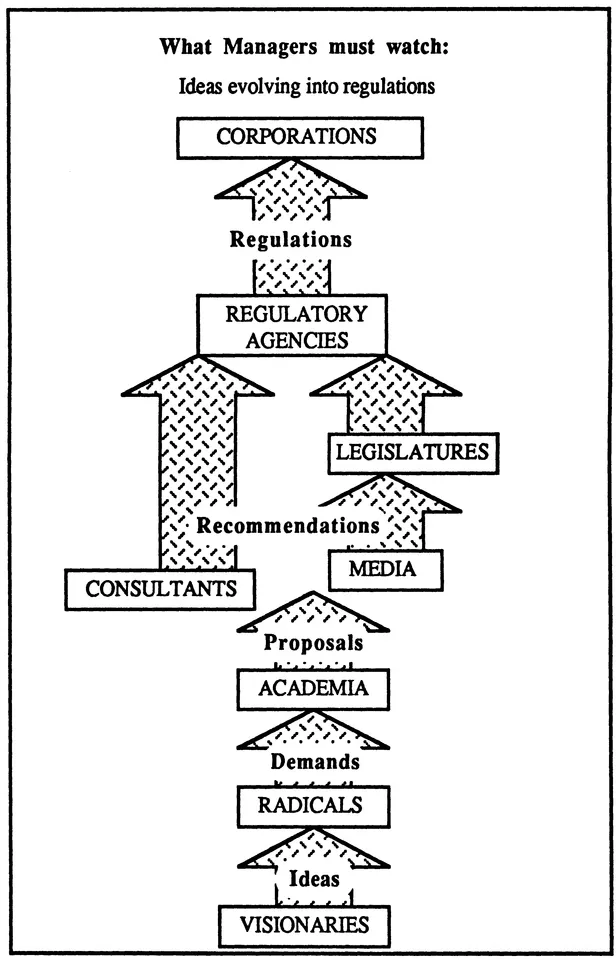
Figure 2.1.1-3 One Perspective of Social Forces
Source: Stanford Research International, 1981
Source: Stanford Research International, 1981
the perspective of Figure 2.1.1-2 places the "public at large" as the origin of forces, and places the "advocates" in an active, interpretative role. To us, this latter view is the more plausible.
In summary, the dominant inputs to the process by which legislation is enacted are from the participating public, concerned professionals, advocates, and the media, through which the concerns of the "public at large" diffusely work. There are other factors that have not been addressed, and other relationships between the factors that have not been described. The forces we have discussed here are those crucial to the passage of legislation.
Expressions of Concern and Values
Social forces may be defined by "expressions of concerns and our historical review concentrated on extracting expressions of concerns from the various sources. The relationship between expressions of concerns and values is close but not always self-evident
Concern develops when the things we value are exposed to or suffer harm. Concerns and values are different but the relative strength of the concern can provide information about the underlying values. Only when one investigates the specific ways in which damage threatens or occurs can one pinpoint the values informing a specific expression of concern (for example, about pesticides. Expressions of concern about pesticides were strong and fairly constant from 1900-78 but the values involved changed drastically in the 1960s).
Statements of concern are pieces of a puzzle. While many statements together are sometimes enough to uncover an underlying value, other relevant technical and historical facts are useful. It is in this light that we offer the following description of values found by interpreting concerns voiced through the media.
2.1.2 Index Content Analysis
To identify the progression of sympathy for the social issues a quantitative approach of index content analysis was used. A large computer database was constructed which contained the results of many hours of reviewing article indexes. Only some of the many histograms produced from this analysis appear in this book and a reader interested in greater detail is invited to inquire with the author.
2.1.2.1 Origin of the Approach
To investigate trends of concern expressed in popular literature, we applied content analysis, referred to here as Index Content Analysis because the material we analyzed was the indexes of popular periodicals such as The Reader's Guide or The New York Times Index. This approach takes the titles of articles as sources for expressions of concern. Index Content Analysis recently has been used to study the origins of interest in public health [Vierthaler, 1981]. Vierthaler refers to the technique as "Wholesale Content Analysis" but his method is the same as that used here. The major points from Vierthaler's thesis that relate to the origin of Index Content Analysis are provided below.
Index Content Analysis: The Research Uses of Library Indexes
In order to study changes in topics of public interest, a new method of index content analysis was devised. The method may be considered a "wholesale" approach because it allows researchers to examine published communications on specific subject matters which remain in the mainstream of public discourse for long periods of time. Bibliographic indexes reference thousands of articles published in hundreds of magazines and arrange them under pertinent subject headings. These indexes are crucial to the study of print media because they readily make available massive amounts of data. Thus, they significantly aid investigations of cultural changes in American society - especially, but not exclusively, elusive changes in public opinion.
Bibliographic indexes include such familiar reference works as The New York Times Index or The Social Sciences and Humanities Index. Most libraries also contain more specialized bibliographic indexes. These are valuable for social research because sources are referenced under topic headings that reflect the historical terms discussed in the periodicals. While a time lag must exist between the discussion of new issues in the literature and the adoption of corresponding subject headings, volumes of updated indexes are published continually to provide "living documents" of cultural change. The researcher who employs these subject categories does not impose an extrinsic structure of meaning upon communications [Cicourel, 1964:142-156] because the subject categories reflect mass media discussion. These "folk" categories are ideally suited for use as a data base to map the emergence of public issues covered in the indexed literature. Although the "public interest" is invoked frequently, insufficient effort has been made to gather evidence necessary to study changes in this important aspect of social organization.
An earlier monograph [Vierthaler, 1974a] examined the utility of The Readers' Guide to Periodical Literature as an instrument for investigating cultural change in American society. Begun by the H. W. Wilson Company, The Readers' Guide is a series of volumes which indexes popular American periodicals published since 1900. The indexed periodicals are chosen to represent areas of major interest to the genera! population. References to the articles published in this diverse collection of periodicals are indexed under alphabetically arranged categories that identify authors, article titles, and subject headings with subtopic headings. ...
Table of contents
- Cover
- Half Title
- Title
- Copyright
- Contents
- Acknowledgments
- 1. Introduction
- 2. Historical Review
- 3. Values Framework for Risks, Concerns, and Health: A Comparative Assessment
- 4. Conclusions and Recommendations for Further Work in the Field
- Bibliography and References
- Subject and Author Index
Trusted by 375,005 students
Access to over 1.5 million titles for a fair monthly price.
Study more efficiently using our study tools.
Frequently asked questions
Yes, you can cancel anytime from the Subscription tab in your account settings on the Perlego website. Your subscription will stay active until the end of your current billing period. Learn how to cancel your subscription
No, books cannot be downloaded as external files, such as PDFs, for use outside of Perlego. However, you can download books within the Perlego app for offline reading on mobile or tablet. Learn how to download books offline
Perlego offers two plans: Essential and Complete
- Essential is ideal for learners and professionals who enjoy exploring a wide range of subjects. Access the Essential Library with 800,000+ trusted titles and best-sellers across business, personal growth, and the humanities. Includes unlimited reading time and Standard Read Aloud voice.
- Complete: Perfect for advanced learners and researchers needing full, unrestricted access. Unlock 1.5M+ books across hundreds of subjects, including academic and specialized titles. The Complete Plan also includes advanced features like Premium Read Aloud and Research Assistant.
We are an online textbook subscription service, where you can get access to an entire online library for less than the price of a single book per month. With over 1.5 million books across 990+ topics, we’ve got you covered! Learn about our mission
Look out for the read-aloud symbol on your next book to see if you can listen to it. The read-aloud tool reads text aloud for you, highlighting the text as it is being read. You can pause it, speed it up and slow it down. Learn more about Read Aloud
Yes! You can use the Perlego app on both iOS and Android devices to read anytime, anywhere — even offline. Perfect for commutes or when you’re on the go.
Please note we cannot support devices running on iOS 13 and Android 7 or earlier. Learn more about using the app
Please note we cannot support devices running on iOS 13 and Android 7 or earlier. Learn more about using the app
Yes, you can access Risks, Concerns, And Social Legislation by W. Curtiss Priest in PDF and/or ePUB format, as well as other popular books in Politics & International Relations & Politics. We have over 1.5 million books available in our catalogue for you to explore.