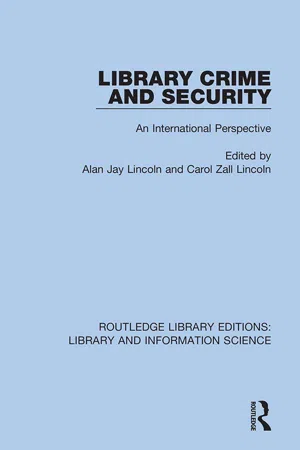
This book, first published in 1987, focuses on the patterns of library crime and disruption in Great Britain, Canada, and the United States. In addition to important data on these problems, there is extensive information on the characteristics of the institutions and the communities in which they are found. The impact of crime on the institution and the individual is examined. The authors present vital insights into the design of crime control programs in libraries of varying sizes that have or anticipate problems with crime such as book theft, vandalism, problem patrons, and attacks against staff. Major issues in the measurement, incidence, and consequences of crime are included, as well as relevant materials from the fields of library science, management, criminology, victimology, and security. An extensive security checklist is included that can serve as a guide for making the library a safer and more secure setting for staff, patrons, and contents.
eBook - ePub
Library Crime and Security
An International Perspective
- 170 pages
- English
- ePUB (mobile friendly)
- Available on iOS & Android
eBook - ePub
About this book
Information
Chapter One
Libraries and Crime:
A Comparative View
INTRODUCTION
The field of library science has been changing in the last two decades. Some of the changes have resulted from innovations in technology; others have come about in response to changing needs of the community and of patrons. Advances in information storage and retrieval have enabled libraries to provide more varied information in less time, but have also strained the budgets of many libraries. Shifting centers and characteristics of the population have forced some public libraries to expand and modify services at a rapid rate, while other libraries have seen declines in the number of patrons.
Many of these issues extend beyond the control of the public library. Public libraries in the United States have been described in the following way: “As the public library approached the last quarter of the 20th century it was beset with a number of difficult problems. The principal one continued to be that of adequate financial support. Urban libraries, particularly those in the older cities of the Northeast and Midwest, were suffering from the effects of urban blight, the flight to the suburbs, and sharply increasing expenses of operation.” (Encyclopedia of Library and Information Science, 1976:288). While this was written about U.S. libraries, the same issues are having an impact in Great Britain and Canada. Economic problems at a national or local level may be manifested in budget cutbacks for libraries and library systems. When cutbacks or even stabilizations occur, they affect both the functioning of the library and the patrons they serve. Present restrictions are particularly inopportune because libraries are undergoing technological changes that often entail great expense. For example, a choice may have to be made between maintaining the current level of acquisitions or adding database information systems. To adapt to the changing habits of the population, many libraries now provide videotapes, audiotapes and computer discs. The effects of these technological changes can be seen beyond the level of the local library. Many graduate programs have maintained a modern image by changing their program titles to include “information science.”
Other changes in the community may have an impact upon the public library. The growing trend to deinstitutionalize the mentally ill affects public institutions. Unless adequate support services are provided for ex-hospital residents, many staying on the streets seek shelter in safe and warm places. Unfortunately, as has been shown in countless communities, the public library meets these needs. Furthermore, changes in the structure of the family and employment patterns may be leading to more unsupervised time for children. Rather than return to an empty home after school, these children may stay on the streets or make use of whatever public facilities are available.
The shifting of population patterns through migration and immigration may require the library to reassess the services provided to the community. Popular and special interest materials may have to be ordered in more than one language. For example, some urban United States libraries have dramatically increased their expenditure on materials in Spanish. Similarly, some British libraries are providing increased materials for the Indian, Pakistani, Middle Eastern and other groups in the population. Canadian libraries are mandated to provide appropriate materials for a variety of ethnic groups found within the area they serve. Immigrants are not the only segment of the population requiring specialized service. Demographic changes such as the increasing proportion of elderly may place special demands on selected library services. The impact of these social changes on the library will be magnified if crime and disruption also become a significant problem.
One of the disturbing changes in industrialized nations has been the significant increase in crime. As will be shown in greater detail in later chapters, each of the countries studied in this project has experienced increases in crime. It may be that in addition to all the other potential problems faced by libraries, the occurrence and threat of crime is among the most difficult to manage. This is in part due to the fact that many of the causes and factors perpetuating crime are beyond the control of the library or librarian. For example, high rates of unemployment influence the crime rate in a com munity. While it is true that the library may face increased demand for services by those who find themselves out of work, the increased rate of crime in the community will probably not be affected by anything that the library does or does not do. However, the library does not exist separately from the community and its problems. If there is an increase in crime as a result of unemployment or some other social issue such as ethnic or racial tension, then the library may suffer along with other public and private institutions.
Some types of crime are easier to control and prevent than others. For example, while librarians may have some success in reducing theft and vandalism, it is much more difficult to control some of the more violent crimes carried out by determined individuals. As pointed out by Camp (ALA Yearbook, 1985:259): “The shooting of President Reagan, President Ford’s two near misses, the assassination of President Kennedy demonstrate rather conclusively that dozens of guards are unable to protect even a President against a sociopath with a gun. Referring to the shooting in Cleveland Public [Library], Police chief William Hamton is quoted as saying that ‘you can have 1,000 policemen nearby and still not prevent something like that’.” Fortunately, deadly attacks within libraries are relatively infrequent.
In the remaining sections of this chapter we will provide brief overviews of: the role of research; a capsule description of the development and “missions” of public libraries in Great Britain, Canada and the United States; and a summary of the risk factors most likely to affect public libraries.
FUNCTIONS OF RESEARCH
It is natural to try to understand the world around us. We tend to ask about the things that intrigue, interest and affect us most. For example, if we make our living by fishing, then we tend to be curious about the best ways to bring in the largest catch. We might base our opinions on any number of possible factors, including tradition or folklore, a single personal experience, the reports of others or a series of trial and error episodes. But what would happen if the single personal experience happened to be misleading or open to conflicting interpretations? To illustrate, assume that a successful catch occurred early one rainy morning in August in a particular spot. What do we know? Was the catch successful because it was “early morning,” “rainy,” “in August,” or “in a particular spot?” The techniques of everyday observation do not always pro vide the obvious answers to our vital questions. We may be tempted to overgeneralize about the conditions favoring large catches or to attribute the cause of our success to the wrong critical factor. Eventually, those explanations that tend to work best would be the ones we hold onto. Those that did not work for us would be discarded. Other fishermen would be likely to test our suggestions against their personal experiences and then reject or adopt these “theories” for maximizing the catch. Similarly, we might be concerned about the factors that increase or reduce the amount of book theft in a library. Research often is initiated as we seek answers to important, everyday questions.
Scientific research protects us from making the common mistakes of every day inquiry. The use of controlled and systematic observation is a crucial factor in scientific inquiry. This is true whether we are studying conditions that increase the catch of fish, causes of a contagious disease, conditions that facilitate theft, or characteristics of the typical mystery reader. Scientific research can be used for many purposes. A recent British Public Libraries Research Group Workshop focused on the role of in-house research in public libraries. In the preface to that report, Linda Stewart (1984) suggested that the “main value of research lies in the guidance that it gives to action.” She goes on to identify four kinds of research that can be helpful in solving problems in the library:
—Diagnostic research is primarily intended to supplement information available at the initial stages of problem-solving.
—Comparative research can help in the middle stages of problem-solving when the nature of the problem is fairly clear and there is uncertainty over the range of solutions available and/or likely consequences of adopting alternate solutions.
—Evaluative research is concerned with the latter stages of problem-solving, i.e., evaluating the outcome of solutions which an organization has selected and implemented.
—Action research — here the researcher plays an active part in all stages of problem-solving. (Stewart, 1984:1)
The major focus of this volume is on comparative victimization studies of crime in public libraries. Victimization studies gather information directly from people who are likely to know about crime affecting them or the institution they are affiliated with. The studies do not rely upon official reports of crime. While the information is first presented in a descriptive manner, the relationships between institutional/community factors and library crime patterns subsequently are presented. It is hoped that the findings answer many of the obvious research questions and that they can be used to develop a variety of programs designed to control crime in the local library setting.
LIBRARY DEVELOPMENT
Great Britain
The concept of the public library as we know it today started in England. Parish, subscription and mercantile libraries were some of the earliest libraries. By the end of the 15th century, Oxford and Cambridge Universities had functioning libraries. Before 1600, Thomas Bodley had established a private library in Oxford. Libraries in Great Britain in the 16th and 17th centuries typically were owned either by corporations or individuals. None was supported by the authorities or the public. According to Albert Predeek’s history of libraries in Great Britain, this pattern continued for many years.
Before the middle of the nineteenth century England had no libraries open to the general public such as the German cities had founded after the Reformation. Likewise the English grammar schools of the sixteenth century and the public schools which sprang from them in the seventeenth and eighteenth centuries, founded with quite considerable libraries, were separated from the people by a much broader gap that has ever been the case with the German Ratschulen and classical Gymnasia…. On the other hand, many church and parsonage libraries which were intended for the lower clergy revealed as early as the seventeenth and eighteenth centuries a notable trend toward providing ministers’ families with better reading matter and thereby instruction which the common schools could not give. (Predeek, 1947:52)
In 1850 the first public library act was passed. “The Act permitted councils of towns of 10,000 population with the approval of 2/3 majority of the local government electors to provide a building, light, and fuel and employ a librarian at an annual cost not to exceed a halfpenny rate. No provision was made for the purchase of books on the assumption that they would be donated by benefactors” (Phillips, 1977). In 1882 Nottingham established the first children’s library. Public libraries grew quickly in England, and by 1900 there were over 350. Many services were common at the libraries. In addition to providing scholarly works, there was an emphasis on adult education. Newspaper areas as well as children’s areas were available. The rural areas were helped by the Carnegie United Kingdom Trust with funds for the initial construction of libraries.
In the 1920s the Kenyon committee prepared a report on libraries in England and Wales. This committee was charged with determining the adequacy of library services. While no legislation followed, a general theme of cooperation did result. In 1959 the Roberts Report, which was to study the structure of public library service in England and Wales, became a guide for future patterns of reorganization. The Bourdillon Report of 1962 also had a strong impact on the British library system. This report set the standards for public library service in both England and Wales. Using the recommendations from the Roberts Report concerning the basic requirements of an efficient library, The Bourdillon Report detailed the standards for staffing, basic library service, building and other services. For example, one standard for basic library service was:
A library providing a basic library service should purchase annually the following library materials: (a) for lending purposes, not less than 2,000 titles of adult non-fiction from the new and older British publications, American and other English language publications from abroad and music scores; together with 300 volumes to allow for duplicates and replacements. (Phillips, 1977:Section 33)
In 1964 the Public Libraries and Museum Act reorganized previous legislation and revised the structure of libraries in Great Britain. This act drew from both the Roberts Report and the Bourdillon Report. “This act designated library authorities covering the whole of England and Wales, allocated to each the duty to provide a comprehensive and efficient library service ….” (Jones and Sewell, 1976:150). In 1972 the British Library Act officially regrouped the British libraries into three separate divisions including reference, lending, and bibliographic services. This act functioned to centralize several different services including mobile library service, school library service, hospital library service, service to the aged and housebound, prison service and service to the army. The British Library became the hub of the British library system rather than the apex. According to Hookway, the hub “… should be more sensitive and quickly responsive to problems and needs elsewhere” (1976:43). Hookway continued by describing the future of the British library system.
Library and information services are under increasing pressure to satisfy from limited resources a wide range of educational, recreational, scholarly, industrial, commercial and other needs. Individual libraries and information services are never likely to meet all the demands of a modern society, and yet as much information as needed should be made available throughout the U.K. as rapidly as necessary and in the most useful and economic form. (1976:44)
As of April, 1974, the 385 previous library authorities were replaced by 117 newly aligned library authorities. The new districts were based on population areas from a minimum of at least 100,000 to over 1,000,000. According to Wilson (1976:202), “Coordination of all publicly supported library services will take place at local level, linked with the service of the British Library to create a truly national library and information service.”
Canada
The history of Canadian Libraries parallels to some extent that of the U.S. but there are also many differences. First there are the French origins of eastern Canada and the continued domination of the French language and culture in Quebec. Then, there is the long colonial status of Canada and the close cultural and political ties with Great Britain, even after the achievement of Dominion and Commonwealth status. Finally, there are the vast distances, the sparse population, the slow development of transportation, and the long winters that accentuate the difficulties in socialization and communication. Despite the difficulties, the development of Canadian libraries has been steady and today they are in much the same position as those of Europe and the United States. (Johnson and Harris, 1976:216)
Canada is a “multicultural society” or a mosaic. Less than half the population is descended from immigrants from the British Isles. An addit...
Table of contents
- Cover
- Half Title
- Title Page
- Copyright Page
- Original Title Page
- Original Copyright Page
- Contents
- Preface
- Chapter One: Libraries and Crime: A Comparative View
- Chapter Two: Library Crime in Great Britain
- Chapter Three: Library Crime in Canada
- Chapter Four: Three Studies of Library Crime
- Chapter Five: Patterns of Library Security
- Chapter Six: Controlling Crime: A Security Checklist
- Bibliography
- Index
Trusted by 375,005 students
Access to over 1.5 million titles for a fair monthly price.
Study more efficiently using our study tools.
Frequently asked questions
Yes, you can cancel anytime from the Subscription tab in your account settings on the Perlego website. Your subscription will stay active until the end of your current billing period. Learn how to cancel your subscription
No, books cannot be downloaded as external files, such as PDFs, for use outside of Perlego. However, you can download books within the Perlego app for offline reading on mobile or tablet. Learn how to download books offline
Perlego offers two plans: Essential and Complete
- Essential is ideal for learners and professionals who enjoy exploring a wide range of subjects. Access the Essential Library with 800,000+ trusted titles and best-sellers across business, personal growth, and the humanities. Includes unlimited reading time and Standard Read Aloud voice.
- Complete: Perfect for advanced learners and researchers needing full, unrestricted access. Unlock 1.5M+ books across hundreds of subjects, including academic and specialized titles. The Complete Plan also includes advanced features like Premium Read Aloud and Research Assistant.
We are an online textbook subscription service, where you can get access to an entire online library for less than the price of a single book per month. With over 1.5 million books across 990+ topics, we’ve got you covered! Learn about our mission
Look out for the read-aloud symbol on your next book to see if you can listen to it. The read-aloud tool reads text aloud for you, highlighting the text as it is being read. You can pause it, speed it up and slow it down. Learn more about Read Aloud
Yes! You can use the Perlego app on both iOS and Android devices to read anytime, anywhere — even offline. Perfect for commutes or when you’re on the go.
Please note we cannot support devices running on iOS 13 and Android 7 or earlier. Learn more about using the app
Please note we cannot support devices running on iOS 13 and Android 7 or earlier. Learn more about using the app
Yes, you can access Library Crime and Security by Alan Jay Lincoln,Carol Zall Lincoln in PDF and/or ePUB format, as well as other popular books in Languages & Linguistics & Library & Information Science. We have over 1.5 million books available in our catalogue for you to explore.