- 216 pages
- English
- ePUB (mobile friendly)
- Available on iOS & Android
eBook - ePub
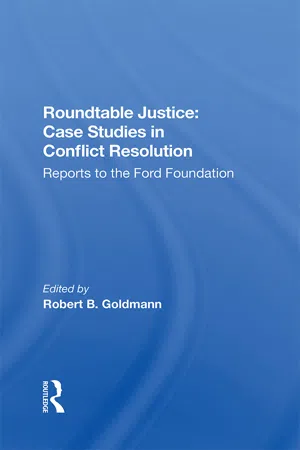
Roundtable Justice: Case Studies In Conflict Resolution
About this book
For close to a decade, the Ford Foundation has supported a variety of efforts to advance both knowledge about and the use of alternatives to the adversary process for the settlement of disputes. The Center for Dispute Settlement of the American Arbitration Association; the In· stitute for Mediation and Conflict Resolution in New York City; the Center for Community Justice in Washington, D.C.; the Institute for Environmental Studies at the University of Washington in Seattle, Washington; and the Office of Environmental Mediation at the Uni-versity of Wisconsin have played a major role in advancing the state of the art in the disposition of major disputes as well as in introducing mechanisms for grievance management and conflict resolution.
Information
Introduction
Robert B. Goldmann
The American society of the sixties and seventies has been called the litigious society. During that period more groups asserted rights through the courts than ever before or than judges, policymakers, or scholars had ever envisaged would do so.
After the civil rights movement, other minority groups became aware that they had been and were underrepresented in the places and processes where decisions were made about the allocation of resources and opportunities. Spanish-speaking people and Native Americans followed the lead of Blacks. The women's rights movement gained momentum. Concern for the nation's and the world's natural environment and worry about the seemingly heedless use and abuse of natural resources gave rise to a dynamic environmental movement that soon found itself at odds with business, organized labor, and minority groups who were pressing for more growth and more jobs. Consumers organized to press their claims for quality products at reasonable prices. New constituencies continued to develop at an astounding rate, and many institutions–corporations, labor unions, schools, colleges, and government agencies at all levels–were and continue to be involved in conflicts of one sort or another.
The courts are not only overburdened by an unprecedented workload, making for lengthy delays and a diminution of justice; they are also saddled with cases that do not necessarily fit the traditional adversary model. The rules of evidence and other limits on judicial fact-finding may make fair resolution of some disputes difficult, if not impossible, since the courts must depend only on litigants for the facts. There is also the question of timing. Courts generally cannot enter a dispute, even one that is justiciable, until it polarizes or becomes "ripe" for judicial action. In many cases it may not be best for society to wait that long.
It is in this context that new and different methods for settling disputes are being sought and developed. Some of the new techniques are based on the model of mediation and arbitration that has been used by business and labor organizations for many years. Neutral third parties have entered social disputes in various stages of crisis and have sought to work out compromises that accommodate the interests of all parties. Unlike a court, an intervenor often can begin operating before the parties are polarized and positions are frozen. Thus, a settlement that satisfies all parties may be reached more quickly and more easily than if the dispute had reached the courts.
This book examines a representative group of mediated disputes and suggests some conclusions based on the successes and failures of these efforts. It is not designed to present a definitive theory of the mediation of social disputes. At this stage, gathering evidence may be as useful as expounding on it.
Many recently mediated social disputes involved complex networks of relationships, needs, and issues that third-party intervenors must learn to deal with. A study of significant or representative cases, such as this one, can serve the following purposes.
- It can help government and private bodies assess the merits of alternate methods of dispute resolution so they can determine which path to follow in a specific dispute or in disputes in general. Some administrators may be unaware of the possibility of third-party intervention. Others may want to know more about the mix of variables involved in social disputes and what they augur for successful mediation
- It can provide some insight into the qualities needed by persons who attempt (through mediation, arbitration, or any other method) to intervene in an incipient or full-blown dispute.
- The growing corps of mediators may learn more about the pitfalls and failures of mediation as well as about methods and approaches that have been successful.
- The study can inform the general public about alternative institutions and approaches for dispute resolution and about what can be accomplished through these mechanisms.
Four aspects of disputes were identified as a result of reviewing and discussing a variety of disputes with individuals and members of several institutions engaged in third-party intervention. Utilising those characteristics, we selected cases that would be most useful to policymakers, administrators, and others eager to find alternatives to mechanisms now available or known to them.
1. The Nature of the Dispute
Intensity. Has the dispute been polarised or inflamed? How defined is it? To what extent do neutral persons or institutions still exist within the dispute community? To what extent do the participants and potential participants see themselves as being involved in a dispute? How strongly do they feel about the issues?
Time pressure. Must something be done quickly to avoid other dangers? Has the dispute gained visibility as the result of some clash or conflict? Or is it a dispute that the intervenor may have "discovered" on his or her own?
Size. How many participants are involved in the dispute?
History. What came before the dispute? What are the relationships among the participants?
The need for resolution. How threatening is the possibility of nonresolution? Do some participants have a vested interest in the dispute not being solved? How great is the motivation to settle?
Legitimacy. Is the dispute sufficiently justified to require the cost of social intervention? Is it a "strike" suit? Is it frivolous? What is meant by a "frivolous" dispute?
2. The Community Within Which the Dispute Exists
The dispute community. Are there overlapping communities? Can the dispute be resolved without also resolving other problems radiating from the dispute? What kind of community does the dispute exist in: a neighborhood? an institution? How defined is the community?
The community interests involved. What are the particular interests of the parties to the dispute? Are they economic, political, ideological (e.g., having to do with the environment or civil rights), "negative" (fear of crime, fear of racial minority, fear of change)? How many adherents does each interest have? How passionate are the adherents about their point of view? How articulate and vocal? What is the source of the authority, or the legitimacy, of those who speak for different sectors of the community?
Local and national disputes. Is the dispute a national one, or if local, one that will have national consequences (perhaps it is the first of its kind)? If local, has national attention been drawn to it? How has news media attention affected the community within which the dispute exists?
3. The Purpose of the Intervenor
Retrospective or prospective function. Is the intervenor attempting to resolve something that has already happened or to set up a structure for the resolution of future problems? Does the intevenor find the facts or suggest solutions? Are the suggestions binding? What methods are used to fulfill the tasks?
Implementation or monitoring of the resolution. Will the resolution be self-enforcing? Should or does the intervenor provide a means of implementation or monitoring? If not, how will a settlement be enforced and related community needs met?
4. Nature and Qualities of the Intervenor
Relation to the community. Does the intervenor come from inside or outside the community within which the dispute exists? Does the intervenor expect something from the community (as a politician might expect votes)? Must he or she continue to live in the community after the resolution?
Source of intervener's authority. Where does the intervener's authority come from? Is he or she appointed by a public body with power to take unilateral action if intervention is not successful?
Personal characteristics of intervenor. What personal qualities does the intervenor have? What qualities are called for in the particular dispute?
The Forest Hills dispute (Chapter 4) was very intense, with a potential for violence and a significance far beyond its immediate boundaries. A policy of city government was challenged; the Mayor intervened; and a mediator of high visibility (Mario Cuomo), backed by considerable power, was brought into the dispute.
In sharp contrast to Forest Hills, the Snoqualmie Dam controversy (Chapter 3) was persistent but of low intensity. The interests and the issues did not require urgent action. No immediate crisis and certainly no violence were in the offing. Yet there was a conflict of interests that sooner or later needed to be resolved for the sake of balanced growth, environmental health, and economic equity of a large area and a sizable population. Here mediation could proceed at a less rapid pace, over a longer time span, and the mediator did not need or want the high visibility and political power that were required in Forest Hills. The mediation was successful, but problems arose in implementation, and this experience, too, holds lessons for the future.
Chapter 7 on the Dayton school problem covers merely one segment of a long and continuing dispute. The work of a federal service in creating the atmosphere for implementing a court decision is documented in this chapter. In all cases, the decision or the settlement is merely the beginning of resolution. The hard work of carrying out the terms and of getting people adjusted to what the courts have decided or what their representatives have agreed to in mediation is the less publicized but vital ingredient that gives meaning to signatures on documents.
The Atlanta case (Chapter 6) tells us much about that city-a community that was determined to resolve a seemingly intractable issue with its own leadership resources. The dispute in St. Louis (Chapter 5) was another of high intensity and urgency, and there seemed to be only one person who was acceptable to all parties to resolve it-and he did the job. In the case involving the Mohawk Indians and New York State (Chapter 1), Mario Cuomo again played a role (but a very different one from his role in the Forest Hills dispute). Chapter 2 describes dispute resolution within a California prison system. Similar approaches could be used by school systems, by colleges and universities, and by individuals dealing with governmental systems, such as social security or services for the aged and handicapped, where challenges to decisions or awards either go unanswered or wend their way through complicated, time-consuming and costly processes.
1
“This Is Our Land”: The Mohawk Indians v. the State of New York
Richard Kwartler
Introduction
If we have come to fight,
we are too few.
If we have come to die,
we are too many.
we are too few.
If we have come to die,
we are too many.
–Statement attributed to anonymous Indian chief on the eve of battle more than 175 years ago.
In some respects, little has changed. There are still some Indians ready to fight if they must and prepared to die if it is absolutely necessary. For them, the reason is compelling-part of it concerns their commitment to settling a question for which there may never be a mutually acceptable answer: Who really owns the land on which much of America stands?
They don't want to fight or die, but they are motivated to take great risks by what for them are real fears of cultural extinction. They see only bleakness ahead if they do not obtain land–land on which they can return to the agriculturally self-sufficient life of their forefathers, and land on which they can freely bring up their children with Indian cultural and religious values and without the alcoholism, mental illness, and other pathology of the existing reservations. As for living elsewhere in America, these deeply committed "traditional" Indians want no part of it that isn't totally their own.
The problem, of course, is that all of the land Indians want is spoken for. Some of the land is government-owned and set aside as parks or "forever wild" areas upon which nothing is supposed to be built, while the rest has on it the homes, farms, schools, businesses, and government buildings constructed by people and agencies convinced that they own that terra firma. They contracted for it and paid for it, and they have the deeds and mortgages to prove it. They also have the support of government officials who cite the long line of treaties that changed the ownership of tens of millions of acres that unwind across the scenic majesty that is the United States of America. The treaties, say the officials, are valid. Other Indian land was given away, abandoned, or captured.
For at least a thousand years before the Pilgrims landed at Plymouth Rock in 1620, the varied Indian nations on this continent controlled those acres. The Iroquois Confederacy (Mohawk, Oneida, Onondaga, Cayuga, and Seneca), the Passamaquoddy and Penobscot, the Sioux, the Pueblo, the Navaho, and many others were among the peoples who once owned vast acreage. Today, members of these and other Indian nations are seeking to regain control of some of that land. They maintain that many of the treaties are illegal, and that fraud was present in a great many cases in which land changed hands. The nature of the claims and of the goals varies from group to group. The issues are complex, and there is a diversity of opinion. Millions of dollars have already been paid in Indian claims.
Some Indians want land and money. In Maine, the Passamaquoddy and Penobscot tribes asked the federal government in 1978 to intervene on their behalf and seek 350,000 acres and $300 million in damages from the state of Maine, but not to sue private landowners. The Indians contend that 12 million acres were taken from them illegally. Some Indians seek land only; they are committed traditionalists who value the old ways and see the land as something sacred that cannot be bought or sold as in the non-Indian world. Traditional Indians are also concerned about maintaining numerical Indian identity by discouraging intermarriage with whites. Today, there are an estimated 750,000 to 1,000,000 Indians in the United States, but no one knows for sure, just as no one is sure how many Indians were here prior to Columbus. Some estimates place the total at that time at around 25 million-but that includes all of North America. Other estimates go much lower.
Indian land claims, however, are diverse and are not easily cataloged-some traditionals seek money as well as land; so do some "elective" Indians. An estimated three-quarters of the Indians in the United States are known as elective because they have opted for the nonIndian way of life and believe in assimilation.
What has eluded the courts, the state and federal agencies, and the individual participants involved in disputes from Maine to Washington State is a formula for settlement. The conflicts drag through the courts for years. A number of Indian leaders have called for a meeting with President Carter or a White House conference to consider the overall question of Indian claims.
There are in New York State a number of people who believe that the formula for resolving a number of the existing Indian disputes may have already been found–and used–to produce an interim solution to the May 13, 1974, seizure by armed Mohawks of 612 acres of New York State land. The land, said the Mohawks, was seized as a symbol because it is part of 8 million acres in New York and 1 million acres in Vermont that together make up the original Mohawk homeland. The Indians claimed that all 9 million acres still belonged to them because the treaties the states relied upon for ownership were invalid. The 612 acres are located at Moss Lake, about fifty miles from Utica, in the Adirondack State Forest Preserve. The land had once been used for an exclusive girls' camp for children from families like the Rockefellers and Roosevelts.
It could have become, in the opinion of many, including the State Police, a bloody battleground that would have made "Attica look like a Sunday school picnic." That was the opinion of former State Police Major Robert S. Charland, who was in command of the troop that covered the Moss Lake area when the Mohawks took control. Charland asked his superiors for permission to remove the Indians, whose strength he estimated at about one hundred men, women, and children. Permission was denied, and the Indians stayed; three years were to go by before an interim agreement was reached that arranged for the Indians to move to a new site in New York's Clinton County near Plattsburg and the Canadian border.
Charland still thinks it would have been right to remove the Indians on that first day "since they took a piece of property in a fashion that led to violence." There were a number of shooting incidents involving Indians and local residents who opposed the takeover, but no one was Sailed "due mainly to the efforts of the State Police." Charland, 46, a native of Brooklyn, New York, is a man who follows the law no matter who is involved-Indian or white–and it is a mark of the extraordinary circumstances surrounding the Moss Lake settlement that one of Charland's strongest supporters is Kakwirakeron (pronounced Gah-Gwee-La-Geh-Lu), a key Mohawk leader. Kakwirakeron is 35; his English name is Arthur Montour. All the non-Indian participants in the Moss Lake controversy agree that if the date were 1600, Kakwirakeron would be a famous chief. His commitment to the Mohawk cause is total, and he said at one point during the occupation of Moss Lake: "We realize we're in a very dangerous position and we know we are in a life-and-death situation–literally, figuratively and culturally. There's always the possibility of death."
Charland retired from the State Police in August 1976 and went to work for the same Rochester utility that employs the man who is considered by most of the other participants to have played the major role in effecting the interim settlement–Howard Rowley. Rowley is a part-time mediator for the American Arbitration Associations (AAA) Community Dispute Services (CDS), and he believes that it was the use of a carefully formulated mediation process that enabled both sides to agree finally on the imaginative use of a trust to hold the Clinton County land for the Mohawks. Rowley, 50, started out as a laborer and now is director of urban affairs for the Rochester Gas and Electric Company. He recently won a $10,000 Rockefeller Public Service Award for his work as a mediator.
The mediation effort lasted thirty months, and during the final ten months New York Secretary of State Mario Cuomo represented Governor Hugh Carey at the sessions. Cuomo is credited with securing acceptance of the interim settlement from Albany, and he played a role in hammering out the agreement.
Cuomo was the fact finder in the Forest Hills housing dispute (see Chap. 4). In discussing that conflict, he said: "In the end we prevailed because we were right, and when is the last time that that happened?" Later on he said:
I think that it happened again with the Mohawks. We got the State to do something there that everyone said was not doable and everyone said that [State Attorney General] Louis Lefkowitz would never ag...
Table of contents
- Cover
- Half Title
- Series Page
- Title
- Copyright
- Contents
- Preface
- The Contributors
- Introduction
Trusted by 375,005 students
Access to over 1.5 million titles for a fair monthly price.
Study more efficiently using our study tools.
Frequently asked questions
Yes, you can cancel anytime from the Subscription tab in your account settings on the Perlego website. Your subscription will stay active until the end of your current billing period. Learn how to cancel your subscription
No, books cannot be downloaded as external files, such as PDFs, for use outside of Perlego. However, you can download books within the Perlego app for offline reading on mobile or tablet. Learn how to download books offline
Perlego offers two plans: Essential and Complete
- Essential is ideal for learners and professionals who enjoy exploring a wide range of subjects. Access the Essential Library with 800,000+ trusted titles and best-sellers across business, personal growth, and the humanities. Includes unlimited reading time and Standard Read Aloud voice.
- Complete: Perfect for advanced learners and researchers needing full, unrestricted access. Unlock 1.5M+ books across hundreds of subjects, including academic and specialized titles. The Complete Plan also includes advanced features like Premium Read Aloud and Research Assistant.
We are an online textbook subscription service, where you can get access to an entire online library for less than the price of a single book per month. With over 1.5 million books across 990+ topics, we’ve got you covered! Learn about our mission
Look out for the read-aloud symbol on your next book to see if you can listen to it. The read-aloud tool reads text aloud for you, highlighting the text as it is being read. You can pause it, speed it up and slow it down. Learn more about Read Aloud
Yes! You can use the Perlego app on both iOS and Android devices to read anytime, anywhere — even offline. Perfect for commutes or when you’re on the go.
Please note we cannot support devices running on iOS 13 and Android 7 or earlier. Learn more about using the app
Please note we cannot support devices running on iOS 13 and Android 7 or earlier. Learn more about using the app
Yes, you can access Roundtable Justice: Case Studies In Conflict Resolution by Robert B. Goldman in PDF and/or ePUB format, as well as other popular books in Politica e relazioni internazionali & Politica. We have over 1.5 million books available in our catalogue for you to explore.