eBook - ePub
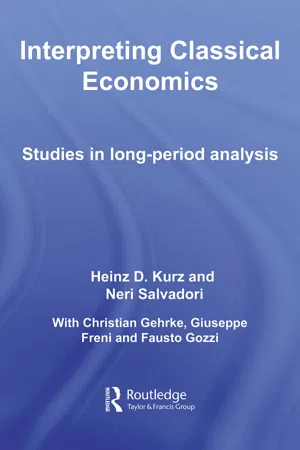
Interpreting Classical Economics
Studies in Long-Period Analysis
- 288 pages
- English
- ePUB (mobile friendly)
- Available on iOS & Android
eBook - ePub
About this book
First Published in 2007. This book is the third volume of previously published essays from Heinz D. Kurz and Neri Salvadori, following Understanding Classical Economics (1998) and Classical Economics and Modern Theory (2003), both published by Routledge. This new collection can be read in isolation but perhaps more fruitfully in conjunction with the previous texts, providing modern interpretations of the classical economists and comparing their analyses with that of contemporary mainstream economics. The essays in the new volume are split between three parts, the first section dealing with classical economics and modern theory focusing specifically on the differences in the analytical structure and content of the theory of value and distribution of Ricardo, on the one hand, and Say and Walras, on the other. The second part is devoted to Piero Sraffa's contribution, drawing from his hitherto unpublished papers. The final part assesses linear theory of production, concentrating on comparative studies of the contributions of von Neumann, Arrow-Debreu, Georgescu-Roegen and Sraffa. This new volume will be of interest to economic theorists and methodologists in Europe, Asia and America and particularly academics and researchers engaged with theories of production, value, distribution, economic growth and the history of economic thought.
1 Interpreting classical economics: studies in long-period analysis
An introduction
Heinz D. Kurz and Neri Salvadori
This volume contains a set of chapters written by the two of us, by one of us alone, or by one of us in collaboration with some other co-author. With the exception of this introduction all chapters have been previously published. The collection is a follow-up to two other volumes with essays from us, the 1998 volume entitled Understanding ‘Classical’ Economics. Studies in Long-period Theory (Kurz and Salvadori, 1998) and the 2003 volume entitled Classical Economics and Modern Theory. Studies in Long-period Analysis (Kurz and Salvadori, 2003). In order to get a more complete picture of what we mean by ‘classical’ economics and why we think it necessary to resurrect and develop the standpoint of the classical economists and those working in their tradition, we ask the interested reader to kindly also consult our previous books. Since some of the chapters reprinted in this volume contain a continuation of arguments developed in chapters published in the earlier two volumes – occasionally directly in response to critics of our work – the reader might find it useful to have the previous volumes at hand when reading this one.
The material is subdivided in three parts. Part I deals with ‘Classical economics and modern theory’ and has four chapters. Chapter 2 grew out of a paper given at the ‘Colloque international Jean-Baptiste Say’, Institut des Sciences de l’Homme, Lyon, 26–28 October 2000. The chapter focuses attention on the differences of opinion between Ricardo and Say in the theory of value and distribution – the main field in dispute between the two. It is shown that whilst at the beginning of their encounter Say acknowledged Ricardo’s authority in political economy, already at the time of his notes to the French edition of Ricardo’s Principles, published in 1819, he changed his attitude. After Ricardo’s death he openly attacked Ricardo and apparently was intent to diminish the latter’s achievements. However, there is clear evidence that Say’s reception of Ricardo’s surplus-based approach to the theory of value and distribution abounds with misunderstandings. These concern, in particular, the distinction between ‘value’ and ‘riches’, the theory of value and the problem of the measure of value, and the explanation of rents and profits. Desirous of establishing himself as an original thinker, Say re-defined the scope, method and content of political economy, opting for a more inductive approach. When confronted with Ricardo’s criticism of his interpretations and views he frequently responded in an evasive way. Ricardo felt with an ever increasing astonishment, which was to turn into disenchantment, that the substance of Say’s respective arguments, which he thought erroneous or misleading, was basically left untouched. Therefore, his belief in Say’s ability to understand his, Ricardo’s, doctrine gradually vanished. Chapter 3 discusses the numerical examples of land saving and capital saving agricultural improvements Ricardo provided in chapter 2, ‘On rent’, of the Principles. His illustrations of the second kind of improvements in particular met with fierce criticism, beginning with Edwin Cannan. It is maintained that Ricardo was not wrong in any substantive sense and that he could only be criticized for having changed the definition of rent as regards the timing of its payment from post to ante factum. Chapter 4 scrutinizes Léon Walras’s ‘Exposition and refutation of the English theory’, by which Walras meant first and foremost Ricardo’s theory, in lessons 38–40 of part 7 of his Eléments d’économie politique pure. While Walras succeeded in pointing out some weaknesses and unnecessarily restrictive assumptions in Ricardo’s theory of differential rent, he made a number of mistakes and misunderstood specific elements of Ricardo’s theory. He was not aware of the fact that singularly restrictive assumptions must hold in corn production in order for marginal productivity curves of capital with regard to each quality of land to exist. His objection that Ricardo tried ‘to determine two unknowns with one equation’, involving that his system was underdetermined, is untenable. More important, Walras failed to see that the classical approach to the theory of value and distribution is fundamentally different from his own demand and supply approach. He treated Ricardo’s theory as if it were just an early and rude version of his own elaborate neoclassical general equilibrium theory. He missed the fact that the data of the classical theory are different from those of the marginalist one and in particular that profits and wages are not treated in a symmetrical manner. Chapter 5 raises the question of whether Ricardian extensive rent is a Nash equilibrium. Following Ricardo and the other Classical authors, none of the modern contributors to the analysis of extensive rent has given a role to the distribution of land ownership among landlords. In this chapter, on the contrary, it is argued that if the demand for agricultural commodities and the distribution of marginal land ownership is such that demand can be satisfied only if the owner of the largest plot of that land rents out at least a part of his or her land, then a positive rent is possible (if landlords behave in a strategic way). In the analysis provided only two cases are explored: that in which each owner has the same amount of marginal land and that in which there are just two owners.
Part II is devoted to ‘Sraffa’s contributions’ and has four chapters. Chapter 6 deals with an important aspect of Sraffa’s preparation of The Works and Correspondence of David Ricardo (Ricardo, 1951–1973). As is well known, the publication of the edition was delayed for a considerable time. One of the reasons for the delay was that Jacob H. Hollander, a then leading authority on Ricardo, effectively obstructed the progress of the edition for many years, first by not disclosing to Sraffa the ‘Ricardiana’ he had acquired, and then, after Sraffa had provided compelling evidence that they must have been in his possession, by refusing Sraffa access to them. How and why Hollander did so requires an intricate story to be unravelled, using hitherto unknown material from several archives. An early version of the paper was presented at a session of the HES meeting at the University of British Columbia in Vancouver, 30 June–3 July 2000, and at the HETSA meeting at Wesley College, Sydney, 4–7 July 2000. Chapter 7 is devoted to a discussion of Sraffa’s ‘objectivist’point of view in the theory of value and distribution. The paper was first given at the IXth conference of the Association Charles Gide devoted to the theme ‘Agréger, répartir, échanger: la valeur d’Aristote à Sraffa, Shapley et Debreu’ at BETA, Université Luis Pasteur, in Strasbourg, 27–29 September 2001. The objectivist point of view, Sraffa was to discover, had been anticipated by the classical economists, whose analysis he was keen to revive by shedding the weaknesses of its earlier formulations and elaborating on their strengths. The chapter draws on Sraffa’s hitherto unpublished papers kept at Trinity College Library, Cambridge, focusing attention on the first period of his interpretative and constructive work, 1927–1931. A follow-up to the chapter providing a more detailed discussion of the various facets of this fascinating topic and especially Sraffa’s concern with the relationship between economics and the laws established by the natural sciences is Kurz and Salvadori (2005) which is reprinted in Kurz, Pasinetti and Salvadori (2007). An early version of Chapter 8 was given on the occasion of a conference at the Max Planck Institute for Research into Economic Systems in Jena, Germany, 29 November–1 December 2001, devoted to alternative approaches to the theory of production. The emphasis in the chapter is on the characteristic features of the Classical theory, including its objectivist orientation; its explanation of all property incomes in terms of the social surplus generated in production conceived of as a circular flow; and its treatment of wages conceived of either as an inventory of commodities or as a share in the social product as a given magnitude. Chapter 9 adds to our previous discussion of Sraffa’s collaboration with his ‘mathematical friends’ (Frank Ramsey, Alister Watson and Abram S. Besicovitch); see Kurz and Salvadori (2003, chapter 10). The chapter was originally given at the conference ‘Piero Sraffa’ organized by the Italian Academy of Science, the Accademia Nazionale dei Lincei, in Rome, 11–12 February 2003. In it we discuss two problems Sraffa faced in the course of preparing his 1960 book: (i) the problem of fixed capital which turned out to be a veritable touchstone to his objectivist approach, because whereas in the case of circulating capital goods the process of value transfer to the product and the physical ‘destruction’ of the input are one and the same thing, in the case of fixed capital items this is typically not so; (ii) the problem of carrying over the distinction between basic and non-basic commodities from systems with only single production to those with joint production. While with Besicovitch’s help Sraffa was able to solve the first problem in terms of the joint-products approach we encounter in chapter X of Sraffa (1960) as early as late summer 1943, he became aware of the second problem only in spring 1957 when he was putting together his book from his old notes. The problem turned out to be intricate and necessitated substantial changes in the structure and content of the book. Sraffa and Besicovitch worked hard on this problem from August to November 1957 and there is a further result found by Besicovitch in December 1957 which was not included in the book, whose manuscript was complete by the end of January 1958.
Part III is entitled ‘Linear theory of production: an assessment’ and has three chapters. Chapter 10 compares the classical theory of value and distribution with von Neumann’s model of equiproportionate growth on the one hand and the Arrow-Debreu model of intertemporal general equilibrium on the other. The chapter is based on a paper given on the occasion of a conference on John von Neumann hosted by the Hungarian Academy of Sciences in Budapest, 5 November 2003. It is argued that von Neumann’s model shares all important features of the classical theory of value and distribution in terms of method of analysis, analytical structure and economic content and differs in important respects from the Arrow-Debreu model of intertemporal general equilibrium. It is also shown that setting aside some purely formal aspects there are no connections between the von Neumann model and the Arrow-Debreu model. More specifically, it is argued that von Neumann’s assumption that each and every commodity enters and/or exits each and every process of production and the assumption ofArrow-Debreu that each agent possesses an initial endowment that allows the agent to survive are not equivalent, as has been maintained in the literature. A claim by Arrow and Debreu (1954) according to which an assumption of the latter plays the ‘same role’ as an assumption of the former is scrutinized and rejected. The paper is a follow-up to Kurz and Salvadori (1998, chapter 2) and Kurz and Salvadori (2003, chapter 11). Chapter 11 is the result of revising and merging two papers given at the conference ‘L’ Oeuvre Scientifique de Nicholas Georgescu-Roegen’ in Strasbourg, 6–7 November 1998. The chapter discusses Georgescu-Roegen’s contribution to production theory, comparing it with the contributions of John von Neumann and Piero Sraffa. The emphasis is on the problem of the choice of technique. It is shown that Georgescu-Roegen’s fund-flow approach, in which fixed capital is treated as an ‘immutable agent’, can be misleading and cannot address issues that are easily handled by the alternative flow-flow approach that reduces fixed capital to circulating within a joint-products framework. The latter allows for an adequate treatment of wear and tear of machines as well as of the problem of capital utilization in both its extensive (the number of hours a fixed capital item is worked per day) and intensive (the speed at which a machine is operated) dimension.
In previous papers (Kurz and Salvadori, 1998, chapter 4; 2003, chapters 6, 7) we have shown that new growth theory essentially formalizes within the framework of steady-state intertemporal equilibrium theory a set of ideas that have been around for a long time and were particularly stressed by the Classical economists. We have shown that several of the models of the ‘new’ growth theory dispense with the traditional neoclassical determination of the rate of profits in terms of the supply of and the demand for ‘capital’. In addition many of them eliminate simple labour from the picture and put in its stead ‘human capital’ or ‘knowledge’, that is, something that a modern audience can accept as a producible (and accumulable) factor of production. Finally, the conditions of production of this surrogate of ‘labour’ play exactly the same role played in the Classical economists’ analyses by the assumption of a given real wage rate. One of us has also elaborated a linear multisector model of ‘endogenous’ growth with heterogeneous capital goods (see Kurz and Salvadori, 2003, Ch. 8). The purpose of this exercise was to show that this kind of model is exempt from the capital theory critique put forward against the conventional long-period neoclassical growth model à la Solow. This confirms the claim that at least some of the new growth models are somewhat extraneous to neoclassical analysis and actually exhibit the logical structure of classical theory. In addition it was shown that the use of an intertemporal analysis to establish a correct long-period position is not necessary and that the adoption of the long-period method may speed up the elaboration of new scientific results. This model was further elaborated in collaboration with Giuseppe Freni and Fausto Gozzi and also by these two scholars alone or in collaboration with others (see in particular Freni, Gozzi, and Salvadori, 2006; Kurz and Salvadori, 2003, Ch. 9). Chapter 12 belongs to this strand of research. It was originally delivered at the Conference ‘Old and New Growth Theories: An Assessmen’, Pisa, 5–7 October 2001. It can be read as an analysis of the problems that the extension to a multisector economy poses for endogenous growth theorists, but it can also be read both as a restatement of some solutions proposed by the theory of production of Classical orientation and as a complement to this theory when the growth rate is negative and depreciation is by evaporation. It provides also a comparison with the linear models of production developed in the sixties and the seventies.
Finally, we should like to draw the reader’s attention to some further works that contribute to the strand of thought explored in this volume. The problem of economic growth as seen from a classical perspective is dealt with in Kurz and Salvadori (2006). Sraffa’s critical assessment in his papers composed in 1943 of Ladislaus von Bortkiewicz’s essay on ‘Wertrechnung und Preisrechnung im Marxschen System’ (Bortkiewicz, 1906–7) against the background of his own achievements up until then is discussed in some detail in Gehrke and Kurz (2006). For a collection of essays dealing with Sraffa’s legacy in economics, using archival material from Sraffa’s hitherto unpublished papers, see Kurz, Pasinetti and Salvadori (2007).
References
Arrow, Kenneth J. and Debreu, Gérard. (1954). ‘Existence of an equilibrium for a competitive economy’, Econometrica, 22, July, pp. 265–90.
Freni, Giuseppe, Gozzi, Fausto and Salvadori, Neri (2001). ‘A multisector “AK model” with endogenous growth: existence and characterization of optimal paths and steady state analysis’, Studi e Ricerche del Dipartimento di Scienze Economiche dell’Università di Pisa, n. 75, http://www.dse.ec.unipi.it/ricerca/collana_studi.asp#FSG
Freni, Giuseppe, Gozzi, Fausto and Salvadori, Neri (2006). ‘Existence of optimal strategies in linear multisector models’, Economic Theory, 29(1), Sept., pp. 25–48.
Gehrke, Christian and Kurz, Heinz D. (2006). ‘Sraffa on von Bortkiewicz: reconstructing the classical theory of value and distribution’. History of Political Economy, 38:1, pp. 91–141.
Kurz, Heinz D. and Salvadori, Neri (1998). Understanding ‘Classical’ Economics. Studies in Long-period Theory. London and New York: Routledge.
Kurz, Heinz D. and Salvadori, Neri (2003). Classical Economics and Modern Theory. Studies in Long-period Analysis. London and New York: Routledge.
Kurz, Heinz D. and Salvadori, Neri (2005). ‘Representing the production and circulation of commodities in material terms: on Sraffa’s objectivism’, Review of Political Economy, 17:3, July, pp. 69–97.
Kurz, Heinz D. and Salvadori, Neri (2006). ‘Endogenous growth in a stylised “Classical” model’, in G. Stathakis and G. Vaggi (eds), Economic Development and Social Change. Historical Roots and Modern Perspectives, London: Routledge, pp. 106–124.
Kurz, Heinz D., Pasinetti, Luigi L. and Salvadori, Neri (eds) (2007). Piero Sraffa: The Man and the Scholar. Exploring his Unpublished Papers. London: Routledge.
Ricardo, David (1951–1973). The Works and Correspondence of David Ricardo, 11 volumes, edited by P. Sraffa with the collaboration of M.H. Dobb, Cambridge: Cambridge University Press.
Sraffa, Piero (1960). Production of Commodities by Means of Commodities. Cambridge: Cambridge University Press.
Part I
Classical economics and modern theory
2 Say and Ricardo on value and distribution*
Christian Gehrke and Heinz D. Kurz
1. Say’s Treatise: bringing Smith to the continent
When Jean-Baptiste Say published his Traité d’économie politique (henceforth Treatise or T) in 1803, economic thinking in England was largely shaped by Smith’s Wealth of Nations, while in France and some other parts of Continental Europe physiocratic ideas were still predominant. Say, who admittedly had adopted (and adapted) the economics of Adam Smith for the main parts of his Treatise, can be credited with having established certain Smithian ideas on the Continent.1
However, while Say had indeed borrowed much of his economics from Smith, he had not followed the Scotsman in every respect and had not confined himself to merely popularizing the latter’s ideas. First, there were other, mostly French authors, especially Condorcet, Condillac and Turgot (see, for example, T: xxxii–xxxvi), who exerted an important influence on Say’s thinking. Secondly, beginning with the second edition of the Treatise Say put forward criticisms of Smith’s Wealth of Nations. He stressed five ‘principal imperfections’ of Smith’s doctrine: (1) ‘To the labour of man alone he ascribes the power of producing value. This is an error’ (T: xl); (2) ‘By the exclusive restriction of the term wealth to values fixed and realized in material substances, Dr Smith has narrowed the boundary of this science’ (T: xli–xlii, emphasis in the original);2 (3) ‘On the subject of commercial production [he] presents us with only obscure and indistinct notions’ (T: xlii); ...
Table of contents
- Cover Page
- Title Page
- Copyright Page
- Acknowledgements
- 1 Interpreting Classical Economics: Studies in Long-Period Analysis
- Part I Classical Economics and Modern Theory
- Part II Sraffa’s Contributions
- Part III Linear Theory of Production
Trusted by 375,005 students
Access to over 1.5 million titles for a fair monthly price.
Study more efficiently using our study tools.
Frequently asked questions
Yes, you can cancel anytime from the Subscription tab in your account settings on the Perlego website. Your subscription will stay active until the end of your current billing period. Learn how to cancel your subscription
No, books cannot be downloaded as external files, such as PDFs, for use outside of Perlego. However, you can download books within the Perlego app for offline reading on mobile or tablet. Learn how to download books offline
Perlego offers two plans: Essential and Complete
- Essential is ideal for learners and professionals who enjoy exploring a wide range of subjects. Access the Essential Library with 800,000+ trusted titles and best-sellers across business, personal growth, and the humanities. Includes unlimited reading time and Standard Read Aloud voice.
- Complete: Perfect for advanced learners and researchers needing full, unrestricted access. Unlock 1.5M+ books across hundreds of subjects, including academic and specialized titles. The Complete Plan also includes advanced features like Premium Read Aloud and Research Assistant.
We are an online textbook subscription service, where you can get access to an entire online library for less than the price of a single book per month. With over 1.5 million books across 990+ topics, we’ve got you covered! Learn about our mission
Look out for the read-aloud symbol on your next book to see if you can listen to it. The read-aloud tool reads text aloud for you, highlighting the text as it is being read. You can pause it, speed it up and slow it down. Learn more about Read Aloud
Yes! You can use the Perlego app on both iOS and Android devices to read anytime, anywhere — even offline. Perfect for commutes or when you’re on the go.
Please note we cannot support devices running on iOS 13 and Android 7 or earlier. Learn more about using the app
Please note we cannot support devices running on iOS 13 and Android 7 or earlier. Learn more about using the app
Yes, you can access Interpreting Classical Economics by Heinz Kurz,Neri Salvadori in PDF and/or ePUB format, as well as other popular books in Business & Business General. We have over 1.5 million books available in our catalogue for you to explore.