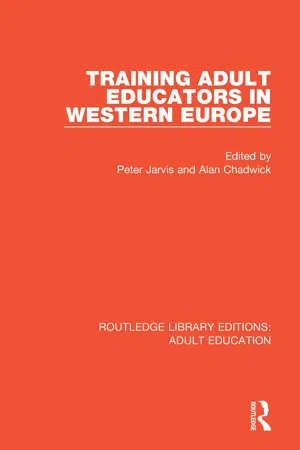
Originally published in 1991 this book is a comparative study of systems of preparing adult educators in the UK, Ireland, Belgium, Netherlands, France, Greece, Italy, Spain, Austria, Germany, Switzerland, Denmark, Finland, Norway, Sweden and Cyprus. The book argues for more formal preparation and training of adult educators with more Europe-wide specialist training and evaluation in teaching and management skills.
eBook - ePub
Training Adult Educators in Western Europe
- 252 pages
- English
- ePUB (mobile friendly)
- Available on iOS & Android
eBook - ePub
Training Adult Educators in Western Europe
About this book
Information
1 Towards a theoretical rationale
Most leadership training, like most adult education, is self-directed. An individual confronted with the responsibility of becoming an educator of adults learns partly by the process of participation and partly by his [sic] own examination of that process. He studies books or pamphlets or manuals, he talks with others in a similar situation, he goes to meetings, he asks for supervisory assistance, he visits other programs, or he analyzes his own performance in terms of a standard which he has developed himself or adopted from some other source. The quality of his learning depends in essence upon his capacity to teach himself.
(Houle 1960: 118)
It is perhaps significant that in the year before Houle’s (1961) seminal study on self-directed learning was published, he was already claiming that those who were entering adult education in America were expected to be self-directed since little provision for professional preparation was made for them, whether they were volunteers, part-time leaders or adult education specialists. Indeed, Liveright (1964:93) recognised that adult education was not a profession that most adult educators had not ‘participated in an organized program of graduate study … [and were] action rather than research oriented.’ But by 1985 the picture had most certainly changed:
Today, there is a profound need to train new and existing personnel in a manner congruent with the field…. the plea for properly trained personnel has become a full-fledge chorus in most parts of the world.
(Boshier 1985: 3)
Indeed, this is a picture that most adult educators will recognise as being fairly true to the late 1980s and indeed the American Commission of Professors of Adult Education has already discussed the standards that should be found in graduate programmes in adult education (see Brookfield 1988: 234-41), and yet this movement has not been without its opponents. It is not uncommon to hear adult educators expressing the desire to have training and yet not wanting to prevent volunteers and others wishing to teach their hobbies (the ‘apprentices’ — Graham et al. 1982) from embarking upon teaching adults, especially if they appear to have a natural aptitude for it. Indeed, the openness of adult education for enthusiasts to enter the field has always been an element of its ethos. Hence it is not surprising that some adult educators have counselled caution in this apparent movement towards professionalisation. (See Carlson 1972, 1977; Ohliger 1974). Others, such as Illich et al. (1977), have also viewed professionalisation as a phenomenon that is not to be encouraged.
However, the movement has occurred and the professional preparation of educators of adults is beginning to appear in many countries of the world and, naturally, this has led to a number of studies of the process, such as that by Graham et al. (1982) in the United Kingdom. However, there have been a very few comparative studies, such as that published by the European Bureau of Adult Education (1982) and that published by the International Council for Adult Education (Boshier 1985).
Hence, this study fits into this trend; its opening chapter has three main purposes. Initially, in a study such as this one it is necessary to set the adult education scene so that it is possible to understand this process of professionalisation against a broader backcloth. This is undertaken here through a sociological analysis of the development of a profession. One model of professionalisation is employed, although it is recognised that any single model over-simplifies the process, but as the aim of the chapter is not an exploration in the sociology of professions, but an analysis of the process of social change in adult education this is not regarded as a hindrance to comprehension (but see Jarvis 1985: 227-41). The second purpose is to relate this study to the increasing awareness of the field of international comparative adult education. Reference is made here both to some of the contemporary movements within it and some of the studies which have emerged in recent years. While this study is regarded as part of that trend, there is also another factor that makes it important; by 1992 Western Europe will have moved into an even closer political-economic community and there is a growing necessity for Europeans everywhere to understand their own cultural heritages so that there can be a process of mutual learning. In the third section there is a short review of some of the contemporary studies of the preparation of adult educators. Finally, there is a brief concluding discussion.
TOWARDS THE PROFESSIONALISATION OF EDUCATORS OF ADULTS
Houle (1960) made the point that the majority of adult educators in America were either volunteers or part-time with only a few being full-time and yet Wilensky (1970: 487) claimed that the first stage in professionalisation is ‘to start doing full time the thing that needs doing’. If this is the first stage of professionalisation, then it might be claimed that adult education has not begun to professionalise. However, other alternatives present themselves, such as the possibility that Wilensky’s model is not correct in the case of adult education, or even that adult education is unique among occupations because it might never have a majority of full-time members. Indeed, it will be shown that Wilensky’s model is too simple for such fields of practice as adult education and that it is necessary to expand his analysis in order to make it relevant to adult education.
Wilensky assumed that there is a direct correlation between an occupation and a profession but it is suggested here that such an assumption cannot be made in the case of adult education, because it is not a single occupation. This is also one of the weaknesses in Houle’s (1960) well-known paper on adult educators when he claimed that there were few specialist adult educators because he omitted from his considerations those people who spend the greater part of their professional lives educating adults but in professions other than education, such as nursing, medicine, etc., although he (1980) was later to write a major book on the professions and their continuing education. Educators of adults may be members of other occupations and professions, and act as educators within the framework of those other professions, or they may be volunteers or part-time tutors who teach on a part-time basis and who may, but need not, be members of other occupations or professions. The irony of the situation is such that those who are full-time adult educators, specialists according to Houle, may actually be administrators of the educational service rather than teachers within it. Hence the majority of those who teach may be part-time in this occupation, some may be members of other occupations and professions, while those who are full-time adult educators may not be teachers. Therefore, the simple correlation drawn by Wilensky between an occupation and a profession may over-simplify the reality of the situation and the growth in preparation of adult educators may represent a process in professionalisation which Wilensky did not consider — that of the professionalisation of a full-time and part-time field of practice simultaneously.
This raises another problem: that of. deciding precisely what is meant by adult education and similar terms and how these relate to fields of practice in different countries. Thus far the terms adult education and educators of adults have been used synonymously although they do convey different conceptions of the process: the former, for instance is often used in respect of adult liberal education whilst the latter has a much wider connotation. The use of the former term was one of the problems in this study which is referred to in the Preface, where the representatives of one country claimed not to have adult education in their country although popular education and professional education, etc., certainly exist there — i.e. education for adults! There can be no simple definition here because the authors of the different chapters employ concepts according to the practice of their own society so that the context must determine the precise meaning.
Wilensky’s discussion of the second stage in the process is extremely relevant to this study in particular and to adult education in general, since it refers to the desire of an occupation to start training and to establish a training school and then to seek to re-locate it in a university, if the school was not originally based in one. It will be seen in the following chapters that this is the situation which is occurring in adult education in Western Europe, with some professional preparation being in higher education, but much outside of it.
The significance of this stage in professionalisation is in constructing a systematic body of knowledge about the field of practice. While research often provides new understanding and quite specific knowledge about aspects of the field of practice, it does not provide a rationale for building up a body of knowledge about it. That occurs in professional preparation when all the knowledge that has been gathered through research and experience, both within and about the field of practice, is systematised into a curriculum which is taught to those about to enter the field, or who are already in it. Clearly this is a significant stage for this study since it is possible to see the body of knowledge about adult education growing and developing as the curricula for professional preparation are examined. Hence the reasons why American adult education has placed so much emphasis upon the standard of graduate programmes in adult education can be understood (see Jensen et al. 1964, Brookfield 1988 inter alia).
Additionally, there has always been some discussion in adult education as to whether preparation for adult teaching should occur before employment or as an in-service exercise. Caldwell (1981: 8) points out that in America: ‘A review of the literature reveals that beyond formal university degree programs in adult and continuing education, pre-service training programs are not common.’ Indeed, the study of adult education in America has tended to concentrate on graduate in-service programmes rather than undergraduate pre-service preparation, but this study will show how the process has differed in various countries in Western Europe.
Wilensky went on to highlight subsequent stages in the process of professionalisation, leading to the formation of a professional organisation. But it might be claimed that each society in Western Europe has its own adult education association, and that each has contributed to this book, so that it cannot be a final stage in the process. This is true, but the extent to which the adult education associations whose members have contributed to this book are actually professional associations, in the way that Wilensky implied, is a much more debatable point. The fact, however, remains that their existence demonstrates that Wilensky’s discussion of professionalisation is not totally relevant and that the process of change in the education of adults that is being studied here is much more complex than this model, or other models of professionalisation, tend to imply.
Consequently, it is pertinent to ask whether the process of change that is recorded here is actually one of professionalisation or merely one of change. That there is some change in the same direction in adult education in most countries tends to suggest that there is a deliberate movement towards certain ideals for adult education as an occupation in different countries, and these include occupational preparation and the consequent emergence of a body of knowledge. It is concluded, therefore, that this process of change is in accord with what is generally regarded as professionalisation, even though the occupation, or occupations, is much more complex than generally assumed. Even more significantly, it is suggested that because of the nature of adult education professionalisation is occurring among part-time practitioners as well as among full-time teachers of adults.
THE EMERGENCE OF COMPARATIVE ADULT EDUCATION
Sociological method is generally regarded as having a comparative basis and the validity of this claim may be seen from the fact that a sociological model was employed here to allow for discussion on the way that the education of adults is developing in an international context.
However, this study is a comparative one and so it is also necessary to place this discussion within that context. From its very earliest organisations adult education has had an international orientation. As early as 1929 there was a World Conference on Adult Education held at Cambridge, United Kingdom and even before that Albert Mansbridge had founded a World Association for Adult Education. These early conferences brought together people who were interested in adult education and it enabled them to see what each other was doing. It was not really until 1966, however, in Exeter, New Hampshire, USA that the comparative aspects of adult education were examined in any detail and here some twenty-five scholars met under the chairmanship of Arthur Adams, of University of New Hampshire, to discuss the comparative study of adult education (Liveright and Haygood 1968).
Since then there has been both the growth in international organisations, such as the European Bureau of Adult Education and the International Council for Adult Education, but these provide a forum for practitioners and administrators rather than a baseline for academic study of an international and comparative type. Recently, however, a number of international conferences have been organised that have endeavoured to provide the opportunity for comparative international adult education, similar to that provided in Exeter, New Hampshire, and a number of networks of scholars have come into being which are fostering the development of comparative international adult education. However, it is essential at this juncture to make the point that comparative studies need not be international, since comparatives are concerned with the rigorous analysis and comparison of educational policies and processes within countries as well as between them.
In addition a number of significant studies have appeared, such as Harris (1980), Charters et al. (1981), Titmus (1981), Charters and Hilton (1989) and Lichtner (1989) and there is considerable research in progress, including that of Knox (see Knox 1987 for an introduction to his work). In the first of the publications referred to here there was an attempt to map the field, whereas the following two were less ambitious in their approach, with Titmus restricting his study to Western Europe. Charters and Hilton, however, have endeavoured to undertake a comparative analysis by setting the format in which the case studies were provided and then analysing them comparatively. By way of contrast, Lichtner has published the papers of an important study seminar on comparative adult education held in 1988 in Frascati. One of the things that most of the authors have done is to use a case study approach from which they endeavoured to draw out significant similarities and differences. However, it must be recognised that this approach has limitations in as much as the authors of the case studies select and classify their data before they are analysed and compared.
The same approach is adopted here and although the framework for the selection was suggested by the editors, it has to be recognised that the chapter authors still made their own data selection which was increased because of the approach adopted by the European Bureau. In this instance the field of study is that of the professional preparation of adult educators in Western Europe. None of the above studies has sought to limit its concern to only one aspect of adulf education even though the Charters and Hilton approach limits the case studies to important programmes in adult education. Even a re...
Table of contents
- Cover
- Halftitle Page
- Title Page
- Copyright Page
- Original Title Page
- Original Copyright Page
- Dedication
- Table of Contents
- List of Tables
- The contributors
- Preface
- Acknowledgements
- 1 Towards a Theoretical Rationale
- Part I Benelux Countries
- Part II English-Speaking Countries
- Part III Franco-Mediterranean Countries
- Part IV German-Speaking Countries
- Part V Scandinavian Countries
- Part VI Conclusions
- Appendices
- Index
Trusted by 375,005 students
Access to over 1.5 million titles for a fair monthly price.
Study more efficiently using our study tools.
Frequently asked questions
Yes, you can cancel anytime from the Subscription tab in your account settings on the Perlego website. Your subscription will stay active until the end of your current billing period. Learn how to cancel your subscription
No, books cannot be downloaded as external files, such as PDFs, for use outside of Perlego. However, you can download books within the Perlego app for offline reading on mobile or tablet. Learn how to download books offline
Perlego offers two plans: Essential and Complete
- Essential is ideal for learners and professionals who enjoy exploring a wide range of subjects. Access the Essential Library with 800,000+ trusted titles and best-sellers across business, personal growth, and the humanities. Includes unlimited reading time and Standard Read Aloud voice.
- Complete: Perfect for advanced learners and researchers needing full, unrestricted access. Unlock 1.5M+ books across hundreds of subjects, including academic and specialized titles. The Complete Plan also includes advanced features like Premium Read Aloud and Research Assistant.
We are an online textbook subscription service, where you can get access to an entire online library for less than the price of a single book per month. With over 1.5 million books across 990+ topics, we’ve got you covered! Learn about our mission
Look out for the read-aloud symbol on your next book to see if you can listen to it. The read-aloud tool reads text aloud for you, highlighting the text as it is being read. You can pause it, speed it up and slow it down. Learn more about Read Aloud
Yes! You can use the Perlego app on both iOS and Android devices to read anytime, anywhere — even offline. Perfect for commutes or when you’re on the go.
Please note we cannot support devices running on iOS 13 and Android 7 or earlier. Learn more about using the app
Please note we cannot support devices running on iOS 13 and Android 7 or earlier. Learn more about using the app
Yes, you can access Training Adult Educators in Western Europe by Peter Jarvis, Alan Chadwick, Peter Jarvis,Alan Chadwick in PDF and/or ePUB format, as well as other popular books in Education & Adult Education. We have over 1.5 million books available in our catalogue for you to explore.