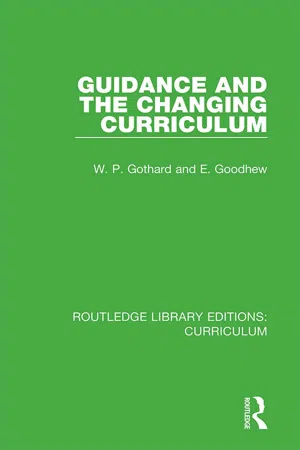
Originally published in 1987. This book examines the growth of pastoral care and the pastoral curriculum, and innovations in vocational education in schools. These two major developments are considered in relation to the guidance and counselling movement whose impact on education over the preceding twenty-five years was considerable. The concept of person-centred learning grew out of this movement and with it many of the liberalising changes in education. This is a fascinating look at this area from a time when the whole nature and direction of schooling in the UK was about to change.
- 172 pages
- English
- ePUB (mobile friendly)
- Available on iOS & Android
eBook - ePub
Guidance and the Changing Curriculum
About this book
Information
Chapter 1
SCHOOLS, GUIDANCE AND VOCATIONALISM
“We might take as our principal aim for secondary education the promotion of dignity. This was earlier defined as a sense of being worthy, of possessing creative, inventive and critical capacities, of having the power to achieve personal and social change”. Hargreaves, (1982).
The aims and concerns of schooling are many and varied. For instance, Silver (1983) identifies ten issues that have been at the forefront of education since 1944 and of these, one in particular demands special attention. Silver describes this issue as the “Social functions of education”, “which range through questions of the social and welfare aspects of education to the curative and socially useful functions of schools with regard to salient social problems. Debates about these issues raised questions of the relationships between educational institutions and the wider society and increasingly between schools and higher education on the one hand, and industry and employment (or unemployment) on the other hand”. It will be argued that this, more than any other issue, most accurately describes the crucial changes that are taking place in our schools.
Eggleston (1977) perceives schooling as a “large and complex pattern of interactions” which overlap and interlock with each other. These interactions form a system made up of the curriculum, examinations, teaching, control and administration. At the heart of this system are a set of values and power relations, which are linked to the wider values and power relations of the society and the economy, as a whole. Thus, according to Eggleston, “the curriculum is one of the key areas in which the values and power system of the school and society areas come together; a key mechanism of social control over the young and over those who teach them”. He goes on to define the curriculum as “the presentation of knowledge and learning experiences in the school”.
Any curriculum is arrived at by a process of selection which will involve in Eggleston’s words, five key factors.
(1) the definition of what shall be regarded as knowledge, understanding, values and skills,
(2) the evaluation of this knowledge – into areas of greater or lesser importance and status.
(3) the principles on which such knowledge shall be distributed; to whom and at what time various kinds of knowledge shall be made available and from whom it shall be withheld.
(4) the identity of the groups whose definitions prevail in these matters.
(5) the legitimacy of those groups to act in these ways.
Different purposes but the same direction?
If we look more closely at the nature of schooling, it is possible to discern two broad and apparently different activities. On the one hand, there is the traditional concern for teaching, based upon a formal curriculum that is taught to groups of pupils, and for most pupils, at 16 is assessed. On the other hand, there is a concern and caring for the individual pupil, based upon the pupil’s personal circumstances and especially focussing on problems and crises in their life. The latter activity has always been present within schools, but in recent years has become more organised, professionalised and diversified. It has emerged under various titles such as “pastoral care, guidance and counselling”, and certain job titles have become common like tutor, year head, house head, etc. As a result, schools have developed a parallel organisational structure (Best et al, 1980) based on the one hand upon academic departments or faculties and on the other on various pastoral systems such as year groups, houses etc. Whilst this change in structure symbolises the present apparently “schizophrenic” character of schooling, it is possible to see a convergence of activities within a growing “pastoral curriculum”, which in the words of the White Paper, “Better Schools”, DES 1985, is being “fostered systematically”, within schools.
Alongside this development, there have been much publicised developments in vocational education, particularly through the Technical and Vocational Education Initiative (TVEI) funded by the Manpower Services Commission (MSC). The intention behind such changes is quite clear-cut, and are stated in the White Paper “Better Schools” (DES 1985); “TVEI embodies the Government policy that education should better equip young people for working life”. Since the great debate in 1977, the concept of vocational relevance has taken on greater significance within curriculum priorities, so that “Better Schools” (DES 1985) makes the point that “all the elements of a broad 5-16 curriculum are vocational in the sense that they encourage qualities, attitudes, knowledge, understanding, comprehensions which are necessary for employment”. Bates et al (1984) however are under no illusions as to the present direction of schooling. They note “the rise of ‘work in the curriculum’ -leading to a fundamental reorientation of the school curriculum, especially as it affects the working class, from a liberal humanist and relatively autonomous perspective, to a much more technicist-applied and industry-linked perspective”.
Silver (1983) identifies this as a long running debate between the liberal and the vocation in twentieth century British Education. In the 1980s he sees “under the impact of economic recession, structural unemployment, international competition and an acute awareness of major unresolved economic and social problems, pressures for vocational interpretations become more vigorous”. The White Paper goes on to describe essential curriculum elements in the following terms “some awareness of economic matters, notably the operation of market forces, the factors governing the creation of private and public wealth, and tax, is a prerequisite for citizenship and employment, and health and sex education, taught within a moral framework, are a necessary preparation for responsible adulthood”. Encapsulated within this policy statement, there lies the two broad developments which form the basis of this book, the “new vocationalism” and the pastoral curriculum. Immediately underlying such developments, is an ideological debate that requires close examination. Bates et al (1984) state the position clearly in saying “currently we can see a clear battle over whether the school should produce an ‘ideal worker’ to help resolve the economic crises or a ‘critical and independent’ person who can develop their own capabilities to the full. As we shall see, this is often apparently resolved by the former pretending to be the latter”.
“Better Schools” (DES 1985) firmly makes the point that “the government’s principal aims for all sectors of education are first, to raise standards at all levels of ability and second, since education is an investment in the nation’s future, to receive the best possible return from resources which are found for it”. Quite clearly, a very functional “accounting” approach is being presented which is developed in greater detail in the White Paper as a whole. However, these two principal aims can be seen as directly linked to some of the major themes outlined in the Green Paper “Education in Schools” (DES 1977) that followed Callaghan’s much publicised Ruskin speech the previous year. Moore (1984) describes the Green Paper’s real theme as “teaching about the world of work and this is something much broader than teaching for it. It is a way of teaching about (and for) the social order, of promoting a particular vision of ‘our society’”. He goes on to state that “the essence of the paper’s vision is a society without inner conflicts and divisions. The aspects of social change denoted by phrases ‘technological change’, multiracial, multicultural, the disappearance of the old stereotypes of the sexes’ rather than with the frustrations, tensions and conflicts they actually entail”.
The attack on “progressivism“
The Green Paper of 1977 and the White Paper that followed eight years later, although emanating from two different governments, do chart a steady, clearly defined trend, described by Sarup (1982) as “the attack on progressivism, the enforcement of stricter discipline, the emphasis on work socialisation and the increasing concentration of power”. Progressivism has been a major movement within education that stems back to Dewey (1916) and focusses on the child centred approach. It maintains that education should concentrate on individual development with a minimum of imposition from above.
Hughes (1971) writes that “phrases associated with the child centred movement have now become familiar…. the whole child, creative self expression, teaching children not subjects, adjusting the school to the child, real-life experiences, teacher-pupil relationships, the needs of the learner, the importance of individual differences, personality development, intrinsic motivations, bridging the gap between school and the home….”.
The phrases contrast strongly with the principal aims of “Better Schools” and herald a “new realism” in official educational thinking. The White Paper does occasionally pay “lip service” to progressivism in statements like “pupils need more opportunity to learn for themselves, to express their own Views and to develop their ideas through discussion; teachers do too much for them”. However, the predominant theme is clear: “more rapid technological change in an increasingly competitive world places a premium on enterprise, personal versatility and rational criticism. These values are the goal, both of the government policy for education and of its policies for revitalizing the economy and for maintaining that freedom under the law which is the precondition of each individual’s fulfilment”.
Put in other terms, the White Paper is pointing to the fact that the structure of British capitalism is under threat by the twin forces of the new “technologies” and tough foreign competition. Clarke and Willis (1984) describe this predicament graphically when they write “There is no room for reluctant heroes in the sinking ship of HMS UK plc. In a word, this view wishes to subjugate young people more completely than ever before to the needs of industry and therefore to the needs of capital. Youth can only be helped by their own contribution towards making a more successful economy and along with it more jobs. The implications for careers teaching and for work on the curriculum are obvious. The needs of industry, their ‘sympathetic’ presentation and production of ‘model workers’ threaten to carry all before them”.
Although central, these pressing economic factors are not alone in determining the direction in which education is being propelled. There are a host of other social factors which have made an impact on schooling. To some extent these centre around social “problems” such as drug-taking, alcoholism, family breakdown, and promiscuity. Schools are required to respond to these issues and are put in the forefront of “dealing” with such problems, as well as being blamed by some politicians for allowing such problems to occur. At the same time, it is possible to discern an increasing radicalism amongst some teachers, particularly within London, which is expressed through ideologies such as feminism and anti-racism. Although they are a minority of the teaching profession, such teachers act as “ginger groups” for broader change.
Ideology and current issues
At this stage, it is useful to examine the role of ideology in relation to education. An ideology is a set or system of ideas that help individuals make sense of their relationship to the rest of society. As such, education is ultimately concerned with ideologies. Baron et al (1981) state that “ideas are properly called ideological when they can be shown to conceal or to resolve in an idealistic or imaginary way the problematic character of social life. In the process of presenting a particular social order as harmonious, natural or in need of rescue from subversion or decay, ideological accounts serve also to secure the position of dominant social groups”.
Smith (1973) suggests a typology of goals in ideologies in education which is helpful in understanding change within the education system. This typology outlines eight criteria which explain the way in which change does or does not take place, thus for example, it is possible to examine how far education develops or frustrates the individual’s talents and personality. There are three concepts that have never been far from the centre of educational discussion and debate. These have emerged as crucial in recent years and form an important part of Smith’s typology. Firstly, a number of factors have made the concept of equality crucial in post war educational circles. Education has been seen as a vehicle for equalising life chances and although this has come in for widely varying attacks from Right and Left, this is still a powerful concept. More recently the search for equality within education has been particularly directed to two especially disadvantaged groups, girls and blacks.
Secondly, the concept of relevance within the curriculum has been promoted in numerous educational reports. This is repeated in the White Paper “Better Schools” (1985) where it is described as one of four fundamental principles; the point is made that “all subjects should be taught in such a way as to make plain their link with the pupil’s own experience and to bring out their applications and continuing value in adult life”. It is possible to see curriculum relevance in two different senses. There is vocational education, as embodied in TVEI, which clearly designed to prepare young people for technical and commercial occupations. On the other hand, there is personal, social and careers education that is ) concerned with “life skills”, moral and sexual issues, political questions and a host of other matters to do with the “adult” world rather than solely employment.
The third concept is personal growth and development. The HMI survey, Aspects of Education in England (1979) mentions “the personal and social development of the pupil as one way of describing the central purpose of education”. However, the concept can be seen as so broad as to be of little value, and consequently requires some clarification. David (1983) offers a wide range of definitions from various sources. For example, it can be understood as growth towards maturity and responsible citizenship. There is a good deal of agreement that personal and social education is engaged in the areas of values, decision making and personal relationships. Typically, it goes “beyond the didactic to embrace problem solving situations, decision making exercises, group discussion, simulation and games”.
The Pastoral care system in a school has become the “vehicle” for delivering much of this, and the need for these systems has become accepted at all levels in education. However, how pastoral care operates in practice and in whose interests is open to debate. For instance, Sarup (1982) observes that “pastoral care in schools is based on a ‘personal knowledge’ of pupils and help is given to deal with their problems. But at some stage, other agencies are called in. What may appear as a compassionate concern for the individual child is really an attempt to socialize the ‘deviant’. Pastoral care thus becomes an inculcation of the ‘expressive order’ with the increasing intervention of the State, there is a growth in the ideology of pastoral care, involving teachers, social workers, police and doctors in this problem, the problem of youth ‘discipline’ and ‘order’”. The growth of pastoral care and the increasing emphasis on personal growth and development in schools is closely linked to the guidance and counselling movement, (Hughes 1985) and it is importance to consider the impact of this movement upon secondary education as a whole.
The Guidance and Counselling Movement
Hughes (1971) describes guidance as being “identified by a tradition of help and service to individual children, involving not only care for rights but also for needs”. He sees the slow struggle for social justice and a changing economy as two major factors contributing to the growth of guidance within schools. Freedom and self determination are the recurring themes in guidance literature which firmly weds the concept to the Western (especially the American) democratic tradition (Bolger 1982). Beck (1971) in a wide survey of American guidance literature describes the most common traits “deemed desirable in a democracy” as productive, healthy, self-governing co-operative, socially efficient, ethically sensitive. At first sign, those traits arouse little discussion but on further examination, it is essential to ask such questions as who defines socially efficient, what is productive and what is not, and finally co-operative to what ends? Such terms only have meaning within a social context; a context that can be either fundamentally conflict-ridden or basically unified and stable depending on the particular perspective that is applied.
Guidance, whilst being concerned with helping, caring and self determination, can also be concerned with “cooling out” those who are unsuccessful in the exam system or who do not get employment. It can be a system as much concerned with the frustration of the individual as with individual growth. Much of the earlier optimism underlying the concept of guidance seems misplaced and perhaps naive in a society increasingly wracked by unemployment, discrimination, erosion of public services, public disorder, and other social forces. However, the underlying principles applying to the guidance and counselling movement still represent a positive and hopeful element for far reaching change within schools.
Shertzer and Stone (1981) identify six basic principles of guidance.
(1) Guidance is concerned primarily and systematically with the personal development of the individual.
(2) The primary mode by which guidance is conducted lies in individual behavioural processes.
(3) Guidance is oriented towards co-operation, not compulsion.
(4) Humans have the capacity for self development.
(5) Guidance is based upon recognis...
Table of contents
- Cover
- Half Title
- Title Page
- Copyright Page
- Original Title Page
- Original Copyright Page
- Contents
- INTRODUCTION
- CHAPTER 1 SCHOOLS, GUIDANCE AND VOCATIONALISM
- CHAPTER 2 THE DEVELOPMENT OF THE PASTORAL CURRICULUM AND THE NEW ROLE OF THE TUTOR
- CHAPTER 3 VOCATIONAL EDUCATION AND LIFE AFTER SCHOOL
- CHAPTER 4 CAREERS EDUCATION UNDER PRESSURE
- CHAPTER 5 POLITICAL EDUCATION – TOO HOT TO HANDLE?
- CHAPTER 6 MANAGING CHANGE: TWO CASE STUDIES
- CHAPTER 7 A NEW CURRICULUM?
- APPENDICES
- REFERENCES AND FURTHER READING
- INDEX
Trusted by 375,005 students
Access to over 1.5 million titles for a fair monthly price.
Study more efficiently using our study tools.
Frequently asked questions
Yes, you can cancel anytime from the Subscription tab in your account settings on the Perlego website. Your subscription will stay active until the end of your current billing period. Learn how to cancel your subscription
No, books cannot be downloaded as external files, such as PDFs, for use outside of Perlego. However, you can download books within the Perlego app for offline reading on mobile or tablet. Learn how to download books offline
Perlego offers two plans: Essential and Complete
- Essential is ideal for learners and professionals who enjoy exploring a wide range of subjects. Access the Essential Library with 800,000+ trusted titles and best-sellers across business, personal growth, and the humanities. Includes unlimited reading time and Standard Read Aloud voice.
- Complete: Perfect for advanced learners and researchers needing full, unrestricted access. Unlock 1.5M+ books across hundreds of subjects, including academic and specialized titles. The Complete Plan also includes advanced features like Premium Read Aloud and Research Assistant.
We are an online textbook subscription service, where you can get access to an entire online library for less than the price of a single book per month. With over 1.5 million books across 990+ topics, we’ve got you covered! Learn about our mission
Look out for the read-aloud symbol on your next book to see if you can listen to it. The read-aloud tool reads text aloud for you, highlighting the text as it is being read. You can pause it, speed it up and slow it down. Learn more about Read Aloud
Yes! You can use the Perlego app on both iOS and Android devices to read anytime, anywhere — even offline. Perfect for commutes or when you’re on the go.
Please note we cannot support devices running on iOS 13 and Android 7 or earlier. Learn more about using the app
Please note we cannot support devices running on iOS 13 and Android 7 or earlier. Learn more about using the app
Yes, you can access Guidance and the Changing Curriculum by W. P. Gothard,E. Goodhew in PDF and/or ePUB format, as well as other popular books in Education & Education General. We have over 1.5 million books available in our catalogue for you to explore.