eBook - ePub
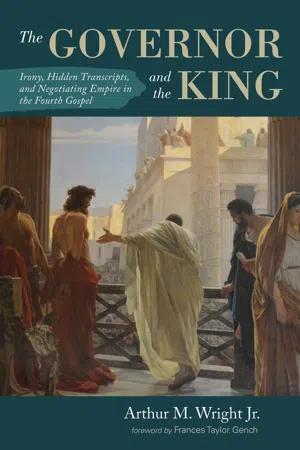
The Governor and the King
Irony, Hidden Transcripts, and Negotiating Empire in the Fourth Gospel
- 264 pages
- English
- ePUB (mobile friendly)
- Available on iOS & Android
eBook - ePub
The Governor and the King
Irony, Hidden Transcripts, and Negotiating Empire in the Fourth Gospel
About this book
The Fourth Gospel is a political document. Although it has often been interpreted primarily as a "spiritual gospel," it has much to offer readers engaged in the difficult task of negotiating life lived under the dominion of empire, whether in the first or twenty-first century. This book gives careful attention to the political dimensions of the Gospel's Passion Narrative, including the arrest scene (18:1-12), the Roman show trial (18:28--19:16), and the crucifixion and burial of Jesus (19:16-40). It employs James C. Scott's model of hidden transcripts and examines the Fourth Gospel's use of irony as it seeks to understand the political dimensions of the Fourth Gospel and its relationship to the Roman Empire.
In this book, Wright argues that the Passion Narrative displays part of a Johannine hidden transcript that resists, contests, and at times mimics elements of Roman imperial power. The Gospel mocks the representatives of Rome, including Pilate, the Roman soldiers, and the Jewish authorities, eroding confidence in the empire and its agents. It also subverts Roman imperial claims of dominance, authority, and power. As such, the Fourth Gospel fosters an alternative worldview and community, one centered on faith in the sovereignty of Jesus and Israel's God.
Information
Topic
Theology & ReligionSubtopic
Biblical CommentaryChapter 1
Introduction
When the Roman governor Pontius Pilate appears on the scene in the Fourth Gospel, his presence dominates the action until Jesus is crucified. Whereas Jesus has been the primary focal point of the narrative to this point, Pilate suddenly steals the spotlight and becomes the central focus of the action. As Jesus arrives at the praetorium in John 18:28, the narrative ceases to follow him and begins to track Pilate’s movement instead as the Roman governor moves back and forth between the Jewish authorities outside and Jesus, the condemned man, within. Not only is Pilate the dominant figure at this point in the Gospel, but the Roman interrogation of Jesus that he conducts in John is lengthier and more involved than in the Synoptics.1 The Gospel rushes rapidly through Jesus’ appearance before the Jewish authorities, arriving quickly at Jesus’ extended Roman “trial” before Pilate.2 The emphasis on Jesus’ appearance before Pilate is so strong in the Fourth Gospel that it forms the centerpiece of John’s passion narrative.
Even the arrest of Jesus earlier in the narrative is steeped in a visible Roman presence that the Synoptic Gospels lack. Whereas the Synoptics describe how armed representatives of the Jewish authorities come to arrest Jesus in the garden, only John includes an entire cohort of Roman soldiers (as many as six hundred strong) in the group that takes Jesus into custody.3 John also includes a specifically political motivation for arresting Jesus in the first place. While meeting together to discuss how to deal with Jesus, the chief priests and Pharisees declare, “If we let him go on like this, everyone will believe in him, and the Romans will come and destroy both our holy place and our nation” (John 11:48).4
All of these references demonstrate that the arrest and “trial” scenes in the Fourth Gospel are flooded with Roman imperial presence and political concerns and should prove fruitful for an exploration of the relationship between John and the Roman Empire. Although the Fourth Gospel in particular has not often been considered a political document, the heightened Roman element in the arrest and “trial” scenes vis-à-vis the Synoptic Gospels, along with the political justification for Jesus’ arrest, are among the reasons that Stephen D. Moore declares John the “most political of the gospels.”5 This project explores the political nature of the Fourth Gospel and its relation to the Roman Empire by examining the arrest, “trial,” and crucifixion scenes. I argue that the Gospel exhibits what James C. Scott calls a “hidden transcript” of resistance that subverts some elements of Roman imperialism. Notably, the irony present in the scenes critiques elements of imperial power and authority while appealing to readers to share the Johannine worldview. Above all, these sections of the Fourth Gospel espouse a vision of the lordship of Jesus Christ over and against the lordship of the Roman Emperor. At the same time, these scenes also mimic elements of Roman imperial power by asserting Jesus’ kingship, power, and worldwide empire.6
The Fourth Gospel and the Roman Empire in Scholarship
1. The “Spiritual Gospel” and the Johannine Community
What is the relationship between the Fourth Gospel and the Roman Empire? Lukan scholars have long discussed and debated the question of the Third Gospel’s relation to the empire, but until recently, Johannine scholarship has paid relatively little attention to this question.7 Even though the Fourth Gospel’s narrative tells the story of a Galilean peasant who is ultimately crucified by a Roman governor, for much of the history of its interpretation, studies have neglected to attend to this narrative’s political dimensions. Instead, scholars have approached and understood this Gospel in three major ways: as the “spiritual gospel”; as a document that was written at a particularly difficult juncture in the Johannine community’s relationship with the Jewish synagogue community; and strictly as a narrative in which the story itself and the way it impacts the reader is of utmost significance.
From an early point in the Gospel’s reception history, leaders of the church referred to it as the “spiritual gospel.” Clement of Alexandria, for example, suggested that John, the latest of the four gospel writers, wrote in direct contrast to the Synoptic Gospels, which had already presented the “external facts” of Jesus’ life.8 Reading the Gospel today, it is not difficult to understand why so many have read and interpreted the Fourth Gospel as a “spiritual gospel.”
The Johannine text presents Jesus’ origins, not through birth stories, but with a soaring, cosmic vision of the preexistent Word. Throughout, it depicts Jesus as the one who is sent from God, who does the works of God, and who reveals God’s own self.9 The Fourth Gospel goes further than the Synoptic Gospels in equating Jesus with God, even while maintaining a distinction between the two.10 The Johannine Jesus does not tend to get involved in relatively mundane matters: he performs only a few miracles and tells no parables. Instead, Jesus speaks in long, sweeping discourses that are primarily about his own identity. The narrative also places heavy emphasis on the Spirit: people must be “born of the Spirit” (John 3:6); worship should be conducted in “spirit and in truth” (4:24); the Spirit “gives life” (6:63); and in his Farewell Discourse, Jesus talks at length about the Holy Spirit (the Paraclete). Thus, it is argued that the Fourth Gospel has much to say about theology and the spiritual significance of Jesus, but little to contribute to discussions of a social or political nature. It has often been viewed primarily as a resource for individual spiritual reflection and for catalyzing personal belief in Jesus.
For similar reasons, many scholars have concluded that the Gospel of John contributes little to a discussion of history. If it has been regarded as the “most spiritual gospel,” it has also been regarded as the least historical of the Gospels, with very little of its material deriving from the historical life of Jesus. Because John differs so radically from the Synoptic Gospels, especially in its presentation of Jesus, many scholars have assumed that it primarily exhibits the influence of various streams of religious thought on the Johannine evangelist and does not contain reliable historical data. Attempts have been made to identify these influences, whether Greek, gnostic, or Jewish, and then to demonstrate...
Table of contents
- Title Page
- Foreword
- Acknowledgments
- List of Abbreviations
- Chapter 1: Introduction
- Chapter 2: The Gospel of John and the Roman Imperial World
- Chapter 3: The Arrest Scene
- Chapter 4: The Roman Show Trial
- Chapter 5: Jesus’ Crucifixion and Burial
- Chapter 6: Conclusion
- Bibliography
Trusted by 375,005 students
Access to over 1.5 million titles for a fair monthly price.
Study more efficiently using our study tools.
Frequently asked questions
Yes, you can cancel anytime from the Subscription tab in your account settings on the Perlego website. Your subscription will stay active until the end of your current billing period. Learn how to cancel your subscription
No, books cannot be downloaded as external files, such as PDFs, for use outside of Perlego. However, you can download books within the Perlego app for offline reading on mobile or tablet. Learn how to download books offline
Perlego offers two plans: Essential and Complete
- Essential is ideal for learners and professionals who enjoy exploring a wide range of subjects. Access the Essential Library with 800,000+ trusted titles and best-sellers across business, personal growth, and the humanities. Includes unlimited reading time and Standard Read Aloud voice.
- Complete: Perfect for advanced learners and researchers needing full, unrestricted access. Unlock 1.5M+ books across hundreds of subjects, including academic and specialized titles. The Complete Plan also includes advanced features like Premium Read Aloud and Research Assistant.
We are an online textbook subscription service, where you can get access to an entire online library for less than the price of a single book per month. With over 1.5 million books across 990+ topics, we’ve got you covered! Learn about our mission
Look out for the read-aloud symbol on your next book to see if you can listen to it. The read-aloud tool reads text aloud for you, highlighting the text as it is being read. You can pause it, speed it up and slow it down. Learn more about Read Aloud
Yes! You can use the Perlego app on both iOS and Android devices to read anytime, anywhere — even offline. Perfect for commutes or when you’re on the go.
Please note we cannot support devices running on iOS 13 and Android 7 or earlier. Learn more about using the app
Please note we cannot support devices running on iOS 13 and Android 7 or earlier. Learn more about using the app
Yes, you can access The Governor and the King by Arthur M. Wright,Arthur M. Wright Jr. in PDF and/or ePUB format, as well as other popular books in Theology & Religion & Biblical Commentary. We have over 1.5 million books available in our catalogue for you to explore.