- 184 pages
- English
- ePUB (mobile friendly)
- Available on iOS & Android
eBook - ePub
About this book
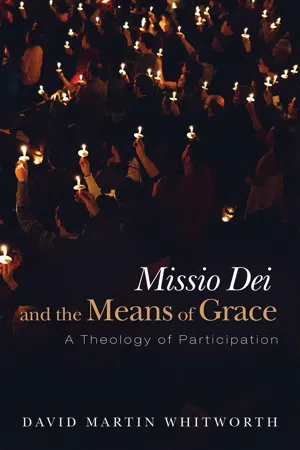
The missio Dei concept has shifted missiological thinking from an anthropocentric view of mission to the understanding that the church and persons are participants in the missio Dei.
A Wesleyan perspective of grace and the means of grace inform the development of a theology of participation in the missio Dei that overcomes the repetitive articulations of mission as simply being human action or divine action. Through the means of grace, Christian disciples participate in the missio Dei as those transformed by God's love and those through whom that love embraces and transforms the world.
Missio Dei and the Means of Grace: A Theology of Participation offers a profoundly simple approach and understanding to twenty-first-century missiology that is applicable for all persons, all ages, and all ecclesial expressions of the Christian church, as participation in the missio Dei through the means of grace is understood to be a holistic way of life where spiritual formation is understood as inseparable from justice ministries.
Information
Subtopic
Ministère chrétienSECTION 1
The Missio Dei and Participation
Chapter 1.
Derivation and Development of the Missio Dei Concept
The Missio Dei Terminology
Following the Willingen Conference in 1952 and two decades of widespread usage of the term missio Dei, Dr. H. H. Rosin of the Department of Missiology at Interuniversity Institute undertook the task of writing ‘MISSIO DEI’: an examination of the origin, contents and functions of the term in protestant missiological discussion. The term ‘missio Dei’ which was introduced by Hartenstein in his ‘Theologische Besinnung’ about the international missionary conference in Willingen (1952), was coined by him, and intended to place mission within the widest possible framework of the ‘Heilsgeschichte’ (salvation history) and God’s plan of salvation.1 The Evangelical Dictionary of World Missions states that the term missio Dei is ‘Latin for “the sending of God,” in the sense of “being sent,” a phrase used in Protestant missiological discussion especially since the 1950s, often in the English form “the mission of God.”’2 It is an expression that is widely used in many missiological and ecumenical circles and is not limited to Protestant scholarship exclusively. Rosin, after identifying where the term missio Dei most and least often occurs in various languages and texts states, ‘This does not however in any way imply that where the term is lacking, the intended concept must also be absent.’3 Prior to Hartenstein’s coinage and the usage of the term missio Dei, the concept is argued to be evident in scripture and Augustinian theology. Rosin concludes his examination of the term with this statement,
For this after all indicates an action, which does not point indiscriminately to all kinds of happenings in the world, but only to one incomprehensible event, namely that God, the creator of all things, submerged himself in his own world as a stranger, as a displaced person, an outcast, in solidarity with other outcasts and strangers, who in this world pursues a very special, hidden road in order to liberate it.4
Since Rosin’s assertion, much effort and attention has been given by scholars to elucidate the ‘incomprehensible event,’ largely in Trinitarian theology and the field of missiology. D. Bosch, C. Wright, N. T. Wright, R. Bauckham, and J. Verkuyl, to name a few, support Rosin’s findings that the focus and impetus of the concept is the activity of God. In the wake of Barth’s challenge early in the twentieth century that theologians and the church alike have been wrongly identifying mission from an anthropocentric vantage, it is natural that almost exclusive attention and research has myopically been centered on the activity of God.
The concept of missio Dei is, undeniably, comprehensive when understood in the light of a God, who, being the creative force that brought all that we know and understand into existence, purposefully participates in and with that creation to fulfil a purpose. Though it is arguable that the inner nature of God is, ultimately, beyond complete human comprehension, God’s purpose is comprehensible and made known through God’s particular and universal activity in the world. Arguably, Rahner is recognized as the foremost scholar in articulating the immanent and economic nature and activity of the triune God. More recently, Flett has re-emphasized the inseparability of the immanent and economic God, using the language of ‘being’ and ‘activity.’
Rosin’s overall contribution was the affirming recognition that the term itself, for missiology, denotes a new starting point for discussion that, arguably, had long been overlooked—God. Simple yet powerful is the newly accepted launching point for all missiological discussion. The starting point for talking about mission, the mission of God, or the missio Dei does not begin with the ecclesia or the missio humanitatis as Thangaraj later argued.5 The missio Dei does not begin with the church, a person, or a context. The missio Dei begins with the triune God. The missio Dei is made manifest through the activity of the triune God in which the church and persons participate. For centuries, Catholic and Protestant practice in ‘missional activities’ was supported by the theory that mission is simply an activity of the church moving into the world and was not understood or articulated as first being an activity of God. The twentieth century witnessed a shift in missiological theory from mission belonging to the church to being an activity of the triune God that is intended for all and invites all to participate.
Developing the Missio Dei
Bosch was a significant contributor to missiology during the twentieth century for his work in paradigmatic thinking and understanding in the history of mission. He writes, ‘After the First World War missiologists began to take note of recent developments in biblical and systematic theology. In a paper read at the Brandenburg Missionary Conference in 1932, Karl Barth ([1932] 1957) became one of the first theologians to articulate mission as an activity of God himself.’6 Barth is widely recognized for giving birth to the missio Dei concept, and he was the first in the twentieth century to speak of mission as the activity of God. Barth’s emphasis was, firstly, a focus upon what God was doing and, secondly, through the activity of God, what the church was doing. Speaking of the missio, Barth states,
Must not even the most faithful missionary, the most convinced friend of missions, have reason to reflect that the term missio was in the ancient Church an expression of the Trinity—namely the expression of the divine sending forth of self, the sending of the Son and the Holy Spirit to the world? Can we indeed claim that we can do it any other way?7
Barth’s reference to the ancient church and the illumination of the Divine sending the Divine is identified in the post-biblical writings of Augustine who also articulated mission as an activity of the triune God. Consider Augustine’s understanding of a key element in the missio Dei:
Behold the purpose for which the Son of God has been sent, or rather behold what it means for the Son of God to be sent. Whatever things have been done in time for the sake of producing the faith, whereby we are cleansed for the contemplation of the truth, in things that had a beginning, have been brought forth from eternity and are referred back to eternity, and have been either testimonies of this mission or are the mission itself of the Son of God.8
Poitras notes, ‘The potential relevance of Augustine’s theology for mission today becomes evident when we notice how a descendant of his concept of the missio Dei has become commonplace in recent mission thought.’9
Vicedom, influenced by Barth, Hartenstein, and the Willingen Conference, became a key voice and proponent of the missio Dei concept. Vicedom contributes to the concept of missio (being sent) as he identifies God’s unique and divine power to be both sender and sendee. ‘If we want to do justice to the biblical conception, the missio Dei must be understood also as an attributive genitive. God becomes not only the sender but simultaneously the One who is sent.’10
It is argued by Glasser and C. Wright, to name only two, that ‘sent’ language within the context of the Trinity is not a concept that began in the twentieth...
Table of contents
- Title Page
- Abstract
- Introduction to Missio Dei and the Means of Grace
- Section 1: The Missio Dei and Participation
- Section 2: Wesleyan Theology of Grace and Participation
- Section 3: Missio Dei and the Means of Grace
- Bibliography
Trusted by 375,005 students
Access to over 1.5 million titles for a fair monthly price.
Study more efficiently using our study tools.
Frequently asked questions
Yes, you can cancel anytime from the Subscription tab in your account settings on the Perlego website. Your subscription will stay active until the end of your current billing period. Learn how to cancel your subscription
No, books cannot be downloaded as external files, such as PDFs, for use outside of Perlego. However, you can download books within the Perlego app for offline reading on mobile or tablet. Learn how to download books offline
Perlego offers two plans: Essential and Complete
- Essential is ideal for learners and professionals who enjoy exploring a wide range of subjects. Access the Essential Library with 800,000+ trusted titles and best-sellers across business, personal growth, and the humanities. Includes unlimited reading time and Standard Read Aloud voice.
- Complete: Perfect for advanced learners and researchers needing full, unrestricted access. Unlock 1.5M+ books across hundreds of subjects, including academic and specialized titles. The Complete Plan also includes advanced features like Premium Read Aloud and Research Assistant.
We are an online textbook subscription service, where you can get access to an entire online library for less than the price of a single book per month. With over 1.5 million books across 990+ topics, we’ve got you covered! Learn about our mission
Look out for the read-aloud symbol on your next book to see if you can listen to it. The read-aloud tool reads text aloud for you, highlighting the text as it is being read. You can pause it, speed it up and slow it down. Learn more about Read Aloud
Yes! You can use the Perlego app on both iOS and Android devices to read anytime, anywhere — even offline. Perfect for commutes or when you’re on the go.
Please note we cannot support devices running on iOS 13 and Android 7 or earlier. Learn more about using the app
Please note we cannot support devices running on iOS 13 and Android 7 or earlier. Learn more about using the app
Yes, you can access Missio Dei and the Means of Grace by David Martin Whitworth in PDF and/or ePUB format, as well as other popular books in Théologie et religion & Ministère chrétien. We have over 1.5 million books available in our catalogue for you to explore.