eBook - ePub
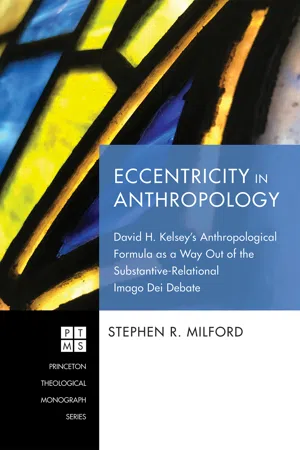
Eccentricity in Anthropology
David H. Kelsey’s Anthropological Formula as a Way Out of the Substantive-Relational Imago Dei Debate
- 254 pages
- English
- ePUB (mobile friendly)
- Available on iOS & Android
eBook - ePub
Eccentricity in Anthropology
David H. Kelsey’s Anthropological Formula as a Way Out of the Substantive-Relational Imago Dei Debate
About this book
Eccentricity in Anthropology brings into conversation a constructive, critical interpretation of David Kelsey's Eccentric Existence with a central--yet often overlooked--debate in theological anthropology: the substantive-relational imago Dei. Milford's work explores new insights into human identity and dignity. In particular he demonstrates the value of an alternate constructive of humanity in the image of God. This construction utilizes an interpretation of Kelsey's anthropological formula so as to describe human identity as part of the created order in terms of its myriad features, which are externally rooted.
Eccentricity in Anthropology demonstrates that an alternate approach to this debate is possible, and that one can combine important aspects of both substantive and relational thinking. As such, Milford's work is an important contribution to studies in the doctrine of the imago Dei. Taking Eccentric Existence's invitation to act as a springboard for further debate seriously, it presents one possible fruitful use of Kelsey's work to address theological anthropological questions. In a very real sense, this book is both a discussion in systematic theology and at the same time a work in contemporary historical theology.
Information
Topic
Theology & ReligionSubtopic
Christian Theology1
A Genuine Choice?
Throughout Christian theology’s long history, the answer to the question ‘What is the human being?’ has often been given, consciously or unconsciously, within the context of the doctrine of the imago Dei. This phrase has been used as a categorical marker, that is to say, as “some essential structural feature of human beings that constitutes them as distinctively human and distinguishes them from animals who do not exhibit God’s image” (895).14 The term has been taken to speak to the very essence of humanity:15 the humanum16 or vere Homo.17 Ray Anderson goes so far as to say that the bestowal of the image of God bestows humanity itself.18 As such, the doctrine’s importance cannot be overemphasized. To many, the position taken on the imago Dei has ramifications for every other area of Christian belief19 and for the very meaning and value of humanity itself. In the words of Pope John Paul II:
Man20 has meaning in this world only as the image and likeness of God. Otherwise, he has no meaning and we might be led to say, as some people have done, that man is nothing but ‘useless suffering.’21
It is no surprise, then, that the doctrine of the image of God has been widely debated with numerous proposals put forward regarding the exact meaning of the term ‘imago Dei.’ Suggestions range from humanity’s rationality to free will,22 from the physical body23 to human dominion over creation.24 The sheer volume of work makes it almost impossible to produce even a summary of these varying proposals.25 In fact, there is no agreement as to how many unique proposals exist and their individual historical and contextual developments.26
The reader will be relieved to learn that this chapter makes no attempt to produce this elusive definitive summary. As David Cairns laments, such a summary would “be in danger of confusing the reader, who would find the account disjointed.”27 Yet it is the task of the theologian to make sense of this doctrine, for to fail to do so would be to fail, as Pope John Paul II has suggested, to find meaning and purpose for the human condition. Such a failure, in the words of J. Edward Barrett, would be “an act of theological irresponsibility.”28
With this in mind, this chapter concerns itself with what are widely considered to be the two broad categories into which most (if not all) theological positions regarding this doctrine fall: the substantive and relational.29 These two categories are often presented as two mutually exclusive choices30 in answer to the questions surrounding the imago Dei. The question this chapter considers is whether or not the substantive-relational debate does indeed present us with two viable yet conflicting alternatives to the anthropological ‘What?’ question, or if in fact this debate presents a counterfeit choice between two positions which, while being approached from different “mindsets,”31 represent similar answers in different theological garb.
The Substantive Scheme
The substantive view, held by the majority of historical thinkers (895–97),32 is perhaps the best known.33 Hall argues that it is impossible to think of the imago Dei without referring to this view, if only subconsciously.34 It remains deeply entrenched in protestant evangelical theology and is still very much current.35 The central tenet of this view is that the image of God is found within the very essence of anthropos. The very substance36 of the species known as Homo sapiens contains, in some form or another, the image of God. Thus, Homo sapiens possess certain “characteristics,” “qualities,” “capacities,” “original excellences” or “endowments.”37 Since these attributes resemble corresponding qualities that one considers to be found in the Godhead, “their possession makes humans like God.”38
The most widely held account puts forward human rationality as the cardinal characteristic. According to Stanley Grenz, the origin of this understanding may be found not in the biblical texts themselves but in the context of early Christianity. The early church fathers grappled with the Greek philosophical tradition and, following an Aristotelian structure of defining objects per genius proximum et differentiam, defined human beings as “the rational animal.”39 Human reason was considered the divine spark, which was later extended to include human will and volition (considered by many as two aspects of the single rationality with which God endowed human beings).40 Grenz notes that this approach was so widely accepted in early church history that church fathers (both in the East and ...
Table of contents
- Title Page
- Acknowledgments
- Introduction
- Chapter 1: A Genuine Choice?
- Chapter 2: Kelsey’s Postliberal Heritage
- Chapter 3: Buoys for Eccentric Existence
- Chapter 4: An Anthropological Formula
- Chapter 5: Basic and Quotidian Identity
- Chapter 6: Personal Identity
- Chapter 7: Unsubstitutable Identity
- Chapter 8: Human Actuality
- Chapter 9: Living Human Body
- Conclusion
- Bibliography
Trusted by 375,005 students
Access to over 1.5 million titles for a fair monthly price.
Study more efficiently using our study tools.
Frequently asked questions
Yes, you can cancel anytime from the Subscription tab in your account settings on the Perlego website. Your subscription will stay active until the end of your current billing period. Learn how to cancel your subscription
No, books cannot be downloaded as external files, such as PDFs, for use outside of Perlego. However, you can download books within the Perlego app for offline reading on mobile or tablet. Learn how to download books offline
Perlego offers two plans: Essential and Complete
- Essential is ideal for learners and professionals who enjoy exploring a wide range of subjects. Access the Essential Library with 800,000+ trusted titles and best-sellers across business, personal growth, and the humanities. Includes unlimited reading time and Standard Read Aloud voice.
- Complete: Perfect for advanced learners and researchers needing full, unrestricted access. Unlock 1.5M+ books across hundreds of subjects, including academic and specialized titles. The Complete Plan also includes advanced features like Premium Read Aloud and Research Assistant.
We are an online textbook subscription service, where you can get access to an entire online library for less than the price of a single book per month. With over 1.5 million books across 990+ topics, we’ve got you covered! Learn about our mission
Look out for the read-aloud symbol on your next book to see if you can listen to it. The read-aloud tool reads text aloud for you, highlighting the text as it is being read. You can pause it, speed it up and slow it down. Learn more about Read Aloud
Yes! You can use the Perlego app on both iOS and Android devices to read anytime, anywhere — even offline. Perfect for commutes or when you’re on the go.
Please note we cannot support devices running on iOS 13 and Android 7 or earlier. Learn more about using the app
Please note we cannot support devices running on iOS 13 and Android 7 or earlier. Learn more about using the app
Yes, you can access Eccentricity in Anthropology by Stephen R. Milford in PDF and/or ePUB format, as well as other popular books in Theology & Religion & Christian Theology. We have over 1.5 million books available in our catalogue for you to explore.