eBook - ePub
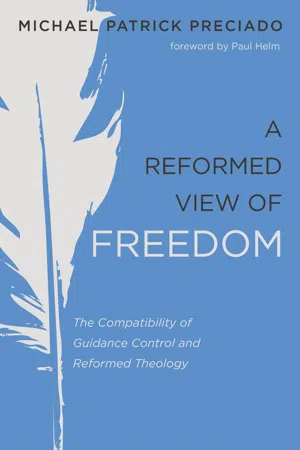
A Reformed View of Freedom
The Compatibility of Guidance Control and Reformed Theology
- 316 pages
- English
- ePUB (mobile friendly)
- Available on iOS & Android
eBook - ePub
A Reformed View of Freedom
The Compatibility of Guidance Control and Reformed Theology
About this book
Reformed Christians do not believe in free will. This is a common assertion today and it is completely false. The Reformed tradition does advocate free will, just not libertarian free will. A Reformed View of Freedom: The Compatibility of Guidance Control and Reformed Theology explains how the Reformed tradition articulated its view of human freedom and moral responsibility in terms of rational spontaneity. It shows how the Reformed view of rational spontaneity is compatible with contemporary compatibilist and semi-compatibilist views, especially that of guidance control.
This work addresses a number of pressing issues in the current academic climate. Is Reformed theology theological determinism? Is it compatibilism? Did Jonathan Edwards part ways with the Reformed tradition? What is the relationship between Reformed theology and contemporary compatibilist and semi-compatibilist positions in analytic philosophy?
This book addresses these questions by exegeting the classic Reformed confessions, catechisms, and Reformed scholastics. It sets them in relation to contemporary analytic philosophy. It is an exercise in analytic theology. The reader will come away with a better understanding of how the Reformed viewed free will and moral responsibility in light of contemporary analytic philosophy.
Information
Topic
Theology & ReligionSubtopic
Christian TheologyChapter One
Frankfurt Examples and Moderate Reasons-Responsiveness
Introduction
This chapter will explore Fischer and Ravizza’s account of moral responsibility. They believe that the essence of moral responsibility is guidance control. An agent is morally responsible for his actions if he possesses guidance control when he commits them. Guidance control consists of two main parts. The first part is moderate reasons-responsiveness. The second part is mechanism ownership. Both of these are necessary for guidance control. In this chapter, I will discuss moderate reasons-responsiveness. In this chapter we will see that Fischer and Ravizza deny the sourcehood condition, deny the alternative possibilities condition and affirm a type of reasons-responsive theory. In the next chapter, I will discuss mechanism ownership. There we will see that Fischer and Ravizza affirm a subjectivist condition.
This chapter has five main parts. The first part will discuss the concept of control. This is important because moral responsibility relates directly to whether or not an agent has appropriate control over his actions. The second part will discuss reasons-responsiveness in general. Here we will see two accounts of reasons-responsiveness that are ultimately rejected: strong reasons-responsiveness (SRR) and weak reasons-responsiveness (WRR). In this section, Fischer and Ravizza will make some important refinements to these theories in order to come up with a more adequate account of reasons-responsiveness. The two main refinements deal with the concepts of “mechanism” and “tracing.” The third part of this chapter is Fischer and Ravizza’s account of moderate reasons-responsiveness. This account will be applied to three areas of human life for which we hold people responsible: (1) actions, (2) consequences, and (3) omission. In the third section, I will deal only with actions. The fourth and fifth sections will apply moderate reasons-responsiveness to consequences and omissions, respectively.
The Concept of “Control”
I could certainly imagine waking up some morning to the newspaper headline, “Causal Determinism Is True!” (Most likely this would not be in the National Inquirer or People—but perhaps the New York Times). . . . I could imagine reading the article and subsequently (presumably over some time) becoming convinced that causal determinism is true—that the generalizations that describe the relationships between complexes of past events and laws of nature, on the one hand, and subsequent events, on the other, are universal generalizations with 100 percent probabilities. And I feel confident that this would not, nor should it, change my view of myself and others as (sometimes) free and robustly morally responsible agents—deeply different from other animals.1
Some philosophers believe that the truth of causal determinism (or determinism of any sort) is incompatible with many of the common-sense beliefs we have about ourselves. For example, it is incompatible with our belief that we are persons, incompatible with the belief that we are free, or incompatible with the belief that we are morally responsible. They see determinism as a threat to very important and fundamental beliefs. These beliefs are central to our way of life and the societies we have built.
John Martin Fischer and Mark Ravizza do not believe that the truth of causal determinism ought to change these beliefs. Their account of moral responsibility is motivated by a desire to preserve these common-sense beliefs. On their account, causal determinism can be true and we can preserve these beliefs. More specifically, their account attempts to show how our belief that we are morally responsible agents is compatible with the truth of causal determinism. Affirming this compatibility is a denial of the sourcehood condition. Though we will not explore it in this book, Fischer and Ravizza believe that their account of moral responsibility is also compatible with the falsity of causal determinism.2
In order to explore Fischer and Ravizza’s theory, we first need to have a definition of “causal determinism.” Peter Van Inwagen gives a basic definition of determinism:
Determinism is, intuitively, the thesis that, given the past and the laws of nature, there is only one possible future.3
The basic idea is that the past entails only one future. This definition is broad enough to incorporate a number of different types of determinism. Robert Kane writes:
Doctrines of determinism have taken many historical forms. But there is a core idea running through all historical doctrines of determinism that reveals why they are a threat to free will—whether the doctrines be fatalistic, theological, logical, physical, psychological or social. According to this core idea:
An event (such as a choice or action) is determined when there are conditions obtaining earlier (such as the decrees of fate or the foreordaining acts of God or antecedent causes plus laws of nature) whose occurrence is a sufficient condition for the occurrence of the event. In other words, it must be the case that, if these earlier determining conditions obtain, then the determined event will occur.4
This definition is broad enough to cover various forms of determinism and gives us a good understanding of the concept of “determinism.” We can see from this definition that any affirmation of any type of determinism denies the sourcehood condition. The agent cannot be the ultimate source of his actions given determinism. Instead, depending on the type of determinism, the laws of physics, the decrees of God, etc. are the ultimate source of the agent’s actions. Fischer and Ravizza’s understanding of determinism fall under Kane’s definition, though they make it more specific. Fischer defines it as follows:
The thesis that, for any given time, a complete statement of the facts about that time, together with a complete statement of the laws of nature, entails every truth as to what happens after that time.5
This definition excludes any appeal to fate or God’s decree as the determining past. Instead, it appeals to facts and laws of nature. These facts and laws entail every truth that happens in the future.
As I mentioned, many believe that the truth of causal determinism threatens, if not eliminates, moral responsibility. Their concerns center on the concept of “control.” If causal determinism is true, then, it is argued, humans do not possess the proper sort of control over their actions. Intuitively, we tend to tie control and moral responsibility together. Most people would not judge a person to be morally responsible for an action that was “out of their control.” Our common-sense conception of “moral responsibility” centers on “control.” Therefore, in order to make progress toward a theory of moral responsibility, we must analyze the concept of “control” more closely. Once we do so, it will become clear that control is not incompatible with causal determinism. Only certain conceptions of control are incompatible with causal determinism.
With this understanding of causal determinism, we can proceed to a basic analysis of the concept of control. Philosophers analyze the concept of control in two main ways: (1) control as access to alternative possibilities and (2) control as being the appropriate source of one’s actions. The first analysis of the concept of control has been labeled the “Principle of Alternative Possibilities” (PAP). Harry Frankfurt’s famous essay, “Alternative Possibilities and Moral Responsibility,” defines PAP as follows:
A dominant role in nearly all recent inquiries into the free-will problem has been played by a principle which I shall call “the principle of alternative possibilities.” This principle states that a person is morally responsible for what he has done only if he could have ...
Table of contents
- Title Page
- Foreword by Paul Helm
- Acknowledgements
- Introduction
- Chapter 1: Frankfurt Examples and Moderate Reasons-Responsiveness
- Chapter 2: Mechanism Ownership
- Chapter 3: Decree, Foreknowledge, and Providence
- Chapter 4: Rational Spontaneity and The Sensus Divinitatis
- Chapter 5: Jonathan Edwards and the Reformed Tradition
- Conclusion
- Appendix: Criticisms of Fischer and Ravizza
- Bibliography
Trusted by 375,005 students
Access to over 1.5 million titles for a fair monthly price.
Study more efficiently using our study tools.
Frequently asked questions
Yes, you can cancel anytime from the Subscription tab in your account settings on the Perlego website. Your subscription will stay active until the end of your current billing period. Learn how to cancel your subscription
No, books cannot be downloaded as external files, such as PDFs, for use outside of Perlego. However, you can download books within the Perlego app for offline reading on mobile or tablet. Learn how to download books offline
Perlego offers two plans: Essential and Complete
- Essential is ideal for learners and professionals who enjoy exploring a wide range of subjects. Access the Essential Library with 800,000+ trusted titles and best-sellers across business, personal growth, and the humanities. Includes unlimited reading time and Standard Read Aloud voice.
- Complete: Perfect for advanced learners and researchers needing full, unrestricted access. Unlock 1.5M+ books across hundreds of subjects, including academic and specialized titles. The Complete Plan also includes advanced features like Premium Read Aloud and Research Assistant.
We are an online textbook subscription service, where you can get access to an entire online library for less than the price of a single book per month. With over 1.5 million books across 990+ topics, we’ve got you covered! Learn about our mission
Look out for the read-aloud symbol on your next book to see if you can listen to it. The read-aloud tool reads text aloud for you, highlighting the text as it is being read. You can pause it, speed it up and slow it down. Learn more about Read Aloud
Yes! You can use the Perlego app on both iOS and Android devices to read anytime, anywhere — even offline. Perfect for commutes or when you’re on the go.
Please note we cannot support devices running on iOS 13 and Android 7 or earlier. Learn more about using the app
Please note we cannot support devices running on iOS 13 and Android 7 or earlier. Learn more about using the app
Yes, you can access A Reformed View of Freedom by Michael Patrick Preciado in PDF and/or ePUB format, as well as other popular books in Theology & Religion & Christian Theology. We have over 1.5 million books available in our catalogue for you to explore.