eBook - ePub
Communion, Covenant, and Creativity
An Approach to the Communion of Saints through the Arts
- 210 pages
- English
- ePUB (mobile friendly)
- Available on iOS & Android
eBook - ePub
Communion, Covenant, and Creativity
An Approach to the Communion of Saints through the Arts
About this book
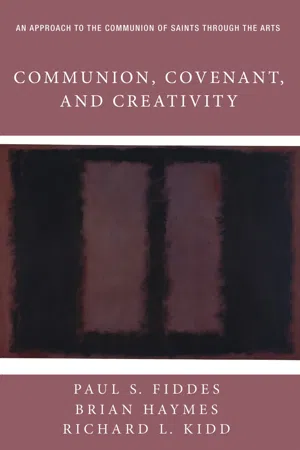
This book is a follow-up to a previous volume by the same three authors, Baptists and the Communion of Saints: A Theology of Covenanted Disciples, though it does not require familiarity with the first study. The present book offers new perspectives on belief in the "communion of saints" by interpreting it through the idea of "covenant," with its two dimensions of relations with God and with each other. Giving attention to the creative arts of painting, music, poetry, and story writing, the authors explore "indications" of a hidden "communion of saints" through embodiment, memory, and connectivity. Included are studies of the work of visual artists Paul Nash and Mark Rothko; musicians John Tavener, Elgar, and Brahms; and writers Thomas Hardy, T. S. Eliot, and James Joyce. Theological reflection on these hints of communion offers a vision of an ongoing communion of prayer with the saints, alive and dead, which does not depend on a dualistic idea of a disembodied soul existing after death but which affirms the Christian tradition of the resurrection of the body. Communion, covenant, and creativity are thus linked to develop a Christian aesthetics based on a mutual indwelling between the triune God and the world.
Information
Topic
Theology & ReligionSubtopic
Christian Theology1
Three Literary Versions of Communion with the Dead
Thomas Hardy, James Joyce, and T. S. Eliot
Who is the third who walks always beside you?
When I count, there are only you and I together
But when I look ahead up the white road
There is always another one walking beside you
Gliding wrapt in a brown mantle, hooded
I do not know whether it is a man or a woman
—But who is that on the other side of you?1
In this passage from his poem The Waste Land, T. S. Eliot evokes a common human experience, that those who have died can in some moments seem close to us, joining our company in a mysterious way, unexpectedly making their presence felt. In his own notes to his poem Eliot recalls one such instance of which he has read and which—he says—stimulated his lines here: on an Arctic expedition, “it was related that the party of explorers, at the extremity of their strength, had the constant delusion that there was one more member than could actually be counted.” At an earlier point in the notes to the poem he also recalls the Gospel story of the disciples journeying on the road to Emmaus, joined by the unrecognized figure of the Christ who had been crucified, and associates him with the one “who walks beside you.”2 Later we shall return to the Emmaus narrative as giving a significant clue to the nature of this phenomenon of the company of the dead, but it certainly happens more widely than on either occasion to which Eliot alludes.
The question is how we should understand such experiences, in the light of the kind of theology of the communion of saints we are developing in this book. I and my fellow-authors intend to warn against the supposition that the dead are present with us in the same way as the living, since this does not take account of the decisive breach in life made by death. We want to contest a dualistic account of the human person, whereby an individual soul might leave an “outer shell” of the body behind at the point of death, and so be able under some circumstances to appear to the living as if they were still essentially the same as before. Such a concept, we argue, owes more to Platonism than to Jewish-Christian concepts. If we think of the communion of saints from the perspective of a covenanted community that transcends the boundaries of the living and the dead—such as held in the Baptist tradition—it cannot be a gathering of disembodied souls. We have already tackled this issue extensively in the first book on the communion of saints that we wrote together (although it is certainly not necessary to have read that former volume to make sense of the present one).3 Now I want to approach it from a different direction, by exploring three presentations in creative literature of communion with those who have died, to see how imagination might shape a theology.
Thomas Hardy: Communion in Absence
Thomas Hardy may seem a curious witness to call in a book about the communion of saints. His renunciation of the orthodox Christian faith of his early years is well-known, and integral to his mature viewpoint was a firmly-held and bleakly-expressed conviction that death is the total end to life. His poems (we shall not be concerned here with his novels) look mortality unflinchingly in the face, as the destiny towards which life and remorseless fate steer every living being. The places which he celebrates testify to the absence of those who were once loved and have passed into oblivion. They are no longer here, and yet the very place with which they were associated will not—it seems—let them go; the place preserves their presence, and the more their absence is dwelt upon, the stronger their presence is felt.
Given Hardy’s theoretical belief in an unconscious, immanent Will operative through laws of nature,4 one might be inclined to call this a poeticizing of memory—that all that is really meant is that the person is still present in the mind and emotions of the poet, especially in a guilty conscience, and that the place triggers the recollection. But it is not easy to reduce the poetry to this rational statement: the poetry itself constantly says more. Nor can it be reduced to a belief in animism, the sense of a literal spirit inhabiting physical place, though Hardy was interested in the studies made of such primitive beliefs by the Oxford anthropologist Max Müller.5 What his poetry is telling us is that there is presence in absence, indeed communion in absence, an experience that defies rationalization.
This is true preeminently of poems about his dead first wife, Emma, who is memorialized in some hundred and fifty poems, among which the small collection entitled Poems 1912–1913 form what has been rightly called “the most intense elegiac writing in English.”6 The poems owe their effect to Hardy’s expression of his feelings in terms of place, and a mysterious oscillation there between a sense of absence and presence in the operation of memory. Here I want to comment in detail on only one example, “The Voice,”7 which begins in a paradoxical sense of loss—the woman missing and yet also speaking:
Woman much missed,8 how you call to me, call to me,
Saying that now you are not as you were
When you had changed from the one who was all to me,
But as at first, when our day was fair.
The experience of hearing the voice of a beloved dead person is common in bereavement, but here the voice seems conveniently to be reinforcing the view of the poet about the tragic, slow disintegration of their marriage over the years. While Emma had become more querulous and censorious of him, especially in her disapproval of his attack on Christian marriage in Jude the Obscure, his attention had wandered to younger women elsewhere. In this opening stanza he has her admitting that she was the one who had “changed.” The poet seems to be aware of this imbalance, and doubts arise: “Can it be you that I hear?” For reassurance he tur...
Table of contents
- Title Page
- Introduction
- Chapter 1 - Three Literary Versions of Communion with the Dead
- Chapter 2 - Perceiving an Absent Presence
- Chapter 3 - Telling Little, Revealing Much
- Chapter 4 - A Death Observed
- Chapter 5 - The Journey and the Dwelling
- Chapter 6 - One World
- Chapter 7 - Hiddenness
- Chapter 8 - Participation
- Bibliography
Trusted by 375,005 students
Access to over 1.5 million titles for a fair monthly price.
Study more efficiently using our study tools.
Frequently asked questions
Yes, you can cancel anytime from the Subscription tab in your account settings on the Perlego website. Your subscription will stay active until the end of your current billing period. Learn how to cancel your subscription
No, books cannot be downloaded as external files, such as PDFs, for use outside of Perlego. However, you can download books within the Perlego app for offline reading on mobile or tablet. Learn how to download books offline
Perlego offers two plans: Essential and Complete
- Essential is ideal for learners and professionals who enjoy exploring a wide range of subjects. Access the Essential Library with 800,000+ trusted titles and best-sellers across business, personal growth, and the humanities. Includes unlimited reading time and Standard Read Aloud voice.
- Complete: Perfect for advanced learners and researchers needing full, unrestricted access. Unlock 1.5M+ books across hundreds of subjects, including academic and specialized titles. The Complete Plan also includes advanced features like Premium Read Aloud and Research Assistant.
We are an online textbook subscription service, where you can get access to an entire online library for less than the price of a single book per month. With over 1.5 million books across 990+ topics, we’ve got you covered! Learn about our mission
Look out for the read-aloud symbol on your next book to see if you can listen to it. The read-aloud tool reads text aloud for you, highlighting the text as it is being read. You can pause it, speed it up and slow it down. Learn more about Read Aloud
Yes! You can use the Perlego app on both iOS and Android devices to read anytime, anywhere — even offline. Perfect for commutes or when you’re on the go.
Please note we cannot support devices running on iOS 13 and Android 7 or earlier. Learn more about using the app
Please note we cannot support devices running on iOS 13 and Android 7 or earlier. Learn more about using the app
Yes, you can access Communion, Covenant, and Creativity by Paul S. Fiddes,Brian Haymes,Richard L. Kidd, Paul S. Fiddes in PDF and/or ePUB format, as well as other popular books in Theology & Religion & Christian Theology. We have over 1.5 million books available in our catalogue for you to explore.