- 204 pages
- English
- ePUB (mobile friendly)
- Available on iOS & Android
eBook - ePub
About this book
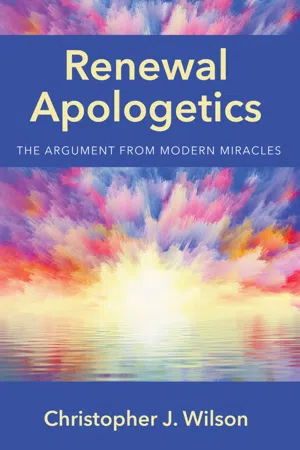
Why do you believe in God? Why do you believe in the Bible? Why do you believe in miracles? These are questions that Christians are often asked by sceptics. The field of apologetics attempts to provide rational answers to these and other questions. Unfortunately, apologetical answers to these questions are often abstract and philosophical. However, the Christian apologist/evangelist has a much more powerful argument in their arsenal: the argument from miracles. Miracles are the original Christian apologetic. It was through the witnessing of miracles that Christianity was originally spread.
By applying modern tools of philosophical inquiry and scientific methodology, Wilson is able to establish a core set of miracles which defy naturalistic explanations and strongly point toward occurrences of Special Divine Action (SDA). However, once these occurrences are proven to be genuine miracles, several questions remain. Why does God sometimes perform miracles? Why does he often answer no? How do these random acts fit into his overall plans of redemption? By answering these and other questions, Wilson develops a comprehensive apologetic for both Christianity in general and the Renewal Movement in particular.
Information
Topic
Theology & ReligionSubtopic
Christian DenominationsChapter 1
Introduction
1.1 Relevance of Study
1.1.1 Importance of the Renewal Movement
Renewal theology is an umbrella term for the various Pentecostal and Charismatic movements throughout the world. The twentieth century saw the rise of the Renewal movement with the 1906 Azusa Street Revival in the United States and various other revivals throughout the world. Within one hundred years, the movement claimed 600,000,000 adherents (25% of all Christians), and is currently the fastest growing segment of Christianity.1
The Renewal movement places a heavy emphasis on the gifts of the Holy Spirit (1 Cor 12: 7–11; Isa 11:1–2) and the immanence of God. Miraculous healings from various medical ailments are an accepted/expected aspect within the various strains of Renewal. Healing miracles are consistent with the biblical witness of the power given to all Christians (Mark 16:15–18).2
1.1.2 Centrality of Signs and Wonders to Christianity
God’s direct interaction with humanity is one of the defining motifs of Christianity. This interaction often occurs through supernatural occurrences such as healings and other signs and wonders. It can be argued that one particular sign and wonder (The Resurrection of Jesus Christ) is the central tenet of Christianity. As Christian apologist/theologian Norman Geisler concluded: “The central claims of Christianity are dependent on the apologetic value of miracles. If miracles have no evidential value, then there is no objective, historical evidence to support the claims of historic, orthodox Christianity.”3
However, claims of miracles are not unique to orthodox Christians, nor is the discussion of miracles limited to religious circles. A 2003 Harris poll found that 84 percent of Americans, and 74 percent of physicians, believed that miracles still occur today. Fifty-five percent of American physicians claimed to have personally witnessed a medical miracle. This is of importance as orthodox Christians represent a minority in both groups.4
1.1.3 Lack of a Renewal Apologetic
Despite the central importance of miracles to the Christian faith, and the persistent belief in modern “post-Christian” America; the scholarship remains sparse in many key areas. For instance, the majority of the existing literature is written by Christian academics relaying testimonials and anecdotal stories of the miraculous. The remaining is written by skeptics such as the New Atheists (Richard Dawkins, Christopher Hitchens, Daniel Dennett, and Sam Harris) who attempt to discredit any possibility of the miraculous due to their naturalistic presuppositions. In recent years, Christian scholars such as Craig Keener and Candy Gunther Brown have attempted to rectify this deficit in the academy. They have produced scholarly texts aimed at providing objective studies of the miraculous examining such issues as the problem of defining the miraculous, scientific and philosophical implications, and medical evidence for miraculous occurrences.
However, what has yet to be developed, is a thorough systematic argument for belief in Christianity due to the occurrence of modern miracles: a Renewal apologetic. While the texts by Cranston and Duffin are a step in the right direction, as they detail the Catholic authentication process including scientific verification; they serve merely as reference books of these occurrences. Keener’s compendium serves as an excellent bibliographic resource and addresses many issues involved in the study of the miraculous within the academy. Keener’s assertion is that it is more plausible to believe that some instances of Special Divine Action have occurred (based upon the sheer volume of unexplainable occurrences); rather than to believe in Hume’s epistemology, or some other highly implausible, naturalistic argument. This assertion is the very start of an apologetical argument based upon the miraculous. However, Keener’s assessment is very brief, only two pages. What is needed is a full 200–300-page book in order to fully answer the question: “Are modern miracles of evidential value in the development of a Renewal apologetic?” That is the purpose of this text.
1.2 Critical Review of Literature
This review will summarize the current study of the miraculous within the academy and the various difficulties and issues involved. Methodologically, this will be accomplished by first examining the skeptical views of the miraculous contained in the writings of David Hume. Despite being nearly 300 years old, Hume’s writings continue to serve as the foundation for the majority of skeptical arguments about the miraculous today.5
Next, an examination of the current status of the study of the miraculous within the academy will be given. This will be done by examining the recent comprehensive survey produced by Craig Keener, as well as the texts by Duffin and Cranston on Catholic miracles. Keener’s text is of importance as it is very insightful and thorough in its description of numerous possible occurrences of Special Divine Action (events which defy scientific explanation). Duffin’s and Cranston’s texts are also valuable resources as they reveal occurrences of Special Divine Action which have withstood the Vatican’s rigorous authentication process.
The final section (developing an interpretive framework of miracles) will show how the works of Jon Ruthven and Jeffrey John provide ...
Table of contents
- Title Page
- Preface
- Acknowledgments
- Chapter 1: Introduction
- Chapter 2: Epistemological Concerns
- Chapter 3: Overview of Special Divine Action Scholarship: Confronting Hume
- Chapter 4: History of Signs and Wonders
- Chapter 5: Documented Cases of Modern Special Divine Action
- Chapter 6: Interpretive Framework
- Chapter 7: Apologetical Significance of Modern Miracles
- Conclusion
- Bibliography
Trusted by 375,005 students
Access to over 1.5 million titles for a fair monthly price.
Study more efficiently using our study tools.
Frequently asked questions
Yes, you can cancel anytime from the Subscription tab in your account settings on the Perlego website. Your subscription will stay active until the end of your current billing period. Learn how to cancel your subscription
No, books cannot be downloaded as external files, such as PDFs, for use outside of Perlego. However, you can download books within the Perlego app for offline reading on mobile or tablet. Learn how to download books offline
We are an online textbook subscription service, where you can get access to an entire online library for less than the price of a single book per month. With over 1.5 million books across 990+ topics, we’ve got you covered! Learn about our mission
Look out for the read-aloud symbol on your next book to see if you can listen to it. The read-aloud tool reads text aloud for you, highlighting the text as it is being read. You can pause it, speed it up and slow it down. Learn more about Read Aloud
Yes! You can use the Perlego app on both iOS and Android devices to read anytime, anywhere — even offline. Perfect for commutes or when you’re on the go.
Please note we cannot support devices running on iOS 13 and Android 7 or earlier. Learn more about using the app
Please note we cannot support devices running on iOS 13 and Android 7 or earlier. Learn more about using the app
Yes, you can access Renewal Apologetics by Christopher J. Wilson in PDF and/or ePUB format, as well as other popular books in Theology & Religion & Christian Denominations. We have over 1.5 million books available in our catalogue for you to explore.