- 262 pages
- English
- ePUB (mobile friendly)
- Available on iOS & Android
eBook - ePub
About this book
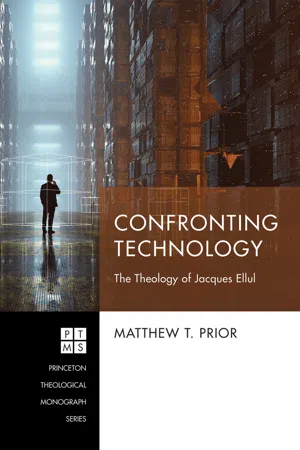
We are living through a digital revolution which already touches every area of life and will continue to shape the future in as yet unforeseen ways. Digital technologies are an ordinary part of daily life, and yet they also present an unprecedented challenge to Christians to articulate a biblical, theological framework to navigate times of rapid change. The work of the French theologian Jacques Ellul is a theological time-bomb primed for times like these.
Accounts of Ellul's career often divide off his sociology and theology, but this book argues that Ellul conceived a single project of bringing technology into confrontation with the Word of God, tackling the phenomenon he named technique, the pursuit of maximal power and efficiency implicit in the technological enterprise, with a profound depth of biblical and ethical insight. Centering himself on the apocalypse or revelation of Jesus Christ in history, Ellul offers a monumental, timely (though far from flawless) contribution to contemporary ethical debates about the uses and abuses of technologies. His work blazes a trail that Christians and all concerned for the future would do well to follow, as we avoid both the naivety of "technological neutrality" and the dread of "technological determinism."
Information
Topic
Theology & ReligionSubtopic
Christian Theology1
Not by Sociology Alone
The Asymmetry of Theology and Sociology in the Work of Jacques Ellul
In my introduction, I explored why I believe Jacques Ellul to be a valuable guide for the mission of the church today. To restate my basic reading of Ellul in negative terms: his work is misunderstood if we think of his theology and sociology as separate categories each with their own integrity. I will argue that Ellul’s life work is an integrated whole born of what he himself would call a biblical dialectic.
I do not claim that approaching Ellul’s thought in this way is entirely new; it has been broached in various forms during the past thirty years of reading Ellul.78 Indeed, Simon Charbonneau, the son of Ellul’s early soul mate Bernard Charbonneau, and an avowed agnostic like his father, states clearly that Ellul’s technology criticism stems from his faith:
This book announces all that his life and work was to be, with its two strands of theology and sociology, each inseparable from the other, despite what people often say. His entire critical stance towards modern society stems from his Christian faith.79
As Charbonneau notes, within the fiercely positivist context of French academic life, separation has been the habitual model, but to the detriment of retrieving Ellul’s legacy today.
To make my case, in this chapter, I will draw on two types of evidence, each in a separate section. In the first section, I will navigate the Ellul’s own statements about the relationship between his theology and his sociology, and their reception by others.
In the second section, I shall explore Frédéric Rognon’s argument for the key influence of Kierkegaard on Ellul and what he calls the asymmetry between theology and sociology in Ellul’s work. In an original reconstruction, I will bring together a number of texts defying easy categorization, which I shall term programmatic, exhibiting an internal dialectic between theology and sociology. They are, in order of publication, Présence au monde moderne (1948); Les nouveaux possédés (1973); La parole humiliée (1981); and Changer de révolution (1982); and the posthumous collection, Théologie et technique: pour une éthique de la non-puissance (2014). Within the standard classification of Ellul’s work, the first is commonly classed as theological, the next three as sociological. Bringing my arguments together in chapter six, I contend that the last and most recently published, Théologie et technique, demonstrates that Ellul’s technology criticism is founded on a dialectical “theology of Technique.”80
Theology as the Key to Jacques Ellul?
Ellul’s reflections upon his work have been a happy hunting ground for his interpreters over the years. American philosopher Jacob Van Vleet has been the latest to offer an outline of what he terms Ellul’s “dialectical Theology.” Based on a careful study of Ellul’s writings, with particular attention to Ellul’s own statements of method, Van Vleet argues that “Theology is the key to Jacques Ellul.”81
Noting that reading Ellul’s sociology alone should perhaps come with a health warning, he begins by attending to the infamous misreading of Ellul identified with the American Unabomber Ted Kaczynski. Kaczynski, who possessed only a number of Ellul’s sociological texts, penned a sentence which should bring a chill to all readers of Ellul: “When I read Technological Society for the first time, I was delighted because I thought: here is someone who is saying what I have already been thinking.”82 Taking this book as his “bible,” Kaczynski’s Ellul was a paranoid “neo-Luddite calling for a complete overthrow of the system,” Van Vleet claims.83 Outlining Ellul’s thought in a clear, integrated and complete way, Van Vleet seeks to dispel the myth of Ellul’s work as “fatalistic” or “deterministic”84 current in popular rejections of his work.
It is of course possible to isolate Ellul’s technology criticism from his theology without such extreme consequences. The 2007 book L’Homme qui avait (presque) tout prévu, by the French journalist Jean-Luc Porquet, re-popularized Ellul’s work in France after years of neglect but essentially dispenses with his faith. Porquet makes a lively case for Ellul as a twentieth-century seer whose work should be required reading today. In encapsulating twenty of Ellul’s “great ideas,” Porquet mines neglected Ellulian analyses from varied works and highlights how they have been validated by events, using an eclectic mix of media clichés, government announcements and purported scientific studies. In closing, he offers a brief chapter on Ellul’s theology, conceding that Ellul’s theology predetermined his iconoclasm, but defending the independence of Ellul’s sociological methods and the prescience of his conclusions.
Porquet’s book is an engaging attempt to apply Ellul’s technology criticism to the present moment, a task Ellul would no doubt have commended. However, its inevitable weakness is...
Table of contents
- Title Page
- Acknowledgments
- Abbreviations and Notes on Translation
- Introduction
- 1. Not by Sociology Alone
- 2. Rupture
- 3. Apocalypse Then
- 4. Apocalypse Now
- 5. The Apocalypse of Creation
- 6. Hearing the Word
- Conclusion
- Bibliography
Trusted by 375,005 students
Access to over 1.5 million titles for a fair monthly price.
Study more efficiently using our study tools.
Frequently asked questions
Yes, you can cancel anytime from the Subscription tab in your account settings on the Perlego website. Your subscription will stay active until the end of your current billing period. Learn how to cancel your subscription
No, books cannot be downloaded as external files, such as PDFs, for use outside of Perlego. However, you can download books within the Perlego app for offline reading on mobile or tablet. Learn how to download books offline
Perlego offers two plans: Essential and Complete
- Essential is ideal for learners and professionals who enjoy exploring a wide range of subjects. Access the Essential Library with 800,000+ trusted titles and best-sellers across business, personal growth, and the humanities. Includes unlimited reading time and Standard Read Aloud voice.
- Complete: Perfect for advanced learners and researchers needing full, unrestricted access. Unlock 1.5M+ books across hundreds of subjects, including academic and specialized titles. The Complete Plan also includes advanced features like Premium Read Aloud and Research Assistant.
We are an online textbook subscription service, where you can get access to an entire online library for less than the price of a single book per month. With over 1.5 million books across 990+ topics, we’ve got you covered! Learn about our mission
Look out for the read-aloud symbol on your next book to see if you can listen to it. The read-aloud tool reads text aloud for you, highlighting the text as it is being read. You can pause it, speed it up and slow it down. Learn more about Read Aloud
Yes! You can use the Perlego app on both iOS and Android devices to read anytime, anywhere — even offline. Perfect for commutes or when you’re on the go.
Please note we cannot support devices running on iOS 13 and Android 7 or earlier. Learn more about using the app
Please note we cannot support devices running on iOS 13 and Android 7 or earlier. Learn more about using the app
Yes, you can access Confronting Technology by Matthew T. Prior in PDF and/or ePUB format, as well as other popular books in Theology & Religion & Christian Theology. We have over 1.5 million books available in our catalogue for you to explore.