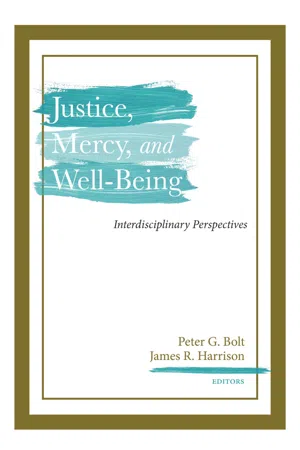
eBook - ePub
Justice, Mercy, and Well-Being
Interdisciplinary Perspectives
- 358 pages
- English
- ePUB (mobile friendly)
- Available on iOS & Android
eBook - ePub
Justice, Mercy, and Well-Being
Interdisciplinary Perspectives
About this book
This collection of essays examines how God's justice and mercy intersect in the lives of individuals and their communities, with a view to the establishment of personal and social well-being in the world. The authors, drawn from England and Australia, approach the theme from a variety of methodological and interdisciplinary perspectives. Theological, exegetical, historical, healthcare, moral, and visual arts approaches are brought to bear in an investigation relevant for the identity and mission of the church in a world characterized by cycles of revenge, the perpetration of injustice, and the marginalization and persecution of various ethnic groups. The practical outcome of these studies has wide-ranging relevance for our attitudes toward indigenous peoples, the well-being of single and married people, healthcare throughout the ages, the spiritual care of people (including those suffering dementia), the personal experience of trauma, issues of moral judgement, and the abiding value of the creative arts.
Information
Topic
Theology & ReligionSubtopic
Christian TheologyPart B
When Mercy Seasons Justice
3
“I Will Walk in Your Midst”
The Implications of Leviticus 26:3–13 for Social Well-Being
The pressing needs of a broken world are continually brought to our attention, whether through the media or through personal experience.176 While Christian people frequently feel compelled to respond to such patent need in both word and deed, what an appropriate response should look like remains debated. What is clear is that biblical and theological rigor is required to develop strategies that align with divine intention. Only by so doing will there be any hope of effecting lasting transformation.
Within Christian discussion of justice, mercy, and social well-being, Leviticus is frequently cited, and rightly so, for the book has much to contribute. Attention often focuses on ch. 19. There is, of course, good precedent for this. Jesus, after all, quotes Leviticus 19:18 to impress upon his listeners that love for one’s neighbor is second only to love for God and must therefore be integral to the life of his followers (Matt 22:39 // Mark 12:32 // Luke 10:27; see also Paul in Gal 5:14, and James in Jas 2:8). From a literary perspective, Mary Douglas argues that Leviticus 19 forms the structural and theological heart of the book.177 Noel Irwin even posits that Leviticus 19:18, with its injunction to love one’s neighbor, is the means to understanding the content of the entire work.178 Certainly, similar themes extend beyond ch. 19. Concern for aliens and strangers permeates the so-called Holiness Code (e.g., 23:22); the humanitarian vision behind the year of Jubilee was and is revolutionary; the sacrificial system explicitly makes provision for the less well-off (e.g., 5:7, 11). Thus, Jacob Milgrom and Walter Brueggemann are correct to asset that a concern for social holiness is central to Leviticus.179
Yet engagement with what Leviticus says about social holiness tends to have one of two aims in mind. The first is purely historical, displaying a desire to better understand the social conditions and attitudes of the ancient Near East as an end in itself.180 A second approach majors instead on contemporary implementation, seeking to either enact,181 or to abrogate,182 Levitical legislation. Much less appreciated, however, are the literary and theological underpinnings of the social justice legislation. Yet the danger of not recognizing these features of the text is to end up with abstracted principles divorced from basis, regardless of whether the concern is historical reconstruction or contemporary application. While such abstraction is not necessarily invalid, it fails to do sufficient justice to the way the issues have been presented by the author/redactor of the book.
Leviticus 26 illustrates the matter well. The pericope functions as a climax to the book, as YHWH, in first-person discourse, outlines the consequences that will accompany either obedience (vv. 1–13) or disobedience (vv. 14–39). The wording of the chapter’s summary in v. 46 indicates that these divine sanctions encapsulate not only the extant text of Leviticus,183 but arguably the entirety of the Sinai material.184 The vision portrayed in the blessing panel (vv. 1–13) functions similarly. Terminology used here alludes to other sections of the book (e.g., v. 2; cf. 19:3) and to the Pentateuch more broadly. Of interest for this essay are allusions to Genesis 1–3 in vv. 3–13.185 As I hope to demonstrate, allusion to the creation narratives is not only intriguing, it is also revealing with respect to the underlying rationale of the social holiness legislation in Leviticus.
My purpose is correspondingly twofold. First, I want to demonstrate that allusion to Genesis 1–3 is, in fact, a literary device employed in Leviticus 26. Then, second, I want to tease out some of the implications that allusion has for understanding the wider literary and theological context of the book’s concern with matters of social justice. In doing so, I hope to contribute to the exegetical and theological understanding of this vital part of the Old Testament and so foster a more nuanced and considered appropriation of Leviticus in relation to contemporary debate and practice.
Parallels between Leviticus 26:3–13 and Genesis 1–3
My aim in this section is to demonstrate th...
Table of contents
- Title Page
- Contributors
- Introduction
- Part A. The Contours of Well-Being
- Part B. When Mercy Seasons Justice
- Part D. Seeking the Welfare of the City
- Part E. Well-Being and Aboriginal Australians
- Part F. Healthcare, Memory Loss, and Well-Being
- Part G. The Moral Compass of Well-Being
- Part H. Well-Being and the Visual Arts
Trusted by 375,005 students
Access to over 1.5 million titles for a fair monthly price.
Study more efficiently using our study tools.
Frequently asked questions
Yes, you can cancel anytime from the Subscription tab in your account settings on the Perlego website. Your subscription will stay active until the end of your current billing period. Learn how to cancel your subscription
No, books cannot be downloaded as external files, such as PDFs, for use outside of Perlego. However, you can download books within the Perlego app for offline reading on mobile or tablet. Learn how to download books offline
Perlego offers two plans: Essential and Complete
- Essential is ideal for learners and professionals who enjoy exploring a wide range of subjects. Access the Essential Library with 800,000+ trusted titles and best-sellers across business, personal growth, and the humanities. Includes unlimited reading time and Standard Read Aloud voice.
- Complete: Perfect for advanced learners and researchers needing full, unrestricted access. Unlock 1.5M+ books across hundreds of subjects, including academic and specialized titles. The Complete Plan also includes advanced features like Premium Read Aloud and Research Assistant.
We are an online textbook subscription service, where you can get access to an entire online library for less than the price of a single book per month. With over 1.5 million books across 990+ topics, we’ve got you covered! Learn about our mission
Look out for the read-aloud symbol on your next book to see if you can listen to it. The read-aloud tool reads text aloud for you, highlighting the text as it is being read. You can pause it, speed it up and slow it down. Learn more about Read Aloud
Yes! You can use the Perlego app on both iOS and Android devices to read anytime, anywhere — even offline. Perfect for commutes or when you’re on the go.
Please note we cannot support devices running on iOS 13 and Android 7 or earlier. Learn more about using the app
Please note we cannot support devices running on iOS 13 and Android 7 or earlier. Learn more about using the app
Yes, you can access Justice, Mercy, and Well-Being by Peter G. Bolt,James R. Harrison, Peter G. Bolt, James R. Harrison in PDF and/or ePUB format, as well as other popular books in Theology & Religion & Christian Theology. We have over 1.5 million books available in our catalogue for you to explore.