eBook - ePub
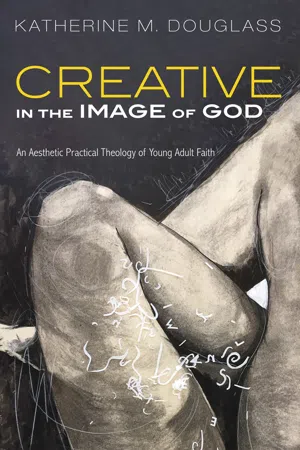
Creative in the Image of God
An Aesthetic Practical Theology of Young Adult Faith
- 154 pages
- English
- ePUB (mobile friendly)
- Available on iOS & Android
eBook - ePub
Creative in the Image of God
An Aesthetic Practical Theology of Young Adult Faith
About this book
The declining religious participation among young adults, or "Rise of the Nones," has signaled alarms across American Christianity. A closer look into the faith lives of thirty young adults who are, or were at one time, connected with a church, however, shows an articulate and aesthetically embodied faith life that seeks out connection with others, expression of their identity, and an openness to encountering God. Young adults see themselves, and all people in this pluralistic world, as bearing the image of God. They see creativity, in their own lives and in the lives of others, as evidence of this identity. This book is not an appeal to put more art into congregations, but rather an invitation to attend to aesthetic, embodied ways of knowing that exist among all people.
Information
Topic
Theology & ReligionSubtopic
Christian Ministry1
Changing Landscapes of Young Adulthood
This chapter presents the current research on young adulthood from the fields of psychology and sociology. This is done to in order to problematize current claims regarding the lack of religiosity among young adults. I will offer evidence to the contrary and argue for a more nuanced interpretation of general trends—that young adulthood is a time of spiritual discernment that is sometimes worked out through participation in the arts. This claim connects with the overarching thesis of this book by showing that the young adult years are a time of high spiritual interest and discernment regarding one’s religious identity. This claim also sets the stage for the following chapter, which elaborates on the role that the arts play in the faith lives of young adults: to foster connection, expression, and opening.
My empirical research study focused on the question, What role do the arts play in the faith lives of young adults? This chapter reviews contemporary research on young adults, highlighting the changing landscape of young adulthood. This review will provide foundational knowledge about young adults and expose some tensions in current research. This chapter will also expose the experiences of the current cohort that make them especially creative.
Since the publication in 2004 of Jeffrey Arnett’s Emerging Adulthood: The Winding Road from the Late Teens through the Twenties there has been increased attention from researchers, churches, and the media given to the life stage of young adulthood.1 This age range has long been acknowledged as a time of transition and major life decisions. This is traditionally the period when individuals move away from home, consider and decide on a career and spouse, and become financially independent from their parents. Whether we call it “emerging adulthood” (Arnett), “later adulthood” (Erik Erikson), or simply “young adulthood,” there is general consensus among psychologists and sociologists that this period of life is changing in significant ways.
A Lively Conversation on Young Adulthood
In my review of psychological and sociological research on young adults I identified four themes of young adulthood. While some of these themes have been seen in previous generations, they seem to be more pronounced with younger generational cohorts. This is happening not only in the United States (although that will be the focus of this research) but internationally as well.2
The first theme within the scope of the changing landscape of young adulthood is taking form in time. The years one spends in young adulthood are expanding, extending into the late twenties and early thirties. Sociologists and psychologists speculate on the reasons for these changes: longer life span, greater support from parents, or lazy young adults. Common to all is the claim that this stage of life is lengthening. A second theme is that young adulthood is the least religious period of a person’s life. This is borne out in both national and denominational research through studies that focus on religious participation, including Bible reading, frequency of prayer, and congregational involvement. The third theme, especially interesting considering the second, is that this lack of church attendance and involvement does not completely correlate with a decrease in interest in matters of faith, religion, and spirituality. The fourth theme is that this generation of young adults is more aesthetically attuned and oriented than past generations, and this is often expressed in their faith lives. This final theme was identified in a preliminary way in the work of sociologist Robert Wuthnow and has been further explored and confirmed in my own research. Inquiry into this fourth theme is the focus of this study.3
Igniting the Conversation: Life Cycle Theory
Before giving greater attention to these four thematic trends with young adults I will offer a critique of Arnett’s life cycle theory.4 I start with Arnett because, as mentioned above, he has been one of the most prominent voices drawing attention to the changing landscape of young adulthood. Some developmental theories, such as life cycle theory, tend toward the straightforward clarity of categorizing life. Life stages, as Erik Erikson lays them out, are a prime example of this. While Erikson’s stages allow for overlap, flexibility, and a return to past stages if the need arises, the general focus is on steps, or stages, through which each human goes with little attention to global, economic, political, or social forces, trends, and events. Life stage theory focuses on the individual human, rather than the individual within society. This makes sense because Arnett and Erikson are in the field of psychology, which is more concerned with the psychic development of individuals, in contrast to sociology, which is more concerned with people groups. It is for this reason that I believe Arnett’s contribution is limited and fails to account for the significant impact that the changing landscape of social institutions can have on a generation.
Take, for example, those who came of age during a military draft. Not only are the lives of drafted young men affected but also the...
Table of contents
- Title Page
- Acknowledgments
- Introduction
- 1. Changing Landscapes of Young Adulthood
- 2. Art Connects, Expresses, and Opens
- 3. Recovering the Aesthetic Dimension of Practical Reason190
- 4. The Image of God, Art, and Christian Formation
- 5. An Aesthetic Practical Theology of Young Adult Faith
- Appendix A
- Appendix B
- Appendix C
- Bibliography
Trusted by 375,005 students
Access to over 1.5 million titles for a fair monthly price.
Study more efficiently using our study tools.
Frequently asked questions
Yes, you can cancel anytime from the Subscription tab in your account settings on the Perlego website. Your subscription will stay active until the end of your current billing period. Learn how to cancel your subscription
No, books cannot be downloaded as external files, such as PDFs, for use outside of Perlego. However, you can download books within the Perlego app for offline reading on mobile or tablet. Learn how to download books offline
Perlego offers two plans: Essential and Complete
- Essential is ideal for learners and professionals who enjoy exploring a wide range of subjects. Access the Essential Library with 800,000+ trusted titles and best-sellers across business, personal growth, and the humanities. Includes unlimited reading time and Standard Read Aloud voice.
- Complete: Perfect for advanced learners and researchers needing full, unrestricted access. Unlock 1.5M+ books across hundreds of subjects, including academic and specialized titles. The Complete Plan also includes advanced features like Premium Read Aloud and Research Assistant.
We are an online textbook subscription service, where you can get access to an entire online library for less than the price of a single book per month. With over 1.5 million books across 990+ topics, we’ve got you covered! Learn about our mission
Look out for the read-aloud symbol on your next book to see if you can listen to it. The read-aloud tool reads text aloud for you, highlighting the text as it is being read. You can pause it, speed it up and slow it down. Learn more about Read Aloud
Yes! You can use the Perlego app on both iOS and Android devices to read anytime, anywhere — even offline. Perfect for commutes or when you’re on the go.
Please note we cannot support devices running on iOS 13 and Android 7 or earlier. Learn more about using the app
Please note we cannot support devices running on iOS 13 and Android 7 or earlier. Learn more about using the app
Yes, you can access Creative in the Image of God by Katherine M. Douglass in PDF and/or ePUB format, as well as other popular books in Theology & Religion & Christian Ministry. We have over 1.5 million books available in our catalogue for you to explore.