eBook - ePub
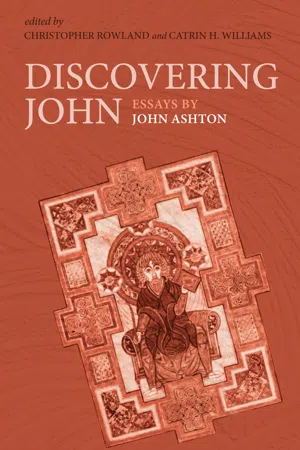
Discovering John
Essays by John Ashton
- 226 pages
- English
- ePUB (mobile friendly)
- Available on iOS & Android
eBook - ePub
Discovering John
Essays by John Ashton
About this book
This collection of posthumously published essays by John Ashton manifests his ongoing exegetical work at the end of his life. The essays explore themes arising from his groundbreaking study, Understanding the Fourth Gospel, which John Ashton intended to be preceded by an intellectual autobiography contextualizing this study both in the wider context of biblical scholarship and the particularities of his life. This in itself is an unusual contribution and it sheds much light not only on the current state of Johannine studies but also on the situation of those involved with both church and academy in the closing decades of the twentieth century.
Information
1
Discovering the Gospel of John
A Fifty-Year Journey of Exploration
La rage de vouloir conclure est une des manies les plus funestes et les plus stériles qui appartiennent à l’humanité.
—Gustave Flaubert
I: The Early Years (1964–70)
The following essay is autobiographical only insofar as events of my own life have a bearing upon my study of the Gospel of John and the conclusions I have reached concerning its nature and significance. Looking back now, in my eighties, I note that if the Gospel was composed during the 80s of the first century CE (as it may well have been) its author, if he too was in his eighties, could have been recollecting events that had occurred fifty years previously.
One main purpose of this essay is to summarize my own thinking as it has developed over the years on a variety of topics related to the Gospel of John. On some issues it has scarcely changed, and my comments on these have come to seem wearisomely repetitive even to myself. But it should nevertheless be possible, even so, to single out certain key points or especially telling arguments. On other topics an initial insight has been reinforced from time to time by ideas that seem to emerge from different areas of thought, and I want to describe these as carefully as possible. On one or two topics I have increased my knowledge, occasionally because new evidence, mostly from Qumran, has come to light, more often because my own reading has broadened. On others, looking at the evidence and the arguments afresh, I have become more critical and more cautious. On one particular topic my ideas have been in a constant state of flux, so that even now, so many years later, I cannot be sure that they will not change again.
If I were to discuss all these topics one after the other without interruption, the biographical element would be lost. Instead, I propose to intersperse them between snippets of biography. The order in which I treat them may seem random; but I will take them up as closely as I can to the point in my own story in which I began to give each careful attention.
Except for a few passages of personal reminiscence I leave aside those aspects of my life (several of them very important to me) that have nothing to do with scholarship. The biographical sections of the essay will be placed between summaries of my work on John, especially Understanding the Fourth Gospel.1 But some of what I consider to be the most important ideas occurred outside the context of the composition of that book, and I will consider each of these in full, starting from the moment in which I began to give them serious consideration.
Understanding the Fourth Gospel, begun in 1980, took nearly ten years to write and has fourteen chapters. Four of these, written between 1980 and 1981, will be summarized in the fourth section of this essay, five more in the sixth, and the remaining five in the seventh. Shorter contributions, notably the articles contained in my collection Studying John: Approaches to the Fourth Gospel and the chapters added to the second edition of Understanding the Fourth Gospel, will be summarized at appropriate points. I will end with a résumé of the main conclusions of my recently published book, The Gospel of John and Christian Origins. Not all readers of this essay, of course, will wish or need to be reminded of the substance of my work on the Gospel: warned in advance, they are invited to skip paragraphs that do not interest them. But a main part of my purpose here is to repeat in shortened form the work of the last fifty years. I will also note briefly issues on which I have changed my mind.
In 1949, at the age of eighteen, I joined the Society of Jesus (usually known as the Jesuits, or the Jesuit Order), accustomed to providing a very full education for those of its members thought likely to benefit from it. After three years studying scholastic philosophy, plus a fourth learning how to be a schoolteacher, I was sent to Campion Hall, Oxford (to this day still run by the Jesuits) in order to pursue the four-year course of classical literature, philosophy, and history known as Greats. Both the scholastic philosophy I had been taught earlier and the mixture of modern (analytic) and classical philosophy (Plato and Aristotle) that I learned in Oxford have influenced my thinking ever since. But the journey I am about to describe had not yet begun, for it was not until 1964—the third year out of the four that I spent studying theology at a Jesuit seminary in France—that I was stimulated to think seriously about the Gospel of John.
The so-called Séminaire des Missions, high up on the Montée de Fourvière, was housed in a large building (now a musical conservatory) that overlooks the old quarter of the city of Lyons; and it was there, listening to the lectures of Xavier Léon-Dufour, that it first dawned on me that there is more to John’s Gospel than meets the eye. The insight that most impressed me (as, looking back, I came to realize) was based on an article he had written many years earlier on the story of the cleansing of the temple in John 2 and Jesus’s subsequent prophecy of his own death and resurrection. Dufour had stressed the distinction implicit in this story between the partial comprehension of those listening to Jesus’s words within the story and the fuller understanding to be expected of readers of the Gospel (who, of course, already knew the outcome).2 He summed up this insight in the phrase deux temps de l’intelligence. The evangelist was not just telling a story, the story of Jesus’s life and death, but underlining its significance for his readers.
After acknowledging Léon-Dufour’s insight that “les deux temps de l’intelligence” is one of the organizing principles of the Fourth Gospel, I went on to link it with the theory of “the two-level drama” outlined in J. Louis Martyn’s little book, History and Theology in the Fourth Gospel (1968). Although Martyn nowhere refers to the temple episode that interested Léon-Dufour, what he calls “the two-level drama” represents an alternative way of highlighting the evangelist’s steady insistence on the essential difference between how Jesus’s words and deeds were understood before his death and how they were understood after. Both scholars, I believe, had laid their hands on an essential key to the comprehension of the Gospel, and it is illuminating to consider their approaches, however different they may be, together. Yet here I want to consider certain weaknesses in each of them that I detected only later.
In the first place, for Léon-Dufour the fundamental distinction was between what he called the time of Jesus’s hearers, and the time of John’s readers. True, he refers occasionally to the milieu historique in which John was written, but the thrust of his article was to distinguish between Jesus’s actual hearers (both Jews an...
Table of contents
- Title Page
- Introduction
- Discovering the Gospel of John
- Really a Prologue?
- John and the Johannine Literature
- Riddles and Mysteries
- “Mystery” in the Dead Sea Scrolls and the Fourth Gospel
- The Johannine Son of Man
- Reflections on a Footnote
- Browning on Feuerbach and Renan
- John Ashton
- Bibliography
Trusted by 375,005 students
Access to over 1.5 million titles for a fair monthly price.
Study more efficiently using our study tools.
Frequently asked questions
Yes, you can cancel anytime from the Subscription tab in your account settings on the Perlego website. Your subscription will stay active until the end of your current billing period. Learn how to cancel your subscription
No, books cannot be downloaded as external files, such as PDFs, for use outside of Perlego. However, you can download books within the Perlego app for offline reading on mobile or tablet. Learn how to download books offline
Perlego offers two plans: Essential and Complete
- Essential is ideal for learners and professionals who enjoy exploring a wide range of subjects. Access the Essential Library with 800,000+ trusted titles and best-sellers across business, personal growth, and the humanities. Includes unlimited reading time and Standard Read Aloud voice.
- Complete: Perfect for advanced learners and researchers needing full, unrestricted access. Unlock 1.5M+ books across hundreds of subjects, including academic and specialized titles. The Complete Plan also includes advanced features like Premium Read Aloud and Research Assistant.
We are an online textbook subscription service, where you can get access to an entire online library for less than the price of a single book per month. With over 1.5 million books across 990+ topics, we’ve got you covered! Learn about our mission
Look out for the read-aloud symbol on your next book to see if you can listen to it. The read-aloud tool reads text aloud for you, highlighting the text as it is being read. You can pause it, speed it up and slow it down. Learn more about Read Aloud
Yes! You can use the Perlego app on both iOS and Android devices to read anytime, anywhere — even offline. Perfect for commutes or when you’re on the go.
Please note we cannot support devices running on iOS 13 and Android 7 or earlier. Learn more about using the app
Please note we cannot support devices running on iOS 13 and Android 7 or earlier. Learn more about using the app
Yes, you can access Discovering John by John Ashton, Christopher Rowland,Catrin H. Williams, Christopher Rowland in PDF and/or ePUB format, as well as other popular books in Theology & Religion & Biblical Criticism & Interpretation. We have over 1.5 million books available in our catalogue for you to explore.