eBook - ePub
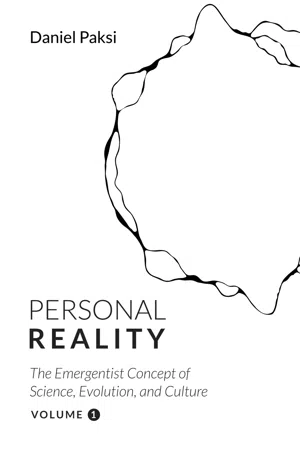
Personal Reality, Volume 1
The Emergentist Concept of Science, Evolution, and Culture
- 288 pages
- English
- ePUB (mobile friendly)
- Available on iOS & Android
eBook - ePub
About this book
Western civilization was built on the concept of God. Today modern science, based on the critical method and so-called objective facts, denies even the existence of our soul. There is only matter: atoms, molecules, and DNA sequences. There is no freedom; there are no well-grounded beliefs. The decline of Western civilization is not the simple consequence of decadence, hedonism, and malevolence. Modern critical science has liberated us from the old dogmas but failed to establish our freedoms, values, and beliefs.
However, human knowledge is not objective but personal. We are the children of evolution. Everybody sees the world from his own personal point of view anchored into his/her body. We use our billions-of-years-old evolutionary skills and thousands-of-years-old cultural heritage to recognize and acknowledge the personal facts of our reality, freedom, and most important natural beliefs: respect and speak the truth. In reality, even science itself is based on our personal knowledge. Only our false conceptual dichotomies paralyze our thinking.
God or matter?--there is a third choice: the emergence of life and human persons. This is the only way to defend our freedoms and the Christian moral dynamism of free Western societies.
Information
Topic
PhilosophySubtopic
Modern Philosophy3
Personal Knowledge
3.1 Preface
Polanyi starts his train of thought in Personal Knowledge with a request to the reader: set aside all your beliefs and prior notions, no matter how natural they may seem to you, and imagine contrasting objectivity to subjectivity with perfect consistency. What is the meaning of this pure objective knowledge? How does the universe and human beings look from this pure objective point of view?
His answer is this: since pure objectivity cannot be biased at all, it cannot take into consideration any subjective viewpoints of human beings; therefore, from a consistent, objective point of view, every small, material part of the whole universe should be examined in absolutely equal manner. In this case, human beings would not get any time for scientific inquiry because the Solar System and the Earth are only tiny parts of the Milky Way among billions of other stars and planets. Of course, the Milky Way is also just one galaxy among billions of others.19
It does not matter how much scientists talk about the need for consistent objectivity, it is clear that there is no such scientist in the world who could and would want to contemplate the universe in this manner. In that case, neither the Earth nor another person could appear in scientific knowledge as a particular, exciting thing or being. We pay attention to specific things and creatures only because of our so-called subjective, anthropocentric point of view. Therefore, the pursuit of pure objectivity in science is unfounded because it ignores the real workings of human knowing, which is rooted in our natural, evolutionary interest toward the particular things and beings of our own environment.
Polanyi, of course, speaks about the viewpoint of Laplace’s demon and its absurd nature (2.3). But if the Laplacian ideal of objective knowledge is false, then the question inevitably will arise: what is the real nature of scientific knowledge? And what is the real meaning when scientists talk about objectivity—what they are hiding?
The purpose of this book is to show that complete objectivity, as usually attributed to the exact sciences, is a delusion and is, in fact, a false ideal. But I shall not try to repudiate strict objectivity as an ideal without offering a substitute, which I believe to be more worthy of intelligent allegiance; this I have called ‘personal knowledge.’20
3.2 The Tacit Roots of Scientific Discovery
Polanyi shows the real meaning of objectivity with the example of the Copernican revolution. According to the modern understanding of science, the previous medieval, Aristotelian/Ptolemaic, and Earth-centric worldview—which was a religious, superstitious, and anthropocentric subjectivism—was superseded by the Sun-centric worldview of modern, objective science. Thus, science transcended the narrow point of view of man and his subjective, illusory impression that the Earth is standing still under his feet. By pure scientific rationality, it was revealed that the Earth revolves around the Sun (with huge velocity) and not vice versa. Man lost his place at the center of the universe and became one of the many incidental existents at the edge of the world.21
The Copernican view of the universe, however, is just as far away from a pure, consistent objectivist viewpoint as the Aristotelian/Ptolemaic one. As much as the Earth is not the center of the universe, neither is the Sun—both of them are insignificant specks of dust in the vast universe. The great, scientific step of Copernicus does not go toward this direction but rather toward a more abstract personal knowledge.
In a literal sense, therefore, the new Copernican system was as anthropocentric as the Ptolemaic view, the difference being merely that it preferred to satisfy a different human affection.22
Copernicus chose the new Sun-centric view not because he wanted to occupy a more pure, consistent, and objective stance, but rather because he preferred the theoretic Sun-perspective over our natural experience that the Earth steadily and immovably stands under our feet. Copernicus had no empirical evidence at all on the side of his theory—as a matter of fact, the apparent empirical evidence supported the old, Aristotelian view—but he still committed himself to the Sun-centric view because it provided him deeper intellectual enjoyment than the old, earthbound one. Nonetheless, in a sense, it can be stated that the Copernican view is more objective than the previous Aristotelian one; not on the basis of pure objectivism but rather because it was a step toward a “more ambitious anthropocentrism.”23
It becomes legitimate to regard the Copernican system as more objective than the Ptolemaic only if we accept this very shift in the nature of intellectual satisfaction as the criterion of greater objectivity.24
It is important to note that the basis of this new, Polanyian sense of objectivity is such personal aspiration—an intellectual enjoyment or passion based on the scientist’s intellectual skills (3.3)—which, according to modern understandings of science, is subjective and thus has to be rejected. For Polanyi, however, these intellectual passions and skills cannot be subjective; otherwise, they would not be able to lead to more objective scientific theories—not even in a weaker sense. At this point, however, Polanyi’s goal is only to establish that although there is no ideal knowledge (in the sense of pure, consistent objectivity), the selection of the Copernican theory did not happen randomly or solely by subjective factors:
[The Copernican theory’s] excellence is not a matter of personal taste on our part but an inherent quality deserving universal acceptance by rational creatures. We abandon the cruder anthropocentrism of our senses—but only in favor of a more ambitious anthropocentrism of our reason.25
According to Polanyi’s example, if we abandon our commitment that the Earth is at the center of the universe—which is based on our natural experience of the Earth, standing still underneath our feet—then we can get a Copernican theory that is not only satisfactory for us but also for every other possible intellectual beings in the Solar system (that is, of course, if they also abandon their previous commitments, based on their natural experiences, that Venus, Mars, etc., is standing still underneath their feet): “Since [Copernicus’s] picture of the solar system disregards our terrestrial location, it equally commends itself to the inhabitants of Earth, Mars, Venus, or Neptune, provided they share our intellectual values.”26
We can acknowledge that the Copernican theory is better, more rational, and more objective ...
Table of contents
- Title Page
- Figures and Tables
- Acknowledgments
- The Origin of Personal Reality
- The Laplacian Ideal of Knowledge
- Personal Knowledge
- The Meaning of Randomness
- Emergence
- Space, Time, and Matter
- The Theory of Boundary Conditions
- Bibliography
Trusted by 375,005 students
Access to over 1.5 million titles for a fair monthly price.
Study more efficiently using our study tools.
Frequently asked questions
Yes, you can cancel anytime from the Subscription tab in your account settings on the Perlego website. Your subscription will stay active until the end of your current billing period. Learn how to cancel your subscription
No, books cannot be downloaded as external files, such as PDFs, for use outside of Perlego. However, you can download books within the Perlego app for offline reading on mobile or tablet. Learn how to download books offline
Perlego offers two plans: Essential and Complete
- Essential is ideal for learners and professionals who enjoy exploring a wide range of subjects. Access the Essential Library with 800,000+ trusted titles and best-sellers across business, personal growth, and the humanities. Includes unlimited reading time and Standard Read Aloud voice.
- Complete: Perfect for advanced learners and researchers needing full, unrestricted access. Unlock 1.5M+ books across hundreds of subjects, including academic and specialized titles. The Complete Plan also includes advanced features like Premium Read Aloud and Research Assistant.
We are an online textbook subscription service, where you can get access to an entire online library for less than the price of a single book per month. With over 1.5 million books across 990+ topics, we’ve got you covered! Learn about our mission
Look out for the read-aloud symbol on your next book to see if you can listen to it. The read-aloud tool reads text aloud for you, highlighting the text as it is being read. You can pause it, speed it up and slow it down. Learn more about Read Aloud
Yes! You can use the Perlego app on both iOS and Android devices to read anytime, anywhere — even offline. Perfect for commutes or when you’re on the go.
Please note we cannot support devices running on iOS 13 and Android 7 or earlier. Learn more about using the app
Please note we cannot support devices running on iOS 13 and Android 7 or earlier. Learn more about using the app
Yes, you can access Personal Reality, Volume 1 by Daniel Paksi in PDF and/or ePUB format, as well as other popular books in Philosophy & Modern Philosophy. We have over 1.5 million books available in our catalogue for you to explore.