- 202 pages
- English
- ePUB (mobile friendly)
- Available on iOS & Android
eBook - ePub
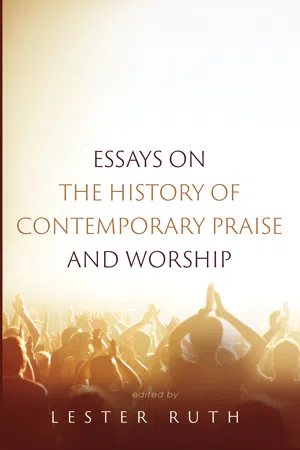
Essays on the History of Contemporary Praise and Worship
About this book
Seeking to push the historical study of the liturgical phenomenon known as "Contemporary Worship" or "Praise and Worship" to a new level, this collection of essays offers an introduction to the phenomenon, documents critical aspects of its development, and suggests methods for future historical study. This multi-authored work investigates topics in both the Pentecostal and mainline branches of this way of worship, looking at subjects little explored by prior work. The provocative issues explored include Integrity Hosanna! Music, James White, charismatic renewal, John Wimber, the development of second services, Black Gospel, overlooked (non-white) sources of worship music, degree programs for worship leaders, and Robert Webber.
Information
Topic
Teología y religiónSubtopic
Denominaciones cristianas6
Forerunning Contemporary Worship Music
The Afro-Pentecostal Roots of Black Gospel
What does Contemporary Worship Music (CWM), formed mostly in white evangelical churches in the late twentieth century, have to do with the formation of black gospel, a development of a different musical genre separated by time, culture, and often race? Black gospel music is not a direct or major historical tributary leading to CWM. CWM emerged in the rock era, while black gospel music developed and blossomed well before rock music—in its formal sense—even existed. Certainly, if we dug deep enough, we could find a musical lineage connecting black gospel to CWM, whether we looked at the pentecostal influence on early rock and roll pioneers (who then influenced the rock music that made its way into evangelical churches) or toward the emergence of artists who straddled the line between CWM and black gospel, like Andraé Crouch or Israel Houghton. Yet that historical digging is not the purpose of this chapter. Nor is this chapter in any sense a thorough historical treatment of black gospel music or even music in the Afro-Pentecostal tradition.348 Plenty of fine studies on both subjects already exist, and their complete histories lie outside the scope of this study. Instead, this consideration of the Afro-Pentecostal roots of black gospel will focus on the inherent “American evangelical logic” (evangelical in the broadest sense) that guided the incorporation of external, “secular” musical forms into the black church sanctuary. The emergence of black gospel music provides us with a historical example of how American Christians transformed what many considered a “noxious noise” into something sacred, a transformation that has several parallels with the development of CWM in the late twentieth century. Many of the themes and concerns that dominated black gospel’s growth into an American cultural institution were revisited by white Evangelicals pioneering CWM some fifty years later. The historical progression of black gospel in the early twentieth century—from marginalized, folk culture beginnings to widespread adoption (through discourses of appropriateness and authenticity), and then to industrial development—replayed itself in the late twentieth century among white Evangelicals with the rise of CWM. By considering the rise of black gospel music, then, we acquire a deeper historical grounding of the logic that has dominated the incorporation of contemporary musical cultures into the church sanctuary.
A Short History of Black Gospel Music Origins
As early Afro-Pentecostalism, steeped in the musical accents and rhythms of earlier slave songs, developed its own “sanctified music,” it gave birth to black gospel music. Though this musical culture was first maligned by established black denominations, it made inroads into black churches in the 1920s and 1930s, particularly through the work of Thomas Dorsey and the National Convention of Gospel Choirs and Choruses. By the late 1930s black gospel had become a major musical expression of black churches and even began to look beyond the sanctuary walls as it grew into a commercial enterprise and eventually a secular musical genre. With this evolution of gospel music, Afro-Pentecostals and black Baptists focused much attention over which sounds, lyrics, and gestures belonged in the church and which were of “the world.” Yet in spite of this cultural war over the music that inhabited black churches, in just a few decades black gospel transformed from a marginalized musical curiosity into a thriving cultural industry.
The “amalgamated sounds”349 of sanctified music—the blending of slave spirituals and white Protestant hymnody, combined with the emotional angst of the blues and the syncopated rhythms of jazz—first emerged in the storefront Afro-Pentecostal churches that dotted the urban landscape of early twentieth-century America. Historian Eileen Southern called these “folk churches,”350 congregations that inherited “the musical practices of the slave invisible church” and embraced “the hand clapping, foot stomping, call-and-response performance, rhythmic complexities, persistent beat, melodic improvisation, heterophonic textures, percussive accompaniments, and ring shouts” that marked such music.351
Folk churches were mostly attended by lower and lower-middle-class folk who were primarily interested in transcendent encounters with the Holy Spirit, experiences of movement, volume, and emotional expression that pulled them out of the difficulties of daily life and into the communion of the saints, allowing them to worship a God of power. For many poor blacks, surviving in post-bellum segregated America and the mass migration to the urban north required reaching back to the musical survival mechanisms they had employed in the antebellum south, while also embracing the blues and jazz those mechanisms had evolved into.352
As Afro-Pentecostals brought the sounds of ragtime, blues, and jazz into the church, they also often brought the accompanying instruments: drums, tambourine, triangle, guitar, upright bass, saxophone, trumpet, trombones, and anything else that felt right in the Spirit. Organs and pianos—commonly used in the “dignified,” wealthier churches—were not shunned in the folk churches, though their expense often exceeded the budgets of small storefront congregations. When money was an issue, folk churches simply sang a cappella, channeling the dynamic power of congregational voice.353
For black pentecostal and Holiness churches, the Holy Spirit did not discriminate against these musical mediums, as long as their use was directed to the worship of the Lord. They looked to Psalm 150, which called for praise with the trumpet, the harp, the timbrel and dance, stringed instruments and organs, and loud cymbals.354 As far as they were concerned, any instrument and sound could be captured for the purpose of worship. This guiding ethos, Levine argued, was articulated later by a church patriarch who riffed on Martin Luther’s supposed quip: “The devil should not be allowed to keep all this good rhythm.”355...
Table of contents
- Title Page
- Contributors
- Acknowledgment
- The Importance and History of Contemporary Praise & Worship
- James F. White, Grady Hardin, and Methodist “Contemporary” Worship in the 1970s
- John Wimber and the Vineyard Influence on Charismatic Catholic Worship
- The Path to a Second Service
- Sounding God’s Enthronement in Worship
- Robert Webber
- Forerunning Contemporary Worship Music
- Nashville and Sydney Are Not the World
- The Rise of the Worship Degree
- Methodological Insights for the Historiography of Contemporary Praise & Worship
Trusted by 375,005 students
Access to over 1.5 million titles for a fair monthly price.
Study more efficiently using our study tools.
Frequently asked questions
Yes, you can cancel anytime from the Subscription tab in your account settings on the Perlego website. Your subscription will stay active until the end of your current billing period. Learn how to cancel your subscription
No, books cannot be downloaded as external files, such as PDFs, for use outside of Perlego. However, you can download books within the Perlego app for offline reading on mobile or tablet. Learn how to download books offline
Perlego offers two plans: Essential and Complete
- Essential is ideal for learners and professionals who enjoy exploring a wide range of subjects. Access the Essential Library with 800,000+ trusted titles and best-sellers across business, personal growth, and the humanities. Includes unlimited reading time and Standard Read Aloud voice.
- Complete: Perfect for advanced learners and researchers needing full, unrestricted access. Unlock 1.5M+ books across hundreds of subjects, including academic and specialized titles. The Complete Plan also includes advanced features like Premium Read Aloud and Research Assistant.
We are an online textbook subscription service, where you can get access to an entire online library for less than the price of a single book per month. With over 1.5 million books across 990+ topics, we’ve got you covered! Learn about our mission
Look out for the read-aloud symbol on your next book to see if you can listen to it. The read-aloud tool reads text aloud for you, highlighting the text as it is being read. You can pause it, speed it up and slow it down. Learn more about Read Aloud
Yes! You can use the Perlego app on both iOS and Android devices to read anytime, anywhere — even offline. Perfect for commutes or when you’re on the go.
Please note we cannot support devices running on iOS 13 and Android 7 or earlier. Learn more about using the app
Please note we cannot support devices running on iOS 13 and Android 7 or earlier. Learn more about using the app
Yes, you can access Essays on the History of Contemporary Praise and Worship by Lester Ruth in PDF and/or ePUB format, as well as other popular books in Teología y religión & Denominaciones cristianas. We have over 1.5 million books available in our catalogue for you to explore.