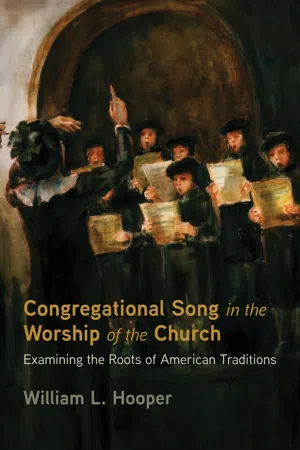
eBook - ePub
Congregational Song in the Worship of the Church
Examining the Roots of American Traditions
- 312 pages
- English
- ePUB (mobile friendly)
- Available on iOS & Android
eBook - ePub
Congregational Song in the Worship of the Church
Examining the Roots of American Traditions
About this book
This book is a study of how congregational song developed and has been used in the worship of Western churches in general and specifically churches in the United States. Beginning with the worship of ancient peoples, the Hebrews, and early Christians and continuing to the present, the author examines historically how song has been and is used as an intentional sacred ritual action, like prayer or Scripture reading. Written primarily as an introductory text for college and seminary students, the overall goal is to make a historical journey with the people, events, and ideas from which have evolved the various types of song we have in American worship today. To help readers think more deeply about the material, study questions are given at the end of each chapter.
Information
Topic
Theology & ReligionSubtopic
Christian Rituals & Practice1
Congregational Song in the Ancient World
His brother’s name was Jubal, the ancestor of all musicians who play the harp and the flute.
—Genesis 4:21
This chapter begins our study with a look at the archaeological evidence for ways primitive humans created song and other objects for worship. This background is then connected to the worship and song of ancient Israel and Abraham. The roots of congregational song go deep into the most ancient religious documents, both biblical and nonbiblical. No one knows exactly when or why mankind first began to worship, but music was part of it.
Christian song also began in these deep roots of human prehistory. No discussion of worship history should ignore these roots, for they have contributed to who we are and to the various forms of worship we have today. Those roots reach back both to prehistoric peoples and to the ancient cultures that existed side by side with Jewish culture found in the Hebrew Bible (the Christian Old Testament).
Prehistoric Peoples
The term “prehistoric peoples” may seem strange to some of you. It simply means people who existed before written history and are generally listed as either Homo neanderthalis, Homo erectus, or Homo sapiens. According to Ian Tattersall, homo sapiens is the species to which all modern human beings belong and is one of several species grouped under the genus Homo, but it is the only one that is not extinct.1 The name homo sapiens means “wise man,” and was created by Carolus Linnaeus, the father of modern biological classification, in 1758 CE. The Latin noun homo means “human being,” and sapiens is the Latin participle that means “discerning, wise, sensible.”
There is evidence that perhaps Homo neanderthalis and Homo sapiens existed at the same time briefly. Skeletons of both populations are found in several adjacent caves in Israel on Mt. Carmel and in Galilee, and Israel is one of the few places in the world where this is so. A wide variety of studies regarding the origins of modern humans (our species) and the demise of the Neanderthals have focused on these remains in Israel. It is also no surprise that the cluster of prehistoric caves on Mt. Carmel was recently declared as a UNESCO World Heritage Site.2
How Do We Learn about Prehistoric People?
Obviously, we are limited in our knowledge of prehistoric people because we have no written records to help us. Our information comes primarily through archaeology, but some information also comes from the field of anthropology. Both of these fields use scientific tools in making their discoveries.
Archaeology is basically the study of humanity and its past through the excavation of sites. Archaeologists study things that were created, used, or changed by humans. They do this by studying the material remains, the stuff we leave behind, such as tools, pottery, jewelry, stone walls, dwellings, food remains, toilet remains, and monuments. The goal of archaeology is to understand how and why human behavior has changed over time.
Some archaeologists were interested in the individuals, nations, and geographical places mentioned in the Bible. Consequently, the field of biblical archaeology was developed and the first biblical archaeologists set out to discover if the Bible was a reliable source of information. As a result, biblical archaeologists have verified many of the places, names, and events through archaeological digs. Though archaeology is the primary way to reconstruct a real-life context for the biblical world, archaeology can never prove any of the theological suppositions of the Bible. Archaeologists can often tell you what happened when and where and how, and even why, but no archaeologist will tell anyone what it means.3 To do so would go beyond the purpose and method of archaeology.
Prehistoric People and the Bible
Some Christians may feel uncomfortable thinking about prehistoric people for whom we have no written records. Where do we find them in the Bible? Since the book of Genesis is the flashpoint, we should approach the book as an ancient document, and use only the assumptions that would be appropriate for the ancient world to gain understanding. God gave his authority to human authors to record his message and share it with the world, writes Walton, “so we must consider what the human author intended to communicate if we want to understand God’s message . . . We must understand how the ancients thought and what ideas underlay their communication.”4
The ancients were concerned with questions about the mysteries of life, such as: Who made the world? How will it end? Where do we come from? Who was the first human? What happens when we die? Why does the sun travel across the sky each day? Why does the moon wax and wane? Why do we have annual agricultural cycles and seasonal changes? What beings control our world, and how can we influence those beings so our lives are easier? The first eleven chapters of Genesis are the answers of ancient people to those questions based upon their understanding of the Creator God and his purposes.
We ask the same questions today, but ancient people answered those questions differently than we do, and we have to interpret Scripture according to the answers that they gave and recorded for us.5 We do a disservice to Scripture when we impose a twenty-first-century mindset upon these ancient thought forms. Because of God’s revelation in Jesus the Christ, Christ followers in the twenty-first century have a knowledge and understanding of God and his purposes and a knowledge of the universe that ancient people did not and could not have.
Christians who take the Bible seriously believe that God inspired the thoughts of the writers when they wrote the Bible, but the words used are tied to the writer’s world and his understanding of God and God’s purposes. The words were not dictated by God. The Bible was not written to us; but it was written for us. What message did the biblical writers send? What was the message the first readers received? When we understand that, we can discover what the message should be for us today. Since we are far removed from the original sacred writings, it is very possible that we could misunderstand the communication that is intended.
The authority of Scripture comes from what the Bible affirms, a...
Table of contents
- Congregational Song in the Worship of the Church
- Prelude
- Acknowledgments
- Chapter 1: Congregational Song in the Ancient World
- Chapter 2: Congregational Song in the Old Testament
- Chapter 3: Congregational Song in the New Testament
- Chapter 4: Congregational Song in the Early Church: 100–600 CE
- Chapter 5: Congregational Song in the Western Church
- Chapter 6: Congregational Song in the Reformation
- Chapter 7: Congregational Song in the English Tradition
- Chapter 8: Congregational Song in Eighteenth- and Nineteenth-Century America
- Chapter 9: Congregational Song in America: 1900–2000
- Chapter 10: Congregational Song in Contemporary America
- Postlude: What Have We Learned?
- Appendix 1: Zwingli’s Zurich Liturgy
- Appendix 2: Presbyterian Church (U.S.A.) Order of Worship
- Bibliography
Trusted by 375,005 students
Access to over 1.5 million titles for a fair monthly price.
Study more efficiently using our study tools.
Frequently asked questions
Yes, you can cancel anytime from the Subscription tab in your account settings on the Perlego website. Your subscription will stay active until the end of your current billing period. Learn how to cancel your subscription
No, books cannot be downloaded as external files, such as PDFs, for use outside of Perlego. However, you can download books within the Perlego app for offline reading on mobile or tablet. Learn how to download books offline
Perlego offers two plans: Essential and Complete
- Essential is ideal for learners and professionals who enjoy exploring a wide range of subjects. Access the Essential Library with 800,000+ trusted titles and best-sellers across business, personal growth, and the humanities. Includes unlimited reading time and Standard Read Aloud voice.
- Complete: Perfect for advanced learners and researchers needing full, unrestricted access. Unlock 1.5M+ books across hundreds of subjects, including academic and specialized titles. The Complete Plan also includes advanced features like Premium Read Aloud and Research Assistant.
We are an online textbook subscription service, where you can get access to an entire online library for less than the price of a single book per month. With over 1.5 million books across 990+ topics, we’ve got you covered! Learn about our mission
Look out for the read-aloud symbol on your next book to see if you can listen to it. The read-aloud tool reads text aloud for you, highlighting the text as it is being read. You can pause it, speed it up and slow it down. Learn more about Read Aloud
Yes! You can use the Perlego app on both iOS and Android devices to read anytime, anywhere — even offline. Perfect for commutes or when you’re on the go.
Please note we cannot support devices running on iOS 13 and Android 7 or earlier. Learn more about using the app
Please note we cannot support devices running on iOS 13 and Android 7 or earlier. Learn more about using the app
Yes, you can access Congregational Song in the Worship of the Church by William L. Hooper in PDF and/or ePUB format, as well as other popular books in Theology & Religion & Christian Rituals & Practice. We have over 1.5 million books available in our catalogue for you to explore.