- 348 pages
- English
- ePUB (mobile friendly)
- Available on iOS & Android
eBook - ePub
About this book
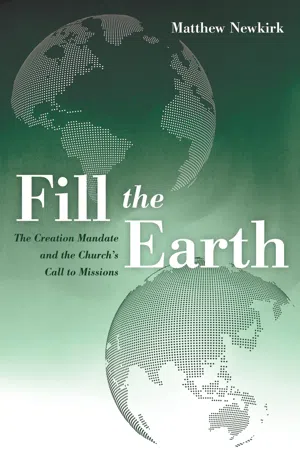
Why does the church engage in missions? Where in the Bible do we find support for this work? These questions have been asked and answered by many throughout the centuries, though rarely does the investigation span across the entire canon of Scripture. In this study Newkirk explores the breadth and depth of biblical teaching concerning God's mission for his people and the church's call to spread the gospel to the ends of the earth. By beginning with creation and ending with new creation, this study reveals that rather than simply deriving from a few "missions verses," the church's call to missions is grounded in the full spectrum of biblical revelation.
Information
Topic
Theology & ReligionSubtopic
Christian Church1
Mission Mandated
Creation
I can still hear the pounding thump of the kick drum. Steady quarter notes came bellowing through the sound system as the worship leader led the crowd, hands lifted high, clapping our hands to the same beat. I was an undergraduate student attending the winter conference of a prominent evangelical campus ministry. This particular evening we had just heard a rousing talk exhorting us to commit ourselves to God’s purposes for the world as outlined in the Great Commission. The speaker’s challenge that night was bold and specific: would we devote at least one year of our life to the work of missions? To the side of the stage was a giant white poster with “The Great Commission” written at the top and the text of Matt 28:18–20 written in smaller font beneath. As the kick drum thumped and the crowd clapped, the speaker returned to the stage and invited everyone who would heed Jesus’ departing command to come down and write their names on the poster. Hundreds of students eagerly descended to the side of the stage and signed their names, thereby committing themselves to a season of missionary service. It was an exciting night. The energy in the room was palpable. Hugs were exchanged. High fives were given. This was a conference that people would remember.
But I did not sign my name.
Looking back, several factors explain my lack of participation that evening. By disposition I am not one to make impulsive decisions, and to sign my name on such a poster felt quite impulsive to me. I am also a bit of a contrarian, so the fact that such a large group responded in such an overwhelmingly positive way made me hesitant to participate at the time. However, the primary reason I did not sign my name that evening was my perception that the speaker was making too much of missions. “This is just one passage,” I thought. “What about the rest of the Bible? If missions is so significant, why doesn’t the Bible talk more about it?”
Years later I continue to find validity in those questions. That is, the rest of the Bible is important, and if missions is so significant we should expect the Bible to devote more space to it than a few scattered verses here and there. However, in the years since that college conference I have also come to realize that the Bible does talk more about missions than a few scattered verses. In fact, I am now persuaded that the entire Bible provides compelling rationale for the work of missions, though such a whole-Bible basis for the missionary task is rarely explicated in the church today. Such is the burden of this book: to show how the church’s call to missions is based not simply on Jesus’ most famous post-resurrection command, or even on a few “missions verses,” but on a biblical theology that begins with God’s first mandate to humanity at creation. My goal is to highlight this missional thread that begins in the creation account and show how it weaves its way throughout the Scriptures, reaching its apex in Jesus’ Great Commission and finding its fulfillment in the new creation. In so doing we will see that, far from being a tangential responsibility of the church, missions is an endeavor that is grounded in the entire breadth of Scripture and therefore is of central importance for the people of God today.
Definitions
Before we embark on this study, however, we must first define our terms. Throughout the following discussion I will use two similar terms that missiologists have long distinguished—mission and missions.1 Etymologically the word “mission” derives from the Latin word missio, which means “sending.” Therefore when we talk about “the mission of the church” we are discussing what the church has been sent into this world to do. Why does the church exist, and what should we be hoping to accomplish? Or to use Christopher Wright’s language, what is the church’s “long-term purpose or goal that is to be achieved through proximate objectives and planned actions”?2 The church’s mission is therefore the big-picture concept; it is the overall task that the church as a whole is called to carry out in this world.
In order to fulfill this mission, as Wright notes, several “proximate objectives and planned actions” must be executed. Activities such as evangelism, discipleship, and worship are no doubt to be included on this list, as is the work of missions. On a popular level, “missions” used to be understood as ministering the gospel in a foreign country, and therefore “missionaries” were those who went to foreign lands and ministered.3 In recent years, however, the label “missions” has come to be applied to a whole spectrum of ministries, both foreign and domestic. These days it is common for everyone from church planters to campus ministers to prison chaplains to be referred to as “missionaries.” Some churches even have signs at the exits of their parking lots that read, “Now entering the mission field,” implying that every believer is a missionary.
In contrast to this, an important stream of missiology has defined “missions” more narrowly and distinguished it from other types of ministry. William Carey, “the father of modern missions” (1761–1834), argued that for missiological purposes we should distinguish between (1) those who do not believe the gospel but have acc...
Table of contents
- TItle Page
- Tables
- Permissions
- Preface
- Acknowledgments
- Abbreviations
- 1. Mission Mandated
- 2. Mission Frustrated
- 3. Mission Resumed
- 4. Mission Organized
- 5. Mission Failed
- 6. Mission Integrated
- 7. Mission Redeemed
- 8. Mission Reinstated
- 9. Mission Executed
- 10. Mission Fulfilled
- 11. Mission Today
- Bibliography
Trusted by 375,005 students
Access to over 1.5 million titles for a fair monthly price.
Study more efficiently using our study tools.
Frequently asked questions
Yes, you can cancel anytime from the Subscription tab in your account settings on the Perlego website. Your subscription will stay active until the end of your current billing period. Learn how to cancel your subscription
No, books cannot be downloaded as external files, such as PDFs, for use outside of Perlego. However, you can download books within the Perlego app for offline reading on mobile or tablet. Learn how to download books offline
Perlego offers two plans: Essential and Complete
- Essential is ideal for learners and professionals who enjoy exploring a wide range of subjects. Access the Essential Library with 800,000+ trusted titles and best-sellers across business, personal growth, and the humanities. Includes unlimited reading time and Standard Read Aloud voice.
- Complete: Perfect for advanced learners and researchers needing full, unrestricted access. Unlock 1.5M+ books across hundreds of subjects, including academic and specialized titles. The Complete Plan also includes advanced features like Premium Read Aloud and Research Assistant.
We are an online textbook subscription service, where you can get access to an entire online library for less than the price of a single book per month. With over 1.5 million books across 990+ topics, we’ve got you covered! Learn about our mission
Look out for the read-aloud symbol on your next book to see if you can listen to it. The read-aloud tool reads text aloud for you, highlighting the text as it is being read. You can pause it, speed it up and slow it down. Learn more about Read Aloud
Yes! You can use the Perlego app on both iOS and Android devices to read anytime, anywhere — even offline. Perfect for commutes or when you’re on the go.
Please note we cannot support devices running on iOS 13 and Android 7 or earlier. Learn more about using the app
Please note we cannot support devices running on iOS 13 and Android 7 or earlier. Learn more about using the app
Yes, you can access Fill the Earth by Matthew Newkirk in PDF and/or ePUB format, as well as other popular books in Theology & Religion & Christian Church. We have over 1.5 million books available in our catalogue for you to explore.