- 230 pages
- English
- ePUB (mobile friendly)
- Available on iOS & Android
eBook - ePub
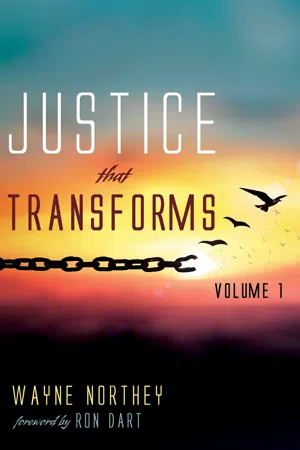
Justice That Transforms, Volume One
About this book
Restorative Justice was a term and concept largely unused before the mid-1970s. Wayne Northey happened to be in on the ground floor of facilitating its worldwide adoption as a challenge to Western retributive justice systems, ultimately to violent responses to conflict domestically and internationally. The most replicated early model of Restorative Justice, based on the well-known "Elmira Case," was a Canadian first, initially dubbed Victim Offender Reconciliation Project (VORP). The author became its second director in 1977. The term "mediation" later displaced the more religious word, "reconciliation," as the model spread outside Christian moorings; and "program" displaced the initially more tentative "project."
At seminary, Northey had learned to think through one's vocation theologically. He began in that vein, writing and publishing on this profound call for a systemic "paradigm shift," and has been at it ever since. This publication is volume 1 of a series of his collected writings, of which two additional volumes may be found online. Two or three further volumes are projected.
Information
A New Paradigm of Justice
Context:
From a Canadian vantage point, Dr. Herman Bianchi, a Dutch criminologist, is one of the three “grandfathers” (if one must use that term) chronologically of Restorative Justice, together with Mark Yantzi and Dave Worth, the first and longstanding Restorative Justice practitioners/theorists in Canada. Though the term predates all three, and other related practices were taking place in the United States and elsewhere. There are issues in any event about referring to “Restorative Justice” as though a unified “movement” with a single “grandfather” or “grandmother.”
Contemporary Western Restorative Justice theory and practice were not first developed by Americans, though they have greatly contributed to its worldwide expansion. In particular Howard Zehr’s name stands out in the earlier and subsequent years; but not as theory originator, or first practitioner. A hagiographic myth assigns the term “grandfather” to one person, when there is in fact no such.
There had been numerous previous publications in Dutch by Dr. Bianchi. One such was the Restorative Justice classic, Justice As Sanctuary, which had been published in Dutch (Gerechtigheid als Vrijplaats) in 1985, and was eventually translated into English in 1994 through American criminologist Harold Pepinsky. A year later Dr. Bianchi co-edited Abolitionism: Towards a Non-Repressive Approach Towards Crime. My contribution was the final chapter seen here. The idea of “paradigm shift” is borrowed from Howard Zehr, in turn from Thomas Kuhn.1 Bianchi’s writings have seldom received their rightful due in relation to Restorative Justice theory. He lent his scholarly weight as well all through the early years of Restorative Justice to “The International Conference on Penal Abolition (ICOPA)”—see more below.
Dan Van Ness’ and Karen Heetderks Strong’s 1998 seminal Restoring Justice was comprehensive in its historically contextualizing Restorative Justice, and more encompassing than Zehr’s 1990 Changing Lenses. Dan’s impact on the early years of development was huge. His was also the first major website (under Justice Fellowship, an arm of Prison Fellowship), and it posted synopses of eventually thousands of resources.
Years ago I read about two persons on a crowded subway train in New York, where one happened to overhear the other say “Frodo” in conversation with someone else. The story goes that he literally dove across the sea of people, exclaiming, “You’re reading Tolkien too?!” In the early years of Restorative Justice, to hear someone in the criminal justice system use that term became a kind of instant bonding. Then the term began to appear in programs of criminal justice gatherings. And finally, emblazoned boldly on their sides were government-funded Restorative Justice “ocean liners” programs, when until then we few had to be content with small speedboats to spread the news—often enough early on running out of gas, then eventually at times initially swamped by the new ocean-going vessels . . .
And though there are other claimants,2 Mark Yantzi’s and David Worth’s “Kitchener Experiment/The Elmira Case” in Kitchener, Ontario, Canada became the most replicated program model, arguably the first.3
There were also significant theoretical contributions and practices from Canadian aboriginal communities that take Restorative Justice back millennia—likewise in indigenous cultures worldwide—though again Dr. Richards negates ahistorical romanticizing about the claimed complete absence of retributive justice elements in those ancient-to-modern cultures. Canadians Crown Attorney Rupert Ross and Judge Barry Stuart are key early theorists and practitioners in this area.
A year after Zehr’s book appeared,4 Harold Pepinsky and Richard Quinney edited and published Criminology As Peacemaking, directly challenging the entire warmaking terminology and practice in criminal justice,5 calling alternatively for commitment to “make peace with crime and criminals [which absence] is reflected in the paucity of our daily personal relations, where we live by domination and discipline, where forgiveness and mercy are seen as naïve surrender to victimization. The essays in this volume propose peacemaking as an effective alternative to the ‘war’ on crime. They range from studies of the intellectual roots of the peacemaking tradition to concrete examples of peacemaking in the community, with special attention to feminist peacemmaking traditions and women’s experience.”6
It was from that amazing book that I learned ever after to describe Restorative Justice at its simplest to be a peacemaking, not a warmaking response to crime—one quite expandable to all brokenness in human and international relationships. Pepinsky and Quinney belong to the panoply of early Restorative Justice “grandfathers.” They also connected this strand to the wider peace movements historically and around the world.
One chapter below, “Is There a Place for Dreaming?,” picks up on the i...
Table of contents
- Title Page
- Foreword
- Preface
- Acknowledgements
- Chapter 1: A New Paradigm of Justice
- Chapter 2: Restorative Justice26 Then, Now and A Dream
- Chapter 3: Presentation on Spirituality of Penal Abolition
- Chapter 4: Punishment and Retribution
- Chapter 5: Homo Homini Ubuntu
- Chapter 6: Spirituality Evaluation of Restorative Justice
- Chapter 7: Restorative Reintegration
- Chapter 8: Restorative Justice and Prison Visitation
- Chapter 10: “Not Enough!” and International Restorative Justice
- Chapter 11: Is There A Place For Dreaming?
- Chapter 12: Restorative Justice Stories
- Chapter 13: The Sex Offender as Scapegoat
- Chapter 14: Transformative Justice Vision and Spirituality
- Bibliography
Trusted by 375,005 students
Access to over 1.5 million titles for a fair monthly price.
Study more efficiently using our study tools.
Frequently asked questions
Yes, you can cancel anytime from the Subscription tab in your account settings on the Perlego website. Your subscription will stay active until the end of your current billing period. Learn how to cancel your subscription
No, books cannot be downloaded as external files, such as PDFs, for use outside of Perlego. However, you can download books within the Perlego app for offline reading on mobile or tablet. Learn how to download books offline
Perlego offers two plans: Essential and Complete
- Essential is ideal for learners and professionals who enjoy exploring a wide range of subjects. Access the Essential Library with 800,000+ trusted titles and best-sellers across business, personal growth, and the humanities. Includes unlimited reading time and Standard Read Aloud voice.
- Complete: Perfect for advanced learners and researchers needing full, unrestricted access. Unlock 1.5M+ books across hundreds of subjects, including academic and specialized titles. The Complete Plan also includes advanced features like Premium Read Aloud and Research Assistant.
We are an online textbook subscription service, where you can get access to an entire online library for less than the price of a single book per month. With over 1.5 million books across 990+ topics, we’ve got you covered! Learn about our mission
Look out for the read-aloud symbol on your next book to see if you can listen to it. The read-aloud tool reads text aloud for you, highlighting the text as it is being read. You can pause it, speed it up and slow it down. Learn more about Read Aloud
Yes! You can use the Perlego app on both iOS and Android devices to read anytime, anywhere — even offline. Perfect for commutes or when you’re on the go.
Please note we cannot support devices running on iOS 13 and Android 7 or earlier. Learn more about using the app
Please note we cannot support devices running on iOS 13 and Android 7 or earlier. Learn more about using the app
Yes, you can access Justice That Transforms, Volume One by Wayne Northey in PDF and/or ePUB format, as well as other popular books in Law & Ethics & Professional Responsibility in Law. We have over 1.5 million books available in our catalogue for you to explore.