eBook - ePub
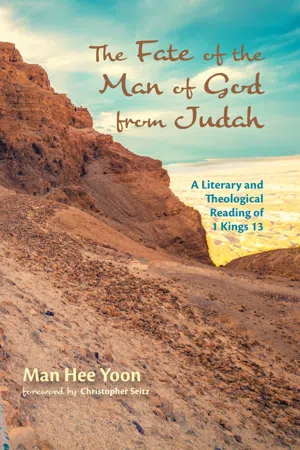
The Fate of the Man of God from Judah
A Literary and Theological Reading of 1 Kings 13
- 186 pages
- English
- ePUB (mobile friendly)
- Available on iOS & Android
eBook - ePub
About this book
An old prophet of Bethel lies to the man of God from Judah, only to lead him to disobey God's command and to die as a result. The man of God is killed for disobedience, while the old prophet lives on and eventually even benefits from the death (2 Kgs 23:18). Why did God punish his prophet who was deceived, not the one who deceived? The text keeps silent about this as well as about the motive of the old prophet's lying.
This strange story takes up a big portion of the Jeroboam narrative (1 Kgs 11-14). For what purpose would the narrator have included the story in his coverage of Israel's history during the reign of King Jeroboam? Does this story have any relevance to the rise and fall of the first king of the northern kingdom? If so, how?
As it untangles the difficult details of the story, this book reveals the narrator's perspective on the way God intervened in the history of Israel and focuses on the suffering that God's prophets sometimes had to undergo as bearers of God's words.
Information
1
A Survey of Modern Scholarship on 1 Kings 13 and Hermeneutical Suggestions
Introduction
More than three decades ago, Lemke said in his article titled “The Way of Obedience” that
This story [1 Kings 13] has been subject to widely divergent scholarly estimates. As yet no consensus has emerged in regard to such basic questions as its date of composition, authorship, form-critical classification, tradition history and significance within the larger structural and ideological framework of the Deuteronomistic History.1
Though there has been some advancement since Lemke regarding the interpretation of 1 Kings 13, most of the issues that Lemke mentioned above have not yet been resolved.
In the first part of this chapter, I will review major approaches to 1 Kings 13 taken by modern scholarship on the issues mentioned previously, especially the issues of the composition and theme. The history of interpretation of 1 Kings 13 has been summarized by some scholars,2 so it is not necessary to reiterate them here. Rather, it will suffice to summarize some of the main paths that scholars have taken and the major shifts made in interpretation in the last several decades. The secondary literature treated in our discussion is by no means comprehensive, but they might be enough to show the trends in the interpretation of 1 Kings 13. The second half of this chapter summarizes the current status of the study of 1 Kings 13 and makes some suggestions for the analysis and interpretation of the story.
A Survey of Modern Scholarship on 1 Kings 13
In the following survey of past scholarship on 1 Kings 13, I will review interpreters and commentators coming from three major approaches: (1) historical-critical approaches, (2) theological/literary interpretations, and (3) narrative criticism.
Historical-Critical Approaches
As in the case with most biblical texts, modern scholars have taken various historical-critical approaches to interpreting 1 Kings 13 such as reconstructing the pre-deuteronomistic state of the text, form-critical and historical studies that focus on the genre of the narrative, and tracing redactional developments of the text.
Historical-Critical Issues Regarding the Date and Composition of 1 Kings 13
The presence of 1 Kings 13 in the larger Jeroboam narrative (1 Kgs 11:26—14:20) has prompted debates among scholars as to whether or not it originally belonged to the Jeroboam narrative. At first glance, 1 Kings 13 seems irrelevant to King Jeroboam. Scholars have noted that the name Jeroboam appears only twice (vv. 1, 4) in the story, and Jeroboam is referred to more often as king (vv. 6, 7, 8, and 11), suggesting perhaps that “Jeroboam” could have been inserted to make this story about Jeroboam. Thus, some historical critics have seen it to be disrupting the Jeroboam narrative, which otherwise would have been a typical narrative that describes a royal reign in Israel. Further, historical critics surmise that there may have existed two different traditions or stories behind the present form of the story (vv. 1–10 and 11–32).
While the first part (vv. 1–10) does seem to relate to the Jeroboam’s reign, it is not as clear how the second half of the story (vv. 11–32)—describing the interactions between the man of God from Judah and an old prophet of Bethel—could be related to the surrounding narratives.3 This suspicion is supported by the facts that Jeroboam disappears from the scene after v. 10 until he reappears in vv. 33–34 and that the issue being addressed in vv. 11–32 seems to have nothing to do with the “sin” of Jeroboam (1 Kgs 12:30; 13:34). These views reflect the seeming differences that may exist in different parts of the story. As a result, some scholars have concluded that the two stories might have been joined together, because of the coincident connection of the character “the man of God” that the two stories share, but they did not investigate further as to why the stories would have been inserted in the present location. Other scholars (e.g., Julian Morgenstern), however, consider vv. 11–32 as a secondary expans...
Table of contents
- Foreword by Christopher Seitz
- Preface
- Acknowledgments
- Abbreviations
- Introduction
- 1 A Survey of Modern Scholarship on 1 Kings 13 and Hermeneutical Suggestions
- 2 Exegesis of 1 Kings 13
- 3 A Literary Analysis of the Jeroboam Narrative
- 4 A Theological Approach to the Jeroboam Narrative
- Conclusion & Future Study
- Bibliography
Trusted by 375,005 students
Access to over 1.5 million titles for a fair monthly price.
Study more efficiently using our study tools.
Frequently asked questions
Yes, you can cancel anytime from the Subscription tab in your account settings on the Perlego website. Your subscription will stay active until the end of your current billing period. Learn how to cancel your subscription
No, books cannot be downloaded as external files, such as PDFs, for use outside of Perlego. However, you can download books within the Perlego app for offline reading on mobile or tablet. Learn how to download books offline
Perlego offers two plans: Essential and Complete
- Essential is ideal for learners and professionals who enjoy exploring a wide range of subjects. Access the Essential Library with 800,000+ trusted titles and best-sellers across business, personal growth, and the humanities. Includes unlimited reading time and Standard Read Aloud voice.
- Complete: Perfect for advanced learners and researchers needing full, unrestricted access. Unlock 1.5M+ books across hundreds of subjects, including academic and specialized titles. The Complete Plan also includes advanced features like Premium Read Aloud and Research Assistant.
We are an online textbook subscription service, where you can get access to an entire online library for less than the price of a single book per month. With over 1.5 million books across 990+ topics, we’ve got you covered! Learn about our mission
Look out for the read-aloud symbol on your next book to see if you can listen to it. The read-aloud tool reads text aloud for you, highlighting the text as it is being read. You can pause it, speed it up and slow it down. Learn more about Read Aloud
Yes! You can use the Perlego app on both iOS and Android devices to read anytime, anywhere — even offline. Perfect for commutes or when you’re on the go.
Please note we cannot support devices running on iOS 13 and Android 7 or earlier. Learn more about using the app
Please note we cannot support devices running on iOS 13 and Android 7 or earlier. Learn more about using the app
Yes, you can access The Fate of the Man of God from Judah by Man Hee Yoon in PDF and/or ePUB format, as well as other popular books in Theology & Religion & Biblical Criticism & Interpretation. We have over 1.5 million books available in our catalogue for you to explore.