eBook - ePub
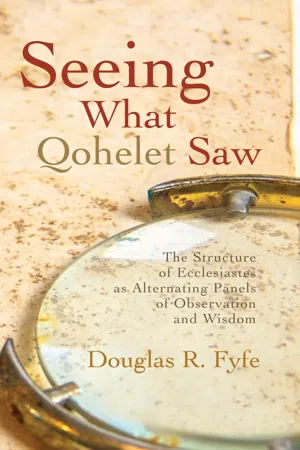
Seeing What Qohelet Saw
The Structure of Ecclesiastes as Alternating Panels of Observation and Wisdom
- 132 pages
- English
- ePUB (mobile friendly)
- Available on iOS & Android
eBook - ePub
Seeing What Qohelet Saw
The Structure of Ecclesiastes as Alternating Panels of Observation and Wisdom
About this book
If the content of Ecclesiastes is not hard enough on its own, the fact that there has been no consensus around the structure adds to its difficulty. With this book, there is a strong argument for a structure which draws various threads together and provides a straightforward way to read Ecclesiastes. This book pays close attention to cues in the text and demonstrates how the verb "to see" helps organize the text into panels of Qohelet's first-person observation, which alternate with panels of his collected wisdom. This book first argues for this structure, and then shows it in practice, working carefully through the individual units to demonstrate how the structure advocated within the book aids the reader in reading Ecclesiastes.
Information
PART 1:
The History of the Search for a Structure
Background
Ecclesiastes is a really difficult book. The goal of this book—discerning the structure Ecclesiastes—is just one of a number of questions which have found little widespread agreement. Other similarly contentious issues include the questions of dating and authorship, the Redaktionsgeschichte (how the book came together), as well as the tone in which we are supposed to read the book. These are indeed important issues, and my hope is that the structure of Ecclesiastes presented in this book will help those trying to think through various questions relating to Ecclesiastes to at the very least have a common starting point for reading the book according to the divisions revealed by this structure.
At the outset I should be very clear that the structure presented in this book is not exclusive to any understanding of the tone, dating, and authorship of Ecclesiastes. My own views on these things will come through in the book, but views different than my own do not affect the way the structure I have presented here is to be understood.1 Nevertheless, it is worth briefly mentioning my approach to the Redaktionsgeschichte. I side with those who perceive one hand behind the final product. That is, it makes most sense to me that Qohelet (the main character of Ecclesiastes, whose words appear in the body of the book) is the literary creation of the author, and it is he whose journey and findings we follow, while his words are framed by a frame narrator. As Fox, who best explicated the idea of the frame narrator, explains, “I suggest that all of 1:2—12:14 is by the same hand—not that the epilogue is by Qohelet, but that Qohelet is ‘by’ the epilogist.”2 Therefore, when talking about the body of the book, it is appropriate to speak of the words of Qohelet as well as the words of the author. However, when speaking of the introduction and conclusion to Qohelet’s words, it is appropriate to speak of the author or frame narrator. From a practical point of view, this frees readers up to work from the final form of the book, sitting as “listeners” without the need to go behind the text to determine (or speculate about) redactional layers. That is, whatever the history may have been, the final form of the text is what we must deal with, rather than any hypothetical Urtext or rearranged reconstruction.
What this book will do then is outline in detail a structure which, from a structural point of view, responds to cues in the text and brings together and develops previous approaches in elucidating a structure. From an heuristic perspective this structure will aid reading and allow the reader to get into the mindset of the author.
Historical Approaches
There have been various approaches to discerning the structure of the book, and there are plenty of good summaries elsewhere. Wright, for instance, worked chronologically through his predecessors, describing two types of approaches before him, with himself as a new third way. The first group he described saw no structure at all, while the second discerned “some unity or progression of thought.” He styled himself the leader of a third group, the beginnings of the “New Stylistics” or the “New Critics.”3 Fifty years on from Wright, Holmstedt, Cook and Marshall note a similar threefold division: a first group who found no structure as they understood the book to be a collection of aphorisms, a second who saw a progression tied to key phrases, while ...
Table of contents
- Title Page
- Preface
- Acknowledgments
- Part 1: The History of the Search for a Structure
- Part 2: The Observation Panels
- Part 3: The Wisdom Collections
- Part 4: The Book’s Bookends
- Conclusion
- Bibliography
Trusted by 375,005 students
Access to over 1.5 million titles for a fair monthly price.
Study more efficiently using our study tools.
Frequently asked questions
Yes, you can cancel anytime from the Subscription tab in your account settings on the Perlego website. Your subscription will stay active until the end of your current billing period. Learn how to cancel your subscription
No, books cannot be downloaded as external files, such as PDFs, for use outside of Perlego. However, you can download books within the Perlego app for offline reading on mobile or tablet. Learn how to download books offline
Perlego offers two plans: Essential and Complete
- Essential is ideal for learners and professionals who enjoy exploring a wide range of subjects. Access the Essential Library with 800,000+ trusted titles and best-sellers across business, personal growth, and the humanities. Includes unlimited reading time and Standard Read Aloud voice.
- Complete: Perfect for advanced learners and researchers needing full, unrestricted access. Unlock 1.5M+ books across hundreds of subjects, including academic and specialized titles. The Complete Plan also includes advanced features like Premium Read Aloud and Research Assistant.
We are an online textbook subscription service, where you can get access to an entire online library for less than the price of a single book per month. With over 1.5 million books across 990+ topics, we’ve got you covered! Learn about our mission
Look out for the read-aloud symbol on your next book to see if you can listen to it. The read-aloud tool reads text aloud for you, highlighting the text as it is being read. You can pause it, speed it up and slow it down. Learn more about Read Aloud
Yes! You can use the Perlego app on both iOS and Android devices to read anytime, anywhere — even offline. Perfect for commutes or when you’re on the go.
Please note we cannot support devices running on iOS 13 and Android 7 or earlier. Learn more about using the app
Please note we cannot support devices running on iOS 13 and Android 7 or earlier. Learn more about using the app
Yes, you can access Seeing What Qohelet Saw by Douglas R. Fyfe in PDF and/or ePUB format, as well as other popular books in Theology & Religion & Biblical Criticism & Interpretation. We have over 1.5 million books available in our catalogue for you to explore.