eBook - ePub
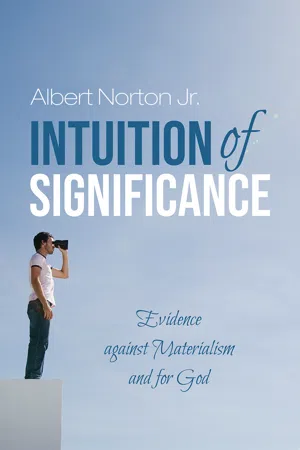
Intuition of Significance
Evidence against Materialism and for God
- 160 pages
- English
- ePUB (mobile friendly)
- Available on iOS & Android
eBook - ePub
About this book
There is a big gap between the orthodox Christian understanding of reality, and that of the default materialism of the culture. We tend not to recognize the default perspective as coherent, doctrinal, and dogmatic, in the same way religion is understood to be. This is partly because of the tendency to describe one's views by what they are not, rather than what they are. To say "I'm not very religious," for example, is to say what one isn't, not what one is. The effect of this tendency is to obscure the metaphysical stance absorbed in place of religion, leaving an illusory neutrality concerning spiritual truth.
Reality is the widest conceptual net we can cast. The right first question is: what constitutes all of reality? Theism provides one answer, materialism another. We would do well to look critically at both. This book traces the fault line between theism and materialism so as to follow the evidence where it leads--evidence like the fact of being; our incessant yearning; our competing desires both for significance and insignificance; and the subjective motivations we have with respect to beauty, truth, and morality, all indicators of transcendent truth to which our physical surroundings point.
Information
Topic
Theology & ReligionSubtopic
Christian TheologyChapter 1: The Question
Significance
There seems to be but two ways of receiving the physical world: as a thing enchanted unto itself, or as a thing just so—a brute fact of physical existence and nothing more. The universe is either alive with meaning and purpose, or it operates mechanistically based on physical laws acting on material things. There is some ultimate significance to how we live this life, or there is nothing beyond physical cause and effect in our actions. Do our lives have significance beyond our daily scrabbling for food, security, acceptance, comfort, and prestige? Is there some ultimate meaning to our being here, or is the intuition of meaning a kind of excess baggage in our biology?
We each of us have a deep intuition of significance. It feels as if there must be some point to our lives, beyond just getting through another day. This intuition is deepened when we consider the alternative of meaninglessness. We are intuitively repulsed by the notion that there is no point to our lives. Or if not repulsed, perhaps sedated, in a manner of speaking, by having pushed the question of meaning outside the periphery of our consciousness. Or we may convince ourselves there is meaning in the very absence of meaning, embracing a kind of existentialist torpor.
This intuition of significance is either an artifact of our biology, merely useful for survival, or it is the recognition of something beyond but also pervading the physical cosmos. There’s no middle ground. Either there is no ultimate point to our existence, or there is. If there is, then the source of that meaning has to lie outside ourselves and the physical world we briefly inhabit. And if it lies outside ourselves, that means it lies in a domain conceptually distinct from the world of causes and effects on material things. It is the unseen reality which exists in and through the seen cosmos. It is spiritual reality.
We could call that which is beyond nature super-nature, so as to imply that it is beyond nature but also running in and through nature. We might describe an event as being “supernatural,” for example, if it in some way defies the laws of physics or is otherwise outside of usual natural processes. That word carries some baggage, however, in that it is sometimes used in the context of ghost stories and the like, which can quickly take us off the point of our inquiry here. So it may better suit our purposes to refer to that which is not physical as being spiritual, signifying an animating presence distinct from physical reality, but to which physical reality is in some way subject, so that spiritual reality can rightly be regarded as the superior reality, supervening upon that which is constrained by space and time.
This requires some explanation because of the many ways we use the word “spiritual.” We speak of school spirit, or spirit in the sense of being unusually animated, or of distilled “spirits” which alter our thinking. Those are all derivative meanings. The primary meaning of “spirit” is that which stands in opposition to “physical” or “natural.” The spiritual realm is understood to be distinct from the physical realm but not spatially or temporally, so it co-exists with us in a way we cannot fully perceive while living in these physical bodies.
This is an inquiry into “metaphysics.” Strictly speaking, a naturalist or materialist might be regarded as anti-metaphysical, inasmuch as he believes that that which is physical constitutes all of reality. It would follow that there is no “meta-” physical reality, in that view, and therefore a materialist stands in opposition to any conception of metaphysical reality. The word “metaphysics” is nonetheless sometimes used even by materialists, because it is a useful way to describe things that are admittedly non-physical but nonetheless real, like love or beauty or thought or honor. Materialists might regard those as being emergent properties of that which is physical, rather than being a part of reality distinct from the physical. Their use of “metaphysical” refers to that which is not itself physical, though derived from that which is.
We typically think of supernatural events as intervening or supervening upon natural events. A supernatural cause would intervene if it stopped the natural chain of events and substituted another. We might think of the miracle of virgin birth in this way, for example. Normally, without the joining of human egg and sperm there would be no baby. This is the necessary physical cause of natural conception. An actual virgin birth would have to have a supernatural cause, therefore.
A supernatural cause would supervene if it acted upon natural causes in some way to steer them to a given result. These would presumably be less obvious. If one were to pray for rain and then it rained, for example, there would normally be no way of knowing whether the rain resulted from divine intervention into the physical causes of the rain.
The supernatural is associated with heaven, a “place” that is not really a place in the way we space-bound creatures conceive things. It is understood to be eternal, which we can take to mean characterized by timelessness; that is, existing outside of time rather than in a “place” where time is unending. Thus, there is a realm for a Creator that is outside the creation and from which he creates, such that physical creation is not self-created. That realm is also not limited spatially in the way creation is, because it does not have defining spatial dimensions in the way our physical surroundings do.
The Creator, God, stands outside time and space, except insofar as he chooses to transcend it. In this conception, it would make sense that nature is a subset, so to speak, of super-nature. Heaven suffuses the physical universe, so it is there alongside us all the time, but not apparent to us given our physical limitations.
Supernatural intervention into space and time could manifest physically. This would be a significant proof of the unseen dominion. And so it makes sense that people who are receptive to the idea of this unseen reality would be eagerly on the look-out for such manifestations. It would be easy to be mistaken and assign supernatural significance to merely natural events. But if there is in fact a supernatural reality, and the possibility that it would manifest inside space-time so that it is apparent to us, then people are quite right to look for signs of it.
There has sometimes been an over-eagerness to look for signs of God. When the natural processes around us were less well-understood, there was a tendency to assign to God (or to a god) activity that was actually merely natural. Thunder might be ascribed to the gods’ anger, for example. Among Christians there was, in scientifically simpler times, a tendency to God-of-the-gaps thinking, wherein gaps in scientific knowledge were ascribed to mysteries of God. But usually gaps in scientific knowledge mean only that the scientific process has not yet filled in the gap. A gap in knowledge of the natural universe is not by itself proof of God. A God-of-the-gaps mentality is rightly discredited, but that does not mean we should lurch entirely to the opposite error. If there are phenomena unexplained by science, we should not assume a naturalism-of-the-gaps mentality, either.
Instances in which natural processes are suspended or set aside are called miracles. The word “miracle” is sometimes over-used to mean anything that is exciting or complex or heartening or otherwise dear to us, like a child being born or recovery from a grave illness. These may involve supernatural intervention, but may not, and the immediate causes are usually explainable by reference to natural processes. As miraculous as new parents might regard the arrival of a new baby, there is a biological explanation for it.
There is a sense, however, in which even such events as recovery from illness or birth of a baby might be regarded as having supernatural origin, though such origin might be so attenuated that “miraculous” is not the right word for it. It is proposed, by many religious belief systems, that there is some sense in which God, who presides over this natural realm, has a continuing involvement with it. Not only in the sense of intervening in ways large and small, from time to time, but also in the sense of a continuing, supervening, upholding of the world. If there is a supernatural reality that is far beyond the limitations of our presently space- and time-bound existence, it is not far-fetched that there is some constant infusion of God-stuff, for want of a better word, that maintains the world as we know it. That God-stuff might be called love, or common grace.
Theism vs. Materialism
If there is a spiritual reality which imparts meaning to humanity, then there must be God. We can conceive of God as the First Cause, and the ultimate superlative to which all human-understood ideals point. It would take this omnipotent source of Being-in-itself to impart genuine meaning or purpose to humanity. A being less than all-powerful and all-good God would yield a counterfeit sense of purpose.
But perhaps this intuition of significance is an illusion. We readily suppose there is a spiritual reality, but we can un-imagine it. We can attempt to conceive of the cosmos as reducible to matter in motion, and nothing more. Immensely complex, but not enlivened by anything beyond it. We can imagine there is no master intelligence, in the universe, and that the intelligence of human beings derives from matter, not the ultimate Mind of God. Matter, in this imagining, creates mind, not the other way around.
The question is whether the evidence points to God, or is better explained by materialism. Materialism (or naturalism) is the spirit of the age, following an epoch of specifically Christian theism, which followed an epoch of paganism. In our culture, when a person rejects God, he doesn’t typically adopt paganism or pantheism instead. Usually the turn is, perhaps unwittingly, to materialism.
Every person who ever considers questions of ultimate reality has to work from the evidence available. Intuition of significance is a form of evidence, and so are physical things accessible to our senses. And so is the rationality of the human mind, and the universal moral sense, and the marvelous order of the cosmos. These and other bits of evidence can be evaluated on the basis of theism, and of materialism, and that’s what is undertaken in this book. “Theism” is the belief that God is, and that he is active in the world. “Materialism” is the belief that there is no God, therefore all evidence must be explained in terms of matter and physical forces acting on it. These two visions of reality are mutually exclusive.
Definitions
Among the difficulties of perceiving the metaphysical viewpoint in opposition to theism is that of simple labeling. What word do we attach? “Materialism” is used here, but it can easily be confused with another definition the word carries: acting upon acquisitiveness, greed, avarice, or the tendency to identify with one’s consumer choices. In philosophical terms, however, “materialism” refers to matter, the physical stuff of the universe. Matter is subject to physical forces, so we can refer to materialism as matter-in-motion, an irreducible description of the physical stuff of the cosmos.
“Naturalism” refers to belief solely in nature, which in turn refers to the physical universe, as distinct from any spiritual reality which may or may not run in and through physical things. So “naturalism” would also be a serviceable label for the metaphysical worldview principally in opposition to theism, in the modern age. But this label, too, is potentially confusing. “Nature” is also used to refer to plants and animals and their interactions in ecosystems of the earth. Or to distinguish environments that are relatively untouched by mankind, like old-growth woodlands or uncultivated prairies or ocean deeps. “Nature” by that definition distinguishes between mankind and its influences, on the one hand, and the rest of the living world, on the other. A person who studies nature so described, or simply has a strong affinity for it, might be called a “naturalist.” “Nature” and “naturalism” are not used in this book to refer to nature-lover endeavors, however, but rather in a philosophical sense, essentially a synonym for materialism. Naturalism describes the belief system which holds that everything is explainable by natural processes; that all of reality consists of matter and forces acting on it according to physical laws; that there is no God and no supernatural reality of any kind. Theism and naturalism stand in fundamental opposition.
While we’re making important word distinctions, let’s consider the word “reality.” We sometimes speak loosely of reality when we mean only the physical cosmos, but that is a mistake if there is also a spiritual realm standing behind and through it. If there’s something other than nature, then reality encompasses that, too. Reality is the largest conceptual net one can cast. It’s important, when speaking of reality, not to assume away the existence of unseen spiritual reality.
Enchantment
The difference between these two competing worldviews—theism and materialism—is profound. Which is true? This is the most important question for any individual, and for any society. We may live with an upward call from the prosaic claims of the body to the poetry of the soul in communion with God. Or we may live with ...
Table of contents
- Title Page
- Introduction
- Chapter 1: The Question
- Chapter 2: Intuition
- Chapter 3: Existence of Physical Things
- Chapter 4: Nature
- Chapter 5: Ideals
- Chapter 6: Order
- Chapter 7: Disorder
- Chapter 8: History
- Chapter 9: Desire for Freedom
- Chapter 10: Conscience
- Chapter 11: Truth and Rationality
- Chapter 12: Consciousness
- Chapter 13: Knowledge, Belief, Faith
- Chapter 14: Significance
- Chapter 15: Yearning
- Chapter 16: Beauty
- Chapter 17: Gratitude
- Chapter 18: Religion
- Chapter 19: Silence
- Bibliography
Trusted by 375,005 students
Access to over 1.5 million titles for a fair monthly price.
Study more efficiently using our study tools.
Frequently asked questions
Yes, you can cancel anytime from the Subscription tab in your account settings on the Perlego website. Your subscription will stay active until the end of your current billing period. Learn how to cancel your subscription
No, books cannot be downloaded as external files, such as PDFs, for use outside of Perlego. However, you can download books within the Perlego app for offline reading on mobile or tablet. Learn how to download books offline
Perlego offers two plans: Essential and Complete
- Essential is ideal for learners and professionals who enjoy exploring a wide range of subjects. Access the Essential Library with 800,000+ trusted titles and best-sellers across business, personal growth, and the humanities. Includes unlimited reading time and Standard Read Aloud voice.
- Complete: Perfect for advanced learners and researchers needing full, unrestricted access. Unlock 1.5M+ books across hundreds of subjects, including academic and specialized titles. The Complete Plan also includes advanced features like Premium Read Aloud and Research Assistant.
We are an online textbook subscription service, where you can get access to an entire online library for less than the price of a single book per month. With over 1.5 million books across 990+ topics, we’ve got you covered! Learn about our mission
Look out for the read-aloud symbol on your next book to see if you can listen to it. The read-aloud tool reads text aloud for you, highlighting the text as it is being read. You can pause it, speed it up and slow it down. Learn more about Read Aloud
Yes! You can use the Perlego app on both iOS and Android devices to read anytime, anywhere — even offline. Perfect for commutes or when you’re on the go.
Please note we cannot support devices running on iOS 13 and Android 7 or earlier. Learn more about using the app
Please note we cannot support devices running on iOS 13 and Android 7 or earlier. Learn more about using the app
Yes, you can access Intuition of Significance by Albert Norton,Albert Norton Jr. in PDF and/or ePUB format, as well as other popular books in Theology & Religion & Christian Theology. We have over 1.5 million books available in our catalogue for you to explore.