eBook - ePub
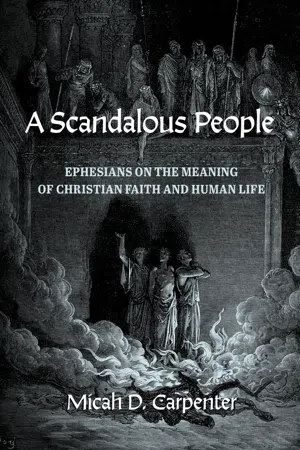
A Scandalous People
Ephesians on the Meaning of Christian Faith and Human Life
- 184 pages
- English
- ePUB (mobile friendly)
- Available on iOS & Android
eBook - ePub
About this book
This book is not a commentary, an exegetical study, or a work of systematic theology. It is a conversation. Let's sit down together, read Ephesians, strain our minds and our imaginations, and have a good chat. If you want all your difficult textual questions answered, there are many good commentaries on the shelf. This book is here to help you ask some new questions--and not just about this ancient letter, but about God, your life, and the purpose of the entire universe.
Paul's letter to the Ephesians is a work of timeless theological genius which brilliantly addresses many of the enduring questions about human life. It presents a scintillating vision of the glory of God and the meaning of Christian faith. It also brings an urgent and revitalizing message to the church in our time: in Christ, God has enacted a plan for the world which is most surprising in the face of its conventional rationalities and religious common sense. God has invited us to be inhabitants of this redemptive drama through faith, and insofar as we do so, we are a scandalous people.
Information
1
The Scandal of Particularity
Paul Among the Philosophers
Paraphrase: Ephesians 1:1–14
From Paul, an apostle of Christ Jesus by the will of God, to God’s holy people in Ephesus, who are faithful in Christ Jesus: grace and peace be to you, from God our Father and the Lord Jesus Christ.
May the God and Father of our Lord Jesus Christ be praised! In Christ, he has blessed us in the heavenly realms with every spiritual blessing.
God chose us in Christ before the creation of the world to be holy and blameless before him. In his love, he pre-purposed us from the beginning to be adopted into his family—royal heirs with and through his Son Jesus Christ. This was not only his purpose but also his pleasure, overflowing to the praise of his glorious grace, which he has freely given us in his beloved one. In him, through his blood, we are redeemed and forgiven of our sins. This too came of his glorious grace which he has lavished on us. In his great wisdom and understanding, God was pleased to reveal to us the mystery of his will (his purpose in Christ) which has unfolded in the appointed time of its fulfillment. This purpose was to bring all things in heaven and earth together into unity under Christ.
It is in him and for this purpose that we too have been chosen. God, who works out everything in accordance with his purpose, also pre-purposed us, his people, according to this plan. He did this so that we, who were among the first people to put our hope in Christ, might contribute to the great praise of his glory. You were included in Christ when you heard the message of truth, the good news of your salvation. When you believed, you were marked “in Christ” with the seal of the Holy Spirit. He is a deposit guaranteeing our inheritance until the time of our redemption, when God comes to claim us as his own. This too will be for the praise of his glory!
In these words, Paul breathlessly exclaims the glories of the eternal purposes of God. His prose here is like a turbulent and effervescent waterfall of delight in the great works of God. But Paul’s contagious joy, which he so wants to share with his audience, is not simply over a grand theological idea about God, but a reality which has entered the world, in which Paul and his audience personally participate: the death and resurrection of Jesus Christ. Because of Jesus and what he has accomplished, Paul joyfully declares that those who put their trust in him are beneficiaries of (and collaborators in) the eternal and glorious purposes of God.
We need to be aware from the outset that these opening paragraphs of Ephesians, which at first glance might appear to us a glorious but somewhat chaotic jumble of theological phrases, are really a story. One of the basic characteristics of all stories is that they are tensed: they have a beginning, a middle, and an ending. That exactly describes the structure of Paul’s paragraph here, although this may be obscured to us by the sheer scope of its timeline, which begins in eternity past, ends in eternity future, and dwells in the “now” of our history which has been punctuated by the great central event of Jesus’ death and resurrection.
Like all stories, however, Paul’s has a backstory. To tell this backstory, we would properly need to recite the entire Old Testament. We won’t do that, of course, though I hope that you will read it yourself. We will at least need to think a little bit about the beginning—God’s purposeful and loving act of creation as described in Genesis. But first, to see this passage in the prophetic perspective in which it properly belongs, we will need to begin with a different kind of backstory: the story of human thought regarding the meaning of the universe and our place in it as human beings—or in other words, the story of philosophy.
The Philosophers’ Quest: The Unity of All Things
The story of philosophy is all about the attempt to answer the question “What is ultimate reality?” Throughout the era of early Greek philosophy, this specifically took the form of the question “What is the one irreducible thing, substance, or concept, to which reality can be boiled down?” One of the first attempts of an answer was put forward by Thales, who speculated that all material reality was some form of water. As silly as such an answer might sound to us, the significance of Thales’s proposal lies in the basic intuition that reality is reducible to some kind of unity. This same intuition continued to drive the development of Greek philosophy, from Pythagoras, who reduced reality down to numbers or mathematical ratios, to Plato, who conceived of ultimate reality as a world of forms (that is, a realm of immaterial, timeless ideals), the top of which was the all-embracing but mysterious form of the good. According to Plato, who has been tremendously influential throughout the history of human thought through the present day (one philosopher from the last century said, with only a little exaggeration, that all Western philosophy is a merely a long series of footnotes to Plato), humans only have contact with ultimate reality through the intellect. According to Platonism, the great good of human life is to detach ourselves from our material and temporal concerns which cloud our reason, and gaze with our mind’s eye upon the immaterial and changeless world of the forms: the good, the true, and the beautiful. Put differently (and significantly for the question which we will examine in a moment), Plato and the philosophers who followed him tended to equate ultimate reality with those things which, while existing apart from the material world, are universal rather than particular. To discover the ultimate meaning of things, we need to look away from particular objects, people, and events, and look to the universal qualities which underlie them.
Certainly not all Greek philosophy took up this exact perspective, as influential as it was, but again the most important point to be seen is that almost all the Greek philosophers were consumed with the question of how to find the essential unity of all things. This has been described as the question of the one and the many, and can be restated as follows: “In a world which contains such a seemingly chaotic multiplicity of objects, materials, creatures, and events, how do we find an underlying unity which makes sense of them all and pulls them together into a single coherent scheme?1 If there is a one underneath the many, how does it have contact with the world? How can we understand it and order our lives accordingly?”
Perhaps no more important question has ever been posed in the history of philosophy. And lest we think that this is merely an academic question suitable only for theorists of the abstract, we should be reminded that this a question which really bedevils us all. Whenever we struggle with the sense that our world and our lives are too chaotic; when we feel that our world is broken into many pieces; that eventually things must (we hope) fall together and make sense; that we want to live our lives in a well-ordered way toward an appropriate goal—we are wrestling with the central question of philosophy, and perhaps of human life itself.
In summary, there are at least two essential questions which emerge from the study of philosophy. First, “What is the ultimate reality which gives unity and coherence to all the complexities of our world?” Second, “What is our relationship to this ultimate reality—how can we connect our life to what ultimately matters?” These are two of the most important questions we can ask about our world and our place in it.
Paul Among the Philosophers: The Great Story of Reality
Ephesians 1:1–14 is kind of a glorious theological explosion which erupts in the midst of this question and presents a scandalous answer. Of course, we don’t know whether Paul had Greek philosophy in mind at all when he wrote these words. But apart from any such reference, the very content of this great passage instantly puts it into dialogue with the basic questions of philosophy, for Paul’s words are luminously charged with the matters of ultimate reality.
Paul’s scandalous answer is this: the ultimate reality which gives unity and coherence to all things in the world is Jesus Christ. The meaning of life, and of the universe itself, is not an “it.” It is not a thing, nor a disembodied idea, but a person: God incarnate as Jesus of Nazareth, and specifically his surprising action, committed within the humble confines of time and space, of dying on a cross. Paul makes this clear: “God was pleased to reveal to us the mystery of his will (his purpose in Christ) which has unfolded in the appointed time of its fulfillment. This purpose was to bring all things in heaven and earth together into unity under Christ.” And the answer to the second part of the question—how we can be personally connected to this ultimate reality and thereby root our lives in something ultimately meaningful—is clear as well. God designed this whole scheme of things with us in an important role: to participate in his glory by being holy and blameless members of his family. We can do this by being united with the unifier of all things, Jesus Christ. We are “included in Christ” (and thereby become beneficiaries of and participants in the eternal purposes of God) when we hear “the message of truth, the good news of your salvation.” When we believe, we are marked “in Christ” with the seal of the Holy Spirit.
Life in our chaotic world therefore has (despite appearances) a center and a unity, in which we as human beings are invited to partake. This center is the person of Jesus Christ, who has come in our history to put our world back together—a unity to mend the shattering of relationships because of human sin and rebellion. His needle for mending the torn garment is the cross, and it did its work by piercing his own flesh.
This reuniting of all things in Christ which Paul describes is also apparent in this passage in the sense that he has renarrated the history of the world in a way which is radically different from any history a human being might have documented or even dreamed up. All human events, as random as they might seem from our perspective, are enfolded into a history written by God, and therefore have a sense of direction, purpose, and coherence. It’s worth taking a moment to unpack this history which we glimpse in Ephesians 1.
The Beginning
God chose us in Christ before the creation of the world to be holy and blameless before him. In his love, he pre-purposed us from the beginning to be adopted into his family—royal heirs with and through his Son Jesus Christ (1:4–5).
It is in him and for this purpose that we too have been chosen. God, who works out everything in accordance with his purpose, also pre-purposed us, his people, according to this plan (1:11).
Genesis 1:1 says “In the beginning, God created the heavens and the earth.” As magnificent a statement as this is, Paul outdoes it by calling attention to God’s work even before the creation of the world. When we think about this, using the word “before” to discuss events which happened before creation—and therefore before history and even time itself—seems rather contradictory. How can there be a “before” when we have stepped outside of the created world of time altogether? But we are misled if we stop merely to puzzle this out (as Augustine did, when in his Confessions he pondered how to respond to the question regarding what God was doing before the creation of the world). The point is that the creation of the heavens and the earth, as tremendous an accomplishment as that was, is in some sense secondary to God’s primal decision to have for himself a people, united in his holy purposes through participation in Christ.
Conceived this way, we might say that the physical creation—earth, sun, stars, galaxies, and space-time itself—exists simply to provide a suitable loc...
Table of contents
- Title page
- A Scandalous People
- Acknowledgements
- Introduction
- Chapter 1: The Scandal of Particularity
- Chapter 2: The Scandal of Power
- Chapter 3: The Scandal of Grace
- Chapter 4: The Scandal of Unity
- Chapter 5: The Scandal of God’s Human Project
- Chapter 6: The Scandal of Love
- Chapter 7: The Scandal of the Church
- Chapter 8: Ethics and the Scandal of the Christian Life
- Chapter 9: Christian Relationships and the Scandal of Submission
- Chapter 10: The Scandal of Warfare
- Bibliography
Trusted by 375,005 students
Access to over 1.5 million titles for a fair monthly price.
Study more efficiently using our study tools.
Frequently asked questions
Yes, you can cancel anytime from the Subscription tab in your account settings on the Perlego website. Your subscription will stay active until the end of your current billing period. Learn how to cancel your subscription
No, books cannot be downloaded as external files, such as PDFs, for use outside of Perlego. However, you can download books within the Perlego app for offline reading on mobile or tablet. Learn how to download books offline
Perlego offers two plans: Essential and Complete
- Essential is ideal for learners and professionals who enjoy exploring a wide range of subjects. Access the Essential Library with 800,000+ trusted titles and best-sellers across business, personal growth, and the humanities. Includes unlimited reading time and Standard Read Aloud voice.
- Complete: Perfect for advanced learners and researchers needing full, unrestricted access. Unlock 1.5M+ books across hundreds of subjects, including academic and specialized titles. The Complete Plan also includes advanced features like Premium Read Aloud and Research Assistant.
We are an online textbook subscription service, where you can get access to an entire online library for less than the price of a single book per month. With over 1.5 million books across 990+ topics, we’ve got you covered! Learn about our mission
Look out for the read-aloud symbol on your next book to see if you can listen to it. The read-aloud tool reads text aloud for you, highlighting the text as it is being read. You can pause it, speed it up and slow it down. Learn more about Read Aloud
Yes! You can use the Perlego app on both iOS and Android devices to read anytime, anywhere — even offline. Perfect for commutes or when you’re on the go.
Please note we cannot support devices running on iOS 13 and Android 7 or earlier. Learn more about using the app
Please note we cannot support devices running on iOS 13 and Android 7 or earlier. Learn more about using the app
Yes, you can access A Scandalous People by Micah D. Carpenter in PDF and/or ePUB format, as well as other popular books in Theology & Religion & Biblical Criticism & Interpretation. We have over 1.5 million books available in our catalogue for you to explore.