- 128 pages
- English
- ePUB (mobile friendly)
- Available on iOS & Android
eBook - ePub
About this book
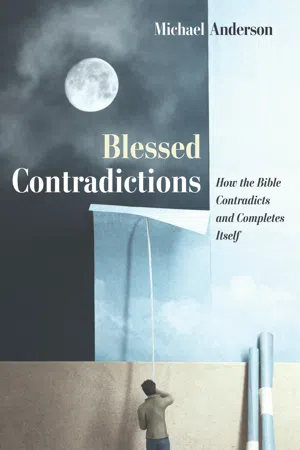
Blessed Contradictions invites the reader to think in new ways about how to understand Scripture. The Bible is written by many authors who often have differing points of view. Instead of seeing these differences as inconsistencies or weaknesses, Blessed Contradictions considers them strengths--ways to see God, theology, ethics, and theodicy from alternative angles. Each of the eight chapters will compare one biblical author to another, show their contradictions, and celebrate the blessings of such diversity.
Information
Chapter One
The Creation Stories
Typically, more than one hundred people will gather in our church in early September to begin the two-year Bible study program called Crossways.1 We get organized by passing out materials, discussing various Bible translations, and looking at the schedule of the classes for the coming nine months. We will meet every Wednesday evening for about an hour and a half, September to May, covering the sixty lessons. At the end of two years, we will have read the entire Bible, from Genesis to Revelation. The first organizational meeting is always filled with excitement, anticipation, and the chance to meet new friends as we begin a significant journey together.
In the second session, when we open our Bibles to the first three chapters of Genesis, the tone of the entire program is set because it is during our discussion of the creation stories in Genesis that we must consider our attitudes toward the Bible itself. Is the Bible to be considered literal? Were there people named Adam and an Eve who actually walked in a garden? Did a snake really talk? And, if we see many of the Bible stories as metaphor, which are fact, which are not? Always, in the first session on Genesis, we end up discussing the contemporary debate between creationism or intelligent design and the theory of evolution. “Which is ‘true’?” people ask. “Where do you stand, Pastor?” “If the creation stories are not ‘true’ what else is not ‘true’ in Scripture?” Such questions give us opportunity to consider a very important idea related to the interpretation of the Bible, that is, how we define “truth.”
Beginning in the seventeenth century with the development of Enlightenment thinking and the scientific method, “truth” has been equated with fact. What is “true” can be proven as factual using the tools of scientific research and evaluation. Truth then is merely fact. Even people who defend the creationism / intelligent design understanding of creation use the scientific framework for the definition of truth. They argue with evolutionists using the same criterion for truth as the scientific method—facts only.
As we begin Crossways one of our most important conversations is the emphasis that truth can be more than mere fact. There is truth which is beyond that which can be scientifically proven. How does one “prove” love? Or beauty? Or compassion? The Bible is not primarily a book of facts, although there are many historically accurate facts in the Bible. The Bible, as it tells the creation stories initially around the campfire, is not as concerned with how the world was created—the scientific emphasis—but rather who created the world and why. The Bible is about the presence of the divine behind the creation. It is about the mystery and the reality of evil and what God does about evil.
Sometimes I will ask my class some stories they all know and ask them the purpose of a story. For example, did George Washington really chop down the cherry tree and then make his confession? It is a story, I tell them, which has no historical accuracy, at least using the criterion of science; but it is a story which speaks to a deeper meaning than fact. It is a story about character and the kind of personal qualities that animated our first president and inspire us. Is the story true? Yes, at the level of what is most important and vital to our nation. It is then that students share their own understanding of stories that may not be literally true but, nonetheless, are fundamentally true—Abraham Lincoln walking miles to return a few pennies in change, “Horatio Alger” stories of self-reliance and perseverance, and many of our movies, books, and art which today speak to the soul and not just of the literal facts. As we return to the Bible and the creation stories, we now can approach them with an even greater reverence than simply the scientific critique of the historian. These are stories meant to carry the deepest yearnings of the soul. They touch us with ideas of the divine, the nature of the universe, evil, and redemption.
At this point in my opening lecture on Genesis, I often surprise the class with a comment no one expects. I mention that it is just fine with me if they choose to understand the creation stories as literally fact. I also say it is fine if you understand the creation stories as metaphorically true. “In this class,” I say, “You can be a creationist [and I hold out one hand to my right] or you can choose to be an evolutionist [and I hold out my other hand to my left]. In this class we will look at what the Bible teaches at a more profound level than simply scientific fact. We don’t have to argue about creationism versus evolution [and then I bang my fists together]. No, we rise above the debate about science, to a third level of interpretation which views the creation stories as theology [and I move my hands together above my head].” Concluding, I tell them that a literal interpreter or a metaphorical interpreter must rise above their concern for scientific truth to a higher level of theological truth.
Two Creation Stories
So, what do the creation stories teach us about the nature of God and our relationship to God? Notice that I have made references to the “creation stories” in Genesis. There are, indeed, two creation stories in the first three chapters of Genesis, each written by an author who offers a certain angle or perspective regarding the nature of God and creation. The two perspectives are quite different from each other—what I would call “blessed contradictions.” The first creation story describes God as distant, remote, “other” than creation. The theological word to describe such an understanding of God’s nature is “transcendent.” God transcends this world and is unknowable and, yet, awe-inspiring. A second creation story describes God as “immanent”; that is, very close to us, as close as our breath, or our heartbeat.
The first of the creation stories begins at Genesis 1:1 and proceeds to chapter 2, verse 4a (the first half of that verse). As my Crossways students read this first creation story, they are struck by how orderly the story is; there is a poetic, even liturgical, day-by-day progression to the language. “On the first day . . . and God saw that it was good.” Each day brings into being some new aspect of creation and always the day ends with the reflection that “God saw that it was good.”
Scholars believe that this orderly account of creation was presented by the priestly class of ancient Israel and is, therefore, given the designation of the “P” writer(s). The priests write their orderly account with liturgical precision and a great emphasis is placed on God’s power, distance, and authority. It is quite understandable that the priests would present God with such a transcendent emphasis, after all, it was the priestly class which was responsible for mediating between God and humanity. The rituals, sacrifices, and worship services organized by the priests all emphasized God as “other” and approachable only through the efforts of the specialized priestly class.
To this day we appreciate and recognize the transcendent nature of God. Priests in many denominations continue to act as mediators between creation and the transcendent creator. Even church architecture, often designed by the priests, can emphasize the transcendence of God. As a child, I attended a small Lutheran church built in the traditional “basilica” style of ancient Rome—a rectangular shaped building with a long center aisle, pews on either side, and an altar far to the front, up a few steps and protected by a fence. Even at nine years of age, I knew that I should not go beyond that “fence” into the altar area; it was sacred and only for the priest/pastor. The greatest cathedrals of Europe are all built with a similar emphasis on the transcendent, powerful, sacred, and mysterious nature of God. It is an emphasis that accurately reflects a part of our understanding of God, but it is not the only perspective. The “P” writer has presented God as transcendent but Genesis provides a counterbalance.
The second creation story in Genesis begins at chapter 2:4b and continues to the end of chapter 3; it presents us with a much different perspective of God and creation. Its description of God is almost opposite that of the priestly writers, and yet is completely understandable and meaningful to the reader. This “blessed contradiction” actually helps us understand that, yes, God is distant from us, but God is also close to us, intimate, personal, and, using the theological word, “immanent.” The writer of this second creation story has been labeled by scholars as the “J” writer because this author always refers to God as “Jahweh.” Jahweh is the Hebrew verb “to be,” so using it as God’s name basically says God “is.” It is not just that God exists somewhere, God is present, here, and will always be here. God as Jahweh, was, is, and will be. Jahweh is immanent like the air surrounding us and giving us moment-by-moment breath and life.
The “J” writer presents an understanding of God’s nature which is nearly the direct antithesis of the “P” writer and so the “J” writer uses a completely different approach or method to tell his creation story. Where the “P” writers use a liturgical, repetitious style of writing, the “J” writer just tells a story, as if we are all sitting around a campfire rather than standing in some ornate cathedral or temple. The story we hear from “J” is familiar to nearly all people on earth. Jahweh creates a garden, in Hebrew, a “paradise,” where Adam is created on the first day. (This is different from the “P” writer, where humanity—male and female—was created on the sixth day.) The “J” writer describes Jahweh walking in the garden, fashioning the human form from the mud of the earth, and breathing the spirit of life into Adam. It is an intimate portrayal of God, much different from the distant, awesome God of the “P” writer. As the story unfolds, we know that God is close to us humans, as close as our breath. God’s spirit is in us, we are created in the image of God, and yet, we realize we are of the earth, the mud.
The garden itself was beautiful, verdant, and Adam could eat of any tree except the one in the middle—the tree of the knowledge of good and evil. The garden, however, is a lonely place, and just as Jahweh desires relationship with Adam, Adam also needs a companion of his own kind. It seems we humans are built for relationship, at least that is what this story teaches. Jahweh creates animals and birds, but no companion is adequate. Jahweh completes the creation finally with Eve. Adam now has a partner and human society—human community—is born. My own understanding of this story, and the Bible generally, was greatly enhanced when, as a twelve-year-old boy, I learned the word “Adam” in Hebrew also meant humanity. Without community and relationship, we are not fully human.
When the “J” story of creation is placed next to the “P” story we see God presented as close to us (immanent) and very distant (transcendent). It appears to be a contradiction, but it is also a blessing because it allows us to hold in tension two aspects of God’s nature we humans have envisaged and experienced throughout history. The two stories complement each other and even though they contradict, they also balance our understanding of God’s nature. It is, however, not only God’s distance versus God’s closeness that finds balance and completion here; there is also the question of evil. Both stories are essential to a new understanding of something called “theodicy”—the theological word for the problem of evil in our world.
The “J” writer speaks about the nearness of God but also about a question the “P” writer leaves unresolved. In the creation story of the priestly writers, God is all powerful, transcendent, and creates with a word and everything is good. It is a creation story different from all the other creation stories circulating in the ancient Near East. Usually creation myth stories included stories of a great struggle or battle between two opposing forces. The Babylonian Enuma Elish creation story is an example. Marduk becomes the great hero of the Babylonian religion because he slew the powerful dragon Tiamat and then sliced her in two. He then used the two halves to create the sky and the earth. Obviously in this story, as with every other creation story in the Near East, the earth, the material world, has some evil embedded in it. The Hebrews told a story where there is only one God who is all powerful and creates the world to be only good. The question that remains then is, “Where does evil come from?”
When “J” tells his story of the garden, part of the purpose is to speak to the question of evil present in God’s good world. As we mentioned “J” uses story to make a theological point. Therefore, “J” tells the story of Adam and Eve, a talking serpent, a fruit from the tree in the middle of the garden, and the dire consequences. The tree of the knowledge of good and evil is in the garden and Jahweh is careful to warn the humans not to eat from it, “for surely on that day you will die.” Jahweh gave the humans the gift of limits, like a parent putting limits on children. A talking serpent (not Satan at this point in Scripture) then tempts Eve to eat of the fruit, Eve tempts Adam, and soon both have eaten and something within them has surely died. The relationship of openness, trust, honesty, and love which Jahweh had intended is replaced by deceit, blame, arrogance, and rebellion. Now Adam and Eve, whose openness had been symbolized by their nakedness, must cover themselves with a façade of competence symbolized by the clothing made of fig leaves.
By telling this story, the “J” writer completes the story of “P.” The “J” writer, however, does not answer the...
Table of contents
- Title page
- Preface
- Chapter 1: The Creation Stories
- Chapter 2: Leviticus vs. the Prophets
- Chapter 3: Deuteronomy vs. Job
- Chapter 4: Ezra/Nehemiah vs. Ruth/Jonah
- Chapter 5: Mark’s Theology of the Cross vs. John’s Theology of Glory
- Chapter 6: Matthew’s New Chosen People vs. Luke’s New Human Society
- Chapter 7: Paul vs. James
- Chapter 8: End of the World: Exclusive vs. Inclusive
- Epilogue
- Bibliography
Trusted by 375,005 students
Access to over 1.5 million titles for a fair monthly price.
Study more efficiently using our study tools.
Frequently asked questions
Yes, you can cancel anytime from the Subscription tab in your account settings on the Perlego website. Your subscription will stay active until the end of your current billing period. Learn how to cancel your subscription
No, books cannot be downloaded as external files, such as PDFs, for use outside of Perlego. However, you can download books within the Perlego app for offline reading on mobile or tablet. Learn how to download books offline
Perlego offers two plans: Essential and Complete
- Essential is ideal for learners and professionals who enjoy exploring a wide range of subjects. Access the Essential Library with 800,000+ trusted titles and best-sellers across business, personal growth, and the humanities. Includes unlimited reading time and Standard Read Aloud voice.
- Complete: Perfect for advanced learners and researchers needing full, unrestricted access. Unlock 1.5M+ books across hundreds of subjects, including academic and specialized titles. The Complete Plan also includes advanced features like Premium Read Aloud and Research Assistant.
We are an online textbook subscription service, where you can get access to an entire online library for less than the price of a single book per month. With over 1.5 million books across 990+ topics, we’ve got you covered! Learn about our mission
Look out for the read-aloud symbol on your next book to see if you can listen to it. The read-aloud tool reads text aloud for you, highlighting the text as it is being read. You can pause it, speed it up and slow it down. Learn more about Read Aloud
Yes! You can use the Perlego app on both iOS and Android devices to read anytime, anywhere — even offline. Perfect for commutes or when you’re on the go.
Please note we cannot support devices running on iOS 13 and Android 7 or earlier. Learn more about using the app
Please note we cannot support devices running on iOS 13 and Android 7 or earlier. Learn more about using the app
Yes, you can access Blessed Contradictions by Michael Anderson in PDF and/or ePUB format, as well as other popular books in Theology & Religion & Biblical Criticism & Interpretation. We have over 1.5 million books available in our catalogue for you to explore.