- 214 pages
- English
- ePUB (mobile friendly)
- Available on iOS & Android
eBook - ePub
About this book
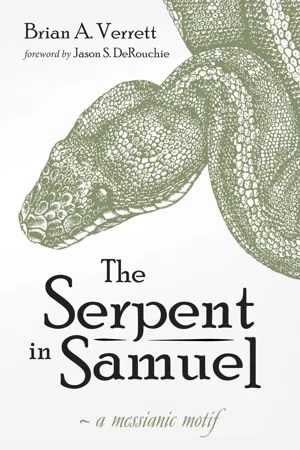
In this study, Brian A. Verrett argues that 1-2 Samuel contains a serpent motif by practicing biblical theology and literary criticism. This motif derives from the serpent in Genesis 3, and its function within the Samuel narrative is to heighten the reader's anticipation in the coming messiah, who is the son of David and the seed of the woman from Genesis 3:15. This messiah will defeat the serpent and inaugurate his glorious reign over a renewed world. When 1-2 Samuel is read in this way, one appreciates previously unnoticed features of the text, understands aspects of the text that were formerly confusing, and rightly sees that the whole of 1-2 Samuel is a messianic document.
Information
1
INTRODUCTION
Allusions to Gen 3 abound throughout the Old Testament and New Testament (hereafter OT and NT). As John L. Ronning has demonstrated, one of these allusions from Gen 3 that permeates the Bible is to the serpent.1 James Hamilton has also shown that the serpent’s defeat is a major theme in Scripture.2
Some have suggested that the joint book of 1 and 2 Samuel (hereafter Samuel) cast particular characters as serpents in order to allude to Gen 3. The Samuel narrative refers to Nahash, the king of the sons of Ammon on multiple occasions.3 As some recognize, Nahash (נחשׁ) means “snake.”4 Given the biblical authors’ tendency to imbue names with meaning, could these references to Nahash be allusions to Gen 3? Furthermore, 1 Sam 17:5 says that Goliath’s armor is scaly (קשׂקשׂים)—a word always used for the skin of a sea creature.5 According to most, David then crushes Goliath’s forehead with a stone.6 He then falls with his face—and therefore mouth—to the ground immediately before David decapitates his head. Perhaps the text intends to allude to Gen 3 when God’s judgment falls on a scaly foe whose mouth is on the ground and who dies from a strike to his head.
1.1. Previous Scholarship Identifying Serpents within Samuel
As mentioned, scholars have identified various characters as “serpents” within Samuel. These characters are Goliath, Nahash (the king of the Ammonites), Hanun, Absalom, and Amasa. What follows is a brief survey of their various arguments for identifying these characters as being serpentine.
1.1.1. Goliath as a Serpent in Samuel
Ronning is one who has argued that the Samuel narrative presents Goliath as a serpent.7 Ronning points out that Goliath has “scale” (קשׂקשׂים) armor and that the word “scale” is used for sea creatures. The only other person to have “scaly” skin is Pharaoh in Ezek 29:3–4, and this text presents Pharaoh as a sea monster. Ronning understands the connection between קשׂקשׂים and sea creatures to suggest that Goliath is serpentine. Ronning finds further support of Goliath’s serpent identity in 1 Sam 17:5–6. In these verses the narrator mentions four times that his armor and weaponry is bronze (נחשׁת), which Ronning suggests is a wordplay with “serpent” (נחשׁ). Finally, in 17:4 Goliath, the Philistines’ “champion,” is literally the “in betweens-man” (אישׁ־הבנים).8 Ronning posits that Goliath’s unusual title alludes to the four times that “between” (בין) is used in Gen 3:15.
Hamilton’s conclusions about Goliath agree in large measure with Ronning’s. After demonstrating that the bruising of the serpent’s skull is a prominent theme throughout the OT, he argues that Goliath’s crushed skull is an allusion to the serpent from Gen 3:15.9 Peter Leithart too believes that the author of Samuel signals that Goliath is a serpent by detailing his scale armor and crushed head.10
1.1.2. Nahash, the King of the Sons of Ammon, and Hanun as Serpents i...
Table of contents
- Title Page
- FIGURES
- FOREWORD
- ACKNOWLEDGEMENTS
- ABBREVIATIONS
- Chapter 1: INTRODUCTION
- Chapter 2: BIBLICAL THEOLOGY OF THE SERPENT
- Chapter 3: GOLIATH AS A SERPENT
- Chapter 4: NAHASH AS A SERPENT
- Chapter 5: THE SERPENT WITHIN SAMUEL
- Chapter 6: THE SEED OF DAVID AS THE SEED OF THE WOMAN
- Chapter 7: THE MESSIANIC HOPE OF THE NEW CREATION IN 2 SAMUEL 23:1–7
- CONCLUSION
- BIBLIOGRAPHY
Trusted by 375,005 students
Access to over 1.5 million titles for a fair monthly price.
Study more efficiently using our study tools.
Frequently asked questions
Yes, you can cancel anytime from the Subscription tab in your account settings on the Perlego website. Your subscription will stay active until the end of your current billing period. Learn how to cancel your subscription
No, books cannot be downloaded as external files, such as PDFs, for use outside of Perlego. However, you can download books within the Perlego app for offline reading on mobile or tablet. Learn how to download books offline
Perlego offers two plans: Essential and Complete
- Essential is ideal for learners and professionals who enjoy exploring a wide range of subjects. Access the Essential Library with 800,000+ trusted titles and best-sellers across business, personal growth, and the humanities. Includes unlimited reading time and Standard Read Aloud voice.
- Complete: Perfect for advanced learners and researchers needing full, unrestricted access. Unlock 1.5M+ books across hundreds of subjects, including academic and specialized titles. The Complete Plan also includes advanced features like Premium Read Aloud and Research Assistant.
We are an online textbook subscription service, where you can get access to an entire online library for less than the price of a single book per month. With over 1.5 million books across 990+ topics, we’ve got you covered! Learn about our mission
Look out for the read-aloud symbol on your next book to see if you can listen to it. The read-aloud tool reads text aloud for you, highlighting the text as it is being read. You can pause it, speed it up and slow it down. Learn more about Read Aloud
Yes! You can use the Perlego app on both iOS and Android devices to read anytime, anywhere — even offline. Perfect for commutes or when you’re on the go.
Please note we cannot support devices running on iOS 13 and Android 7 or earlier. Learn more about using the app
Please note we cannot support devices running on iOS 13 and Android 7 or earlier. Learn more about using the app
Yes, you can access The Serpent in Samuel by Brian A. Verrett in PDF and/or ePUB format, as well as other popular books in Theology & Religion & Biblical Criticism & Interpretation. We have over 1.5 million books available in our catalogue for you to explore.