- 150 pages
- English
- ePUB (mobile friendly)
- Available on iOS & Android
eBook - ePub
About this book
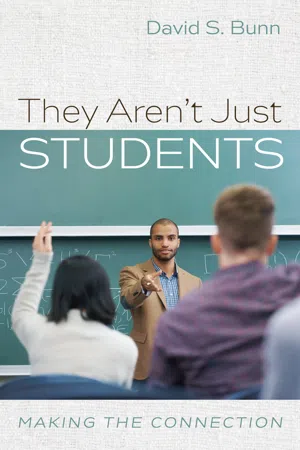
This book is geared towards the academic as well as the trade audience. There are very few books for college teachers that encourage them with specific ways to become better teachers. As such, this book is very unusual in its information and purpose, making it a very valuable tool for anyone who wants to teach. This book stands well on its own but would also make a great supplement for any college text book.
For a trade audience this book has applications to high school and elementary school teachers who can easily make the leap between teaching college and their current level students. It will also be of interest to parents as they evaluate the quality of those who teach their children.
Written in the style of Irvin. D. Yalom and his book The Gift of Therapy, this work is based on general research themes and experience rather than specific studies. It is written in a direct and personal style to the reader with many examples from the twenty-one years of teaching experience by the author.
Information
Topic
EducationSubtopic
Education Teaching MethodsChapter One
How It All Began
I wish that I could say that in becoming a teacher I achieved a goal that I had been aspiring to all along. To do so would be acting in bad faith because nothing could be further from the truth. So, while I don’t think teaching has to be a “calling” to be done well, I do think it has to be a “passion” to be done well. I am very passionate about it.
I met Donna Zulch when I was a nineteen-year-old, long-haired kid who was playing guitar in a local heavy metal band. She taught the first class of my first semester as a college student. Thirty-one years later I remember that day like it just happened. Donna was, and still is, beautiful, intelligent, and compassionate. As a teacher she had a gentle and charismatic way about her. She was wise yet humble. She related to us students in a way that made me feel very connected with her. From my years in high school I was used to teachers being a bunch of judgmental and arrogant hypocrites whose sole purpose seemed to be making teenagers feel worthless. The Assistant Principal of the high school I attended told me at age sixteen that, “you will never amount to anything.” My experience with Donna was a much different and wonderful change of pace for me. Additionally, she worked professionally in the field as a Licensed Clinical Social Worker, so she had a wealth of practical experience which she used effectively to illuminate the course material. My goal when I started college was to become a therapist. This class with Donna, which started my academic career as a college student, validated for me that I was in the right place.
Through the years as I completed my bachelor’s and master’s degrees, I remained friends with Donna. I began working professionally in the field of human services upon completion of my bachelor’s degree, so in addition to being a friend, Donna had also become a professional colleague. On several occasions she would invite myself and other service providers from the community into her classroom to talk about our various professional experiences with her students.
One day I received an unexpected phone call from Donna. She expressed that she was no longer going to be teaching and asked how I would feel about her recommending me to teach one of the courses she had. It was a course named Therapeutic Intervention Skills. This request caught me off guard. I had never thought about teaching. Donna and I had never discussed this before either. I was as flattered as I was shocked at this suggestion.
I asked her, “Why me? I have never taught before. Surely you know other people who are more qualified. What makes you think that I of all people would be good at this?” She simply responded, “When I decided I wasn’t going to be teaching anymore, you were the first person who came to mind when I thought about someone to take over this class.” I have always held Donna in extremely high regard, so hearing her say that was one of those special moments that I will never forget.
Now, here is what I was secretly thinking inside as I mulled this over. As a young person working in the field of human services, I loved my jobs (I had two), but I was always broke and living paycheck to paycheck. This is not an unusual scenario for people who work in our field. Everyone knows going in that human services delivery is not the place to go if money is your motivation. I also admired Donna so much as a teacher that I was convinced that I could never do the job as well as she did, so I was not sure if I should even try.
Here is what I ultimately decided to do and why. I have always felt strongly that students should get the best experience possible, and the only way I could find out if I could provide that was to try it. I trusted Donna completely and I concluded that she would not have recommended me for this type of position if she didn’t think I was capable of it. The other motivating factor was that it paid much better than the other “second” job that I was doing, and at that time, I always needed money. Ultimately, I interviewed for and accepted my first adjunct teaching position in 1998 at the age of twenty-nine. I figured I would try it for a semester and if I didn’t like it, or if I was not good at it, I would resign and chalk it up to experience.
And the rest is history. It turned out that I loved it and I was good at it. I have been teaching part-time as an adjunct in the field of psychology in addition to my full-time job as a therapist ever since. Naturally I am a better teacher now than I was twenty-one years ago, just like I am a better clinician now than I was twenty-five years ago. I am a person who is constantly motivated towards self-improvement, so for me this is a natural progression.
In this opening chapter of the book, I want to express my eternal thanks and gratitude to you, Donna. You are a testament to how powerful teachers are. You have been a part of my life for the past thirty-one years as a teacher, mentor, therapist, life coach, and most importantly, a friend. You saw something in me that I did not see within myself. Had it not been for you, I would never have become a teacher, and I would never have written this book. I should mention here that Donna has been my life coach for the past two years, and in that role has served to support and keep me motivated to complete this project. When we found each other, I was nineteen-years old, confused, somewhat lost, and unsure if I had anything of value to offer the world. Your confidence in me helped me to have confidence in myself. I am blessed that you came into my life when you did, and even more so that you have stayed with me through it all. Thank you, Donna.
Chapter Two
To Teach Is to Touch A Life Forever
My mother gave me a framed version of this expression as a gift twenty-one years ago when I accepted my first position as an adjunct instructor. I keep it on my desk at home and refer to it often. It keeps me humble. It serves as a constant reminder that teachers have an important responsibility that goes beyond simply imparting information. We teachers hold the emotional well-being of our students in our hands. We cannot reach them intellectually until we make them feel safe emotionally. Whether we choose to acknowledge it or not, we are very powerful. The self-esteem, motivation, and success of our students are greatly impacted by our actions, words, and example.
To teach is to touch a life forever. As teachers it is important to be aware that the students whom we have the privilege of teaching will remember us for the rest of their lives. So, the question is not whether our students will remember us, but rather, what will they remember us for? As teachers, we will impact the lives of countless others through the lessons we teach our students. In his book Staring at the Sun, Irvin Yalom refers to this as rippling. He says, “rippling refers to the fact that each of us creates, often without our conscious intent of knowledge, a concentric circle of influence that may affect others for years or even generations to come.”1 I once taught basic counseling to a group of medical students. The goal was to teach them to relate to patients with empathy and compassion. At the end of the semester, a student wrote to me, “Professor Bunn, the lessons you taught us in this class not only impacted us in a positive way but will also impact the lives of all of the patients that we will treat in our careers. I thank you, and our future patients thank you.” The ripple effect in action.
The above feedback validates why rippling is a most important concept for we teachers to be mindful of. Statistically, teachers touch more lives during their careers than most others . I will make the argument here that we teachers must be cognizant of this fact and begin to consciously ensure that the ripples that we set into motion have a positive impact on others as opposed to a negative one. The following examples from my own experiences as a student will illuminate this point.
I am currently fifty years old. Forty-three years ago, at the age of seven, when I was in the third grade, a substitute teacher walked up behind me, physically pulled me out of my seat, and screamed at me. When she did this, her face was so close to mine that I could smell the aroma of cigarettes and coffee on her breath. Her eyes were opened so widely that she looked demented. This experience was painful, frightening, and humiliating for me. And the infraction that generated her response? I was talking to the kid sitting next to me. This teacher violated my trust. She violated my physical safety. She hurt my self-esteem. She essentially damaged me. Forty-three years later I can recall this incident like it was yesterday. She touched my life forever in a very negative way. The result? I became very distrustful and formed a very poor opinion of these authority figures we call teachers. A negative ripple.
Another incident occurred three years later when I was in the sixth grade. I remember I did very poorly on an exam. The teacher of that class took great joy in announcing the following, “Well, David, you scored a thirty-seven. It looks like someone is going to fail this class.” The teacher said this loudly as he slammed the test on my desk. My classmates found this funny. I didn’t see the humor in it then, nor do I now. It was embarrassing, and while the teacher’s intention may have been to shame me into trying harder, all it did was add hatred to how frustrated I was already. I failed the class. His methods did not inspire me to succeed. A negative ripple.
And now an example of a positive experience. Several years later as a sophomore in high school, I was required to take a biology class. While I had a strong dislike for biology at the time, and still do, I adored my teacher. She was great. I can still picture her. She was a kind, patient, and compassionate person. She touched my life forever in a very positive way. Why? How did she do this? She was extremely intelligent, but this is not why I remember her. No, I remember her because she was nice to me. She treated me like a human being. She did not care that I wore my hair long, or that I overtly disliked her class. She did not equate my inherent worth as a human being with my physical appearance or academic performance. In Rogerian terms, she treated me with unconditional positive regard. In doing so she restored some of my faith in authority figures, specifically teachers. She helped to repair some of the damage that had been done to me by previous teachers. She gave me what I will call a corrective academic experience. I will remember her fondly for the rest of my life. Kindness and respect are powerful. A positive ripple.
Throughout my career as both a therapist and an adjunct instructor, I am ever mindful of the permanent impact that scenarios like these have. I deliberately ensure that I treat all students and clients with empathy, compassion, and respect. During each semester I request anonymous feedback at various times from students because I want to know what they are thinking and feeling about the class. I will elaborate on this technique in a later chapter. While the comments and concerns vary, there is one theme that remains consistent. Statements like, “I appreciate that you treat us with respect,” and, “You are the first teacher I had that considers me an equal,” are always there. I am proud of that.
As a teacher, I know that I will touch the lives of my students forever. Since they will remember me for the rest of their lives, I want the memories to be positive. That should be the goal of all teachers. Current teachers pay for the sins of teachers who came before them. Let us be sure to behave in a way that creates positive ripples and does not cause teachers that come after us to pay for our sins. Remember, “They Aren’t Just Students.”
1. Yalom, Staring at the Sun, 83.
Chapter Three
“You Seem Awfully Young to Have a Job Like This”
These were the very first words ever spoken to me by a student, ever. Let me explain why. The first eight years of my teaching career were spent at a local community college. It was a two-year school where people could obtain an associate’s degree in various courses of study. It also offered several certificate programs, a nursing program, and was a less expensive place for students to take core courses and then transfer those credits to a more lucrative four-year school. There were many students of a non-traditional age who were there to prepare for a second career, etc. Many of the students on campus were what is considered in the academic world, non-traditional. This means they were older than the average freshman. In some cases, twenty to thirty years older.
This was the case in the first class that I was assigned. I was twenty-nine years old at the time, and I looked much younger. All my students that first semester were at least five years ol...
Table of contents
- Title Page
- Preface
- Acknowledgments
- Introduction
- Chapter 1: How It All Began
- Chapter 2: To Teach Is to Touch A Life Forever
- Chapter 3: “You Seem Awfully Young to Have a Job Like This”
- Chapter 4: A Semester of Academic Therapy
- Chapter 5: A Journey of Personal Growth
- Chapter 6: The Office Hour
- Chapter 7: The Therapeutic Lecture
- Chapter 8: The Semester as a Metaphor for Life
- Chapter 9: You Cannot Be Your Student’s Therapist
- Chapter 10: There Is No Substitute for Experience
- Chapter 11: The Treatment Plan
- Chapter 12: The Academic Alliance
- Chapter 13: The Classroom Is Your Stage
- Chapter 14: Motivational Speaking
- Chapter 15: The First Day of Class
- Chapter 16: Communicate with Students in Writing
- Chapter 17: Show Random Acts of Kindness
- Chapter 18: Tell Your Story If You Have One
- Chapter 19: Sharing Facilitates Intimacy
- Chapter 20: Eighteen and Life
- Chapter 21: What Do You Think I Should Do?
- Chapter 22: When the Best of Intentions Went Wrong
- Chapter 23: Clinical Supplements
- Chapter 24: Redefine What It Means to Be Successful
- Chapter 25: Relationships Are an Investment in Your Future
- Chapter 26: Want to Know How You Are Doing?
- Chapter 27: Trust: It’s a Great Form of Flattery
- Chapter 28: Convince Them the Class is Worth Their While
- Chapter 29: I Almost Got That Job
- Chapter 30: The Gratitude Letter
- Chapter 31: The Self-Talk Evaluation Paper
- Chapter 32: The Wake-Up Call
- Chapter 33: The Empathy Paper
- Chapter 34: Papers Are a Vehicle for Catharsis
- Chapter 35: When the “Academic Illness” is Terminal
- Chapter 36: Can You Defend That in Court?
- Chapter 37: Never Weigh in On the Opinion of Parents
- Chapter 38: Student Evaluations: Read Them
- Chapter 39: Avoid Diagnosing Your Students or People They Know
- Chapter 40: It’s A Human Encounter
- Chapter 41: Use Emotional Precautions
- Chapter 42: Give Students Your Résumé to Establish Credibility
- Chapter 43: A Discussion About Stress
- Chapter 44: I Was A Student Once Too
- Chapter 45: You Won’t Reach Everyone
- Chapter 46: The Benefit of Continuity
- Chapter 47: A Teacher Is Never the Right Age
- Chapter 48: Forget Power Point Slides. Do Power Lectures.
- Chapter 49: Do the Assignments Too.
- Chapter 50: Don’t Teach a Class, Create an Experience
- Chapter 51: Make Direct Observations and Share Them
- Chapter 52: The Students Are Innocent
- Chapter 53: Share What You Have Learned About Life
- Chapter 54: The Journey Ends but the Impact Remains
- Bibliography
Trusted by 375,005 students
Access to over 1.5 million titles for a fair monthly price.
Study more efficiently using our study tools.
Frequently asked questions
Yes, you can cancel anytime from the Subscription tab in your account settings on the Perlego website. Your subscription will stay active until the end of your current billing period. Learn how to cancel your subscription
No, books cannot be downloaded as external files, such as PDFs, for use outside of Perlego. However, you can download books within the Perlego app for offline reading on mobile or tablet. Learn how to download books offline
Perlego offers two plans: Essential and Complete
- Essential is ideal for learners and professionals who enjoy exploring a wide range of subjects. Access the Essential Library with 800,000+ trusted titles and best-sellers across business, personal growth, and the humanities. Includes unlimited reading time and Standard Read Aloud voice.
- Complete: Perfect for advanced learners and researchers needing full, unrestricted access. Unlock 1.5M+ books across hundreds of subjects, including academic and specialized titles. The Complete Plan also includes advanced features like Premium Read Aloud and Research Assistant.
We are an online textbook subscription service, where you can get access to an entire online library for less than the price of a single book per month. With over 1.5 million books across 990+ topics, we’ve got you covered! Learn about our mission
Look out for the read-aloud symbol on your next book to see if you can listen to it. The read-aloud tool reads text aloud for you, highlighting the text as it is being read. You can pause it, speed it up and slow it down. Learn more about Read Aloud
Yes! You can use the Perlego app on both iOS and Android devices to read anytime, anywhere — even offline. Perfect for commutes or when you’re on the go.
Please note we cannot support devices running on iOS 13 and Android 7 or earlier. Learn more about using the app
Please note we cannot support devices running on iOS 13 and Android 7 or earlier. Learn more about using the app
Yes, you can access They Aren’t Just Students by David S. Bunn in PDF and/or ePUB format, as well as other popular books in Education & Education Teaching Methods. We have over 1.5 million books available in our catalogue for you to explore.