- 88 pages
- English
- ePUB (mobile friendly)
- Available on iOS & Android
eBook - ePub
About this book
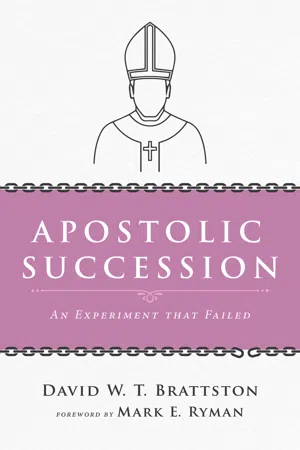
This book is the first in generations to examine writers in the early church in order to ascertain the original Christian intent as to how early Christian clergy were chosen, their powers and responsibilities, and the methods of placing people in church office and displacing them. This book demonstrates what the first writers meant when they advocated apostolic succession, the scope of authority particular church officers would possess, and how their authority would be transmitted.
Besides concentrating on writings in the first to third centuries AD, this book draws on later material to question the assertions made today for bishops claiming apostolic succession. It reveals they are contrary to early church thought, that the doctrine or theory of apostolic succession cannot be proved, and does not work in practice even in our own day. This publication is rare in the field of Christian scholarship in that it challenges the fundamental claims that diocesan bishops do or can trace their lines of ordinations back to the apostles.
This unusual book will comfort many, and disquiet many, and surprise all, because it investigates what many assume, without solid proof, to be the bedrock of church authority.
Information
Topic
Theology & ReligionSubtopic
Christian Theology1
Meaning of “Apostolic Succession”
Apostolic succession is the doctrine or theory that the legitimate ministry of the Christian Church comes through a continuous succession of incumbent bishops ordaining new clergymen, such as a new bishop, by laying their hands on him. Such ordination gives him key authority over public worship, rulership of the church, and ordaining presbyters, deacons, and other bishops. It is essential that the ordaining bishops themselves have been ordained by similar bishops who had been ordained by similar bishops in an unbroken line which stretches back to the apostles. According to its adherents since the Reformation, such apostolic succession is indispensable for the sacraments of an individual clergyman to be valid and in conformity with church law, guarantees doctrinal orthodoxy and correctness in public worship, and gives authority to the ordain presbyters (priests), deacons, and other bishops. In our time, ordination in the apostolic succession confers the right to govern the church in the geographic area assigned to a bishop, usually a diocese consisting of several congregations. He is the ultimate authority within the area allotted to him. Apostolic succession is held and practiced as vital to church life by the Roman Catholic church, the Eastern Orthodox, the Oriental Orthodox (derisively called “monophysites”), the Assyrian Church of the East (“Nestorians”), Anglicans/Episcopalians, and some other denominations with an episcopal, hierarchical, polity. Some denominations which believe themselves to be in the apostolic succession do not recognize the status or lineages of some other families of denominations which claim it, but in recent decades some families of denominations have begun recognizing the apostolic succession of others. Clergy that convert from one family to another are often ordained again, as are converts from Protestant denominations that do not believe in it, which implies that the original denomination lacked an essential facet of church life.
Apostolic succession is not in the Bible, nor should we expect to see it there. It is a program for how Christians should cope with issues that did not arise until after the New Testament was completed. It is proposed as a method for ascertaining which among several doctrines is correct and for disseminating correct ones. As long as there was recourse to living apostles who had been trained by Jesus personally, there was no need to look elsewhere. Apostolic succession is seen as the best and only legitimate replacement for functioning without such personal contact, now for almost two thousand years. This succession is alleged to give legitimacy to the church and provide God’s authority to its administrative and sacramental officers.
Apostolic succession is different from apostolic tradition. The apostolic succession is a line of people throughout history dating back to the time of the apostles. The apostolic tradition is the substance of the teachings of the original church, as evidenced to a particular date. The terminal date has long been in dispute. The content of the apostolic tradition is straightforward enough to ascertain, if a person is prepared to do enough reading of the extant early sources, all but one of which have been translated into English or French. Many appear on the internet. In fact, they provide us with an advantage most early Christians did not possess, for the full text of the New Testament and thoughts of other Christian writers were seldom available at the time of the formulation of the theory of apostolic succession.
During the period under discussion in this book, a bishop was a congregational official. Together with the presbyters (elders) and deacons, he led the local church. A bishop was not distinct from the other elders in the New Testament period nor in western Europe prior to the middle of the second century. Monepiscopacy (a single rather than several bishops in a local congregation) began in the Middle East in the late first or early second century and slowly spread westward, reaching the City of Rome by the middle of the second. Although a man could be bishop or pastor of two congregations simultaneously, the institution of one bishop governing a number of congregations in a single diocese did not begin until the middle of the third. Since the Reformation, it has been debated whether the true modern equivalent of a Biblical bishop is a pastor of a congregation or small number of self-governing congregations on the one hand (presbyterian polity, congregational polity) or is the leader of many congregations which depend on him as chief legislator (diocesan, episcopal polity), such as Anglican and Orthodox, with Roman Catholicism as a variant of episcopacy whose ultimate leader is the pope of Rome as bishop of bishops. Apostolic succession is held to especially by denominations with episcopal polities, while those with presbyterial and congregational structure deny that it has any value or simply did not exist in the early Christian centuries. Monopoly over doctrinal orthodoxy has come to include the sole authority to interpret the Bible and early sources correctly, which leads to the episcopally-ordained bishops having final word on the appropriate form of church government and teaching as a matter of doctrine.
Since the Middle Ages, the following types of exclusive ecclesiastical powers are alleged to be transmitted to clerics in the apostolic succession as part and parcel of their office: to govern the church spiritually and materially, to validate sacraments except baptism, to decide and teach points of doctrine, to ordain presbyters and deacons, to collect money, and to transmit the succession to future bishops.
Some Anglican candidates for the ordained ministry doubt whether certain of their bishops possess true lines of succession from the apostles, being descended from a pedigree when valid ordination rites were temporarily suspended in the Church of England. Such candidates are assiduous in seeking ordination from the successors of bishops who held the proper pedigree who entered the Anglican line after the Reformation. This demonstrates the importance and faith of some people who believe sacraments, doctrinal orthodoxy, and ecclesiastical governance to be invalid or illegitimate outside an uninterrupted lineage from the apostles.
2
Need to Study the Origins
Most reform and renewal movements in Christianity assert that their aim and teachings are a return to the original, pristine, Christian faith.1 Longstanding traditional ones, especially denominations with an episcopal polity, usually assert that they have maintained it all along. Study of the early sources is an indispensable guide to what this faith was like, and provide a gauge to see how well they accomplish their purpose.
To avoid reading into the Christian past, or any past, only what we want to see there, we must obtain knowledge of the real past, based on the best evidence procurable of what that past really was. Drawing from sources originating centuries after the events can yield errors and misconceptions. The best possible evidence comes from people who were personally acquainted with the characters, thought, and events of the era, or at least not many hands removed from them. Thus, consulting the earliest nonbiblical sources about New Testament and other pristine Christianity is superior to consulting sources that came much later in time—many over a millennium and a half—in which there was plenty of opportunity for misconceptions, deceptions, and other errors to creep in and distort their perceptions and knowledge or render them wildly incorrect.
The probability is vanishingly remote that even the most dedicated and protracted study of the Scriptures in the sixteenth century or later would uncover an important spiritual truth unknown to early Christians. Christianity has never been a mere collection of writings that can be interpreted by one person as accurately as by another regardless of time or place. The Christian faith has always been a living community or group of communities in which the gospel is shared and transmitted. One Christian interacts with others; older members tell younger members; unwritten memories are recorded in writing by a later generation; and each person directly or indirectly interacts with other Christians from whom they are not isolated by geography. Everyone dies sometime and recollections grow dim, thus gradually weakening the recollections of earlier times and practices. The full meaning and milieu of the Christian message (including the New Testament) gradually fades over the generations. Thus, we need the witness of as many as possible of the early heirs of the gospel, i.e., believers who had been personally acquainted with the apostles or their early disciples who had inherited much fresher memories of Christ and His teaching, in preference to those of later decades or centuries. The present book therefore consults all truly ancient Christian writings, letting all available voices be heard, not just those judged orthodox by their own or a later age. Such inclusiveness (1) avoids applying suppositions as to what is true or authentic Christianity by the criteria of a later time or of a rival denomination within its own time, (2) provides a fuller view of the subject-matter, (3) avoids straightjacketing the literature by my own—or my age’s—unwitting assumptions or presuppositions, and (4) gives the consensus of the whole of the Christianity of its day instead of a single denomination or author.
The written word has no effect until read and understood by human beings, who vary in their ability to interpret and understand. The concept of rejecting guidance from outside the Scriptures is really guidance by an interpretation of Scripture, usually an interpretation which dates back no further than five hundred years at most. Bible passages do not select themselves nor do they arrange themselves of their own accord to produce the most correct exegesis.2 In contrast, where the early Christian authors agree among themselves, it must be deduced that their interpretations were made within a milieu received from the apostles not many years earlier. They too present only an interpretation, but it is a better interpretation than those formulated since the sixteenth century because it was made closer in time, life, culture, and way of thinking to the authors of the New Testament, with whom some of them were personally acquainted. It is also more neutral than some diocesan bishops’ self-serving interpretation that Scripture authorizes only an episcopal polity for the church.
Christians who seek to reform or “restore” the original faith will benefit from study of the antiquities because they give possible scenarios of what might happen to their movement after they leave the scene, when they see what happened after the deaths of the apostles. The rise and fall of Christian movements since the Reformation demonstrate that th...
Table of contents
- Title Page
- Foreword by Rev. Mark E. Ryman
- 1. Meaning of “Apostolic Succession”
- 2. Need to Study the Origins
- 3. Earliest Arguments for Apostolic Succession
- 4. Examining Older and Contemporary Sources for Apostolic Succession
- 5. The Bishops Themselves
- 6. Old Testament as a Model
- 7. The Purpose of Apostolic Succession
- 8. Apostolic Succession did Not Work
- 9. Apostolic Succession Cannot be Proved
- 10. The Onus of Proof
- 11. The Alternatives
- Appendix
- Bibliography
Trusted by 375,005 students
Access to over 1.5 million titles for a fair monthly price.
Study more efficiently using our study tools.
Frequently asked questions
Yes, you can cancel anytime from the Subscription tab in your account settings on the Perlego website. Your subscription will stay active until the end of your current billing period. Learn how to cancel your subscription
No, books cannot be downloaded as external files, such as PDFs, for use outside of Perlego. However, you can download books within the Perlego app for offline reading on mobile or tablet. Learn how to download books offline
Perlego offers two plans: Essential and Complete
- Essential is ideal for learners and professionals who enjoy exploring a wide range of subjects. Access the Essential Library with 800,000+ trusted titles and best-sellers across business, personal growth, and the humanities. Includes unlimited reading time and Standard Read Aloud voice.
- Complete: Perfect for advanced learners and researchers needing full, unrestricted access. Unlock 1.5M+ books across hundreds of subjects, including academic and specialized titles. The Complete Plan also includes advanced features like Premium Read Aloud and Research Assistant.
We are an online textbook subscription service, where you can get access to an entire online library for less than the price of a single book per month. With over 1.5 million books across 990+ topics, we’ve got you covered! Learn about our mission
Look out for the read-aloud symbol on your next book to see if you can listen to it. The read-aloud tool reads text aloud for you, highlighting the text as it is being read. You can pause it, speed it up and slow it down. Learn more about Read Aloud
Yes! You can use the Perlego app on both iOS and Android devices to read anytime, anywhere — even offline. Perfect for commutes or when you’re on the go.
Please note we cannot support devices running on iOS 13 and Android 7 or earlier. Learn more about using the app
Please note we cannot support devices running on iOS 13 and Android 7 or earlier. Learn more about using the app
Yes, you can access Apostolic Succession by David W. T. Brattston in PDF and/or ePUB format, as well as other popular books in Theology & Religion & Christian Theology. We have over 1.5 million books available in our catalogue for you to explore.