For decades, the earnings from farming in many developing countries have been depressed because of a pro-urban, anti-agricultural bias in own-country policies and because governments in more well off countries are favoring their farmers by imposing import barriers and providing subsidies. These policies have reduced national and global economic welfare, inhibited economic growth, and added to inequality and poverty because no less than three-quarters of the billion poorest people in the world have been dependent directly or indirectly on farming for their livelihoods (World Bank 2007). The purpose of the rest of this chapter is to outline the analytical framework and the common empirical methodology adopted in the global and national case studies reported in subsequent chapters, to summarize and compare the modeling results from the global and national models, and to draw some general policy implications. The findings are based on three chapters (part two) that each use a global model to examine the effects of farm and nonfarm price and trade policies on global poverty and the distribution of poverty within and across many of the countries identified, plus ten individual developing-country studies (parts three-five) spanning the three key regions: Asia (where nearly two-thirds of the world's poor live), Sub-Saharan Africa, and Latin America.
eBook - PDF
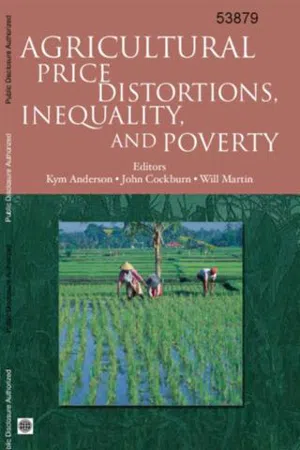
Agricultural Price Distortions, Inequality, and Poverty
- 544 pages
- English
- PDF
- Available on iOS & Android
eBook - PDF
Agricultural Price Distortions, Inequality, and Poverty
About this book
Information
Subtopic
Trade & TariffsTable of contents
- CONTENTS
- Foreword
- Acknowledgments
- Contributors
- Abbreviations
- PART I INTRODUCTION
- PART II GLOBAL CGE APPROACHES
- PART III NATIONAL CGE APPROACHES: ASIA
- PART IV NATIONAL CGE APPROACHES: AFRICA
- PART V NATIONAL CGE APPROACHES: LATIN AMERICA
- Appendix: Border Price and Export Demand Shocks in Developing Countries from Rest-of-the-World Trade Liberalization: The Linkage Model
- Index
- Figures
- Tables
Trusted by 375,005 students
Access to over 1.5 million titles for a fair monthly price.
Study more efficiently using our study tools.
Frequently asked questions
Yes, you can cancel anytime from the Subscription tab in your account settings on the Perlego website. Your subscription will stay active until the end of your current billing period. Learn how to cancel your subscription
No, books cannot be downloaded as external files, such as PDFs, for use outside of Perlego. However, you can download books within the Perlego app for offline reading on mobile or tablet. Learn how to download books offline
Perlego offers two plans: Essential and Complete
- Essential is ideal for learners and professionals who enjoy exploring a wide range of subjects. Access the Essential Library with 800,000+ trusted titles and best-sellers across business, personal growth, and the humanities. Includes unlimited reading time and Standard Read Aloud voice.
- Complete: Perfect for advanced learners and researchers needing full, unrestricted access. Unlock 1.5M+ books across hundreds of subjects, including academic and specialized titles. The Complete Plan also includes advanced features like Premium Read Aloud and Research Assistant.
We are an online textbook subscription service, where you can get access to an entire online library for less than the price of a single book per month. With over 1.5 million books across 990+ topics, we’ve got you covered! Learn about our mission
Look out for the read-aloud symbol on your next book to see if you can listen to it. The read-aloud tool reads text aloud for you, highlighting the text as it is being read. You can pause it, speed it up and slow it down. Learn more about Read Aloud
Yes! You can use the Perlego app on both iOS and Android devices to read anytime, anywhere — even offline. Perfect for commutes or when you’re on the go.
Please note we cannot support devices running on iOS 13 and Android 7 or earlier. Learn more about using the app
Please note we cannot support devices running on iOS 13 and Android 7 or earlier. Learn more about using the app
Yes, you can access Agricultural Price Distortions, Inequality, and Poverty by Kym Anderson, John Cockburn, Will Martin in PDF and/or ePUB format, as well as other popular books in Politics & International Relations & Trade & Tariffs. We have over 1.5 million books available in our catalogue for you to explore.