The Federal Government of Nigeria (FGN) and the World Bank have agreed to carry out a Climate Change Assessment (CCA) within the framework of the Bank's Country Partnership Strategy (CPS) for Nigeria (2010-13). The CCA includes an analysis of options for low-carbon development in selected sectors, including power, oil and gas, transport, and agriculture. The goal of the low-carbon analysis is to define likely trends in carbon emissions up to 2035, based on government sector development plans, and to identify opportunities for achieving equivalent development objectives with a reduced carbon footprint. This study comprises the following components: (i) development of a reference scenario of greenhouse gas (GHG) net emissions for the agriculture sector, consistent with vision 20: 2020 and other government plans; (ii) identification of opportunities for reduced net emissions- reduced emissions and or enhanced carbon sequestration- while achieving the same development objectives as in the reference scenario; and (iii) economic assessment of low-carbon options in order to help the Nigerian government to prioritize policy options. The study evaluates costs and benefits in a partial equilibrium setting, with no attempt to capture the indirect, general equilibrium effects of adopting low-carbon technologies or management practices. The results of this analysis (the first of its kind in Nigeria) should be considered as a first approximation of the potential for low-carbon development in the Nigerian agriculture sector. The study aims at providing policy makers with an order-of-magnitude estimate of mitigation potential, and an understanding of the value of dedicating further efforts (including through specific projects) at pursuing low-carbon development in agriculture, but is not meant to inform the design of specific, project-level interventions.
eBook - PDF
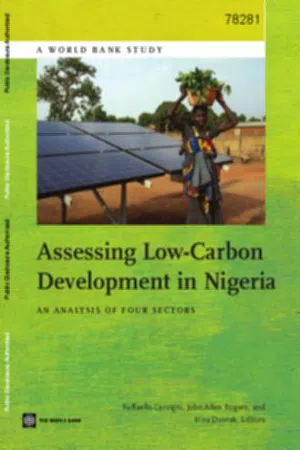
Assessing Low-Carbon Development in Nigeria
An Analysis of Four Sectors
- 425 pages
- English
- PDF
- Available on iOS & Android
eBook - PDF
Assessing Low-Carbon Development in Nigeria
An Analysis of Four Sectors
About this book
Information
Subtopic
Environmental EconomicsIndex
EconomicsTable of contents
- Front Cover
- Contents
- Preface
- About the Editors and Authors
- Acknowledgments
- Part 1 Agriculture and Land Use Sector
- Part 2 Oil and Gas Sector
- Part 3 Power Sector
- Part 4 Road Transport Sector
- Boxes
- Figures
- Maps
- Tables
Trusted by 375,005 students
Access to over 1.5 million titles for a fair monthly price.
Study more efficiently using our study tools.
Frequently asked questions
Yes, you can cancel anytime from the Subscription tab in your account settings on the Perlego website. Your subscription will stay active until the end of your current billing period. Learn how to cancel your subscription
No, books cannot be downloaded as external files, such as PDFs, for use outside of Perlego. However, you can download books within the Perlego app for offline reading on mobile or tablet. Learn how to download books offline
Perlego offers two plans: Essential and Complete
- Essential is ideal for learners and professionals who enjoy exploring a wide range of subjects. Access the Essential Library with 800,000+ trusted titles and best-sellers across business, personal growth, and the humanities. Includes unlimited reading time and Standard Read Aloud voice.
- Complete: Perfect for advanced learners and researchers needing full, unrestricted access. Unlock 1.5M+ books across hundreds of subjects, including academic and specialized titles. The Complete Plan also includes advanced features like Premium Read Aloud and Research Assistant.
We are an online textbook subscription service, where you can get access to an entire online library for less than the price of a single book per month. With over 1.5 million books across 990+ topics, we’ve got you covered! Learn about our mission
Look out for the read-aloud symbol on your next book to see if you can listen to it. The read-aloud tool reads text aloud for you, highlighting the text as it is being read. You can pause it, speed it up and slow it down. Learn more about Read Aloud
Yes! You can use the Perlego app on both iOS and Android devices to read anytime, anywhere — even offline. Perfect for commutes or when you’re on the go.
Please note we cannot support devices running on iOS 13 and Android 7 or earlier. Learn more about using the app
Please note we cannot support devices running on iOS 13 and Android 7 or earlier. Learn more about using the app
Yes, you can access Assessing Low-Carbon Development in Nigeria by Raffaello Cervigni, John Allen Rogers, Irina Dvorak in PDF and/or ePUB format, as well as other popular books in Economics & Environmental Economics. We have over 1.5 million books available in our catalogue for you to explore.