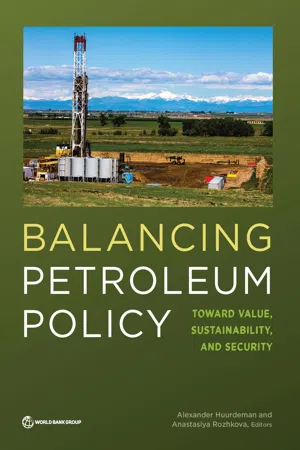
Petroleum discovery in a country presents its policy makers with a challenging and complex task: formulating and agreeing on policies that will shape the country's petroleum sector and guide the translation of the newly discovered resources into equitable and sustainable economic and social growth for the nation over the long term. Balancing Petroleum Policy provides policy makers and other stakeholders with the basic sector-related knowledge they need to embark on this task. It introduces a number of topics: the petroleum value chain and pivotal factors affecting value creation, a consultative process for developing a nation's common vision on key petroleum development objectives, design of a legislative and contractual framework, petroleum fiscal regimes and their administration, prudent fiscal management, transparency and governance, environmental and social safeguards, and economic diversification through industrial linkages. Although much of the material is relevant to designing policies for the development of the petroleum sector in general, the book gives special focus to developing countries, countries in a federal or devolved setting, and countries that have experienced or are still experiencing civil conflict. With this focus in mind, the book examines three questions—ownership, management, and revenue sharing of petroleum resources—that are central to petroleum policy in any federal or devolved state. It also offers important perspectives on how to prevent violent conflicts related to such resources. Petroleum policies tend to vary significantly from country to country, as do the objectives that such policies aim to achieve in the specific context of each particular country. Although there is no one-size-fits-all policy and there are no clear-cut answers to the many potential policy dilemmas associated with the discovery of petroleum resources, this publication may help policy makers find the right balance among the chosen objectives—and the right policy choices to achieve these objectives.
eBook - PDF
Balancing Petroleum Policy
Toward Value, Sustainability, and Security
- 299 pages
- English
- PDF
- Available on iOS & Android
eBook - PDF
Balancing Petroleum Policy
Toward Value, Sustainability, and Security
About this book
Information
Subtopic
Sustainable DevelopmentIndex
EconomicsTable of contents
- Front Cover
- Contents
- Preface and Acknowledgments
- Contributors
- Abbreviations
- Introduction
- Chapter 1. The Petroleum Value Chain and Governmental Policies: An Overview
- Chapter 2. Planning for the Development of a Petroleum Sector
- Chapter 3. Petroleum Legislative Frameworks and Contracts in a Federation: Issues for Constitutions, Petroleum Laws, Regulations, and Contracts
- Chapter 4. Petroleum Fiscal Regimes in Developing Countries
- Chapter 5. Petroleum Fiscal Administration in Developing Countries
- Chapter 6. Key Aspects of Fiscal Management in Resource-Rich Countries
- Chapter 7. Transparency in the Petroleum Sector: The Importance of Information and Clear Processes for Effective Development in Fragile Contexts
- Chapter 8. Managing Environmental and Social Impacts of the Petroleum Sector: Using Environmental and Social Assessment toward More Sustainable Development
- Chapter 9. Understanding Commodities, Linkages, and Industrial Development in Africa: Developing a Conceptual Framework
- Chapter 10. Ownership, Management, and Revenue Sharing of Petroleum Resources in Federal and Devolved Regimes
- Chapter 11. Petroleum Development and Conflict Prevention Strategies
- Boxes
- Figures
- Map
- Tables
Trusted by 375,005 students
Access to over 1.5 million titles for a fair monthly price.
Study more efficiently using our study tools.
Frequently asked questions
Yes, you can cancel anytime from the Subscription tab in your account settings on the Perlego website. Your subscription will stay active until the end of your current billing period. Learn how to cancel your subscription
No, books cannot be downloaded as external files, such as PDFs, for use outside of Perlego. However, you can download books within the Perlego app for offline reading on mobile or tablet. Learn how to download books offline
Perlego offers two plans: Essential and Complete
- Essential is ideal for learners and professionals who enjoy exploring a wide range of subjects. Access the Essential Library with 800,000+ trusted titles and best-sellers across business, personal growth, and the humanities. Includes unlimited reading time and Standard Read Aloud voice.
- Complete: Perfect for advanced learners and researchers needing full, unrestricted access. Unlock 1.5M+ books across hundreds of subjects, including academic and specialized titles. The Complete Plan also includes advanced features like Premium Read Aloud and Research Assistant.
We are an online textbook subscription service, where you can get access to an entire online library for less than the price of a single book per month. With over 1.5 million books across 990+ topics, we’ve got you covered! Learn about our mission
Look out for the read-aloud symbol on your next book to see if you can listen to it. The read-aloud tool reads text aloud for you, highlighting the text as it is being read. You can pause it, speed it up and slow it down. Learn more about Read Aloud
Yes! You can use the Perlego app on both iOS and Android devices to read anytime, anywhere — even offline. Perfect for commutes or when you’re on the go.
Please note we cannot support devices running on iOS 13 and Android 7 or earlier. Learn more about using the app
Please note we cannot support devices running on iOS 13 and Android 7 or earlier. Learn more about using the app
Yes, you can access Balancing Petroleum Policy by Alexander Huurdeman, Anastasiya Rozhkova in PDF and/or ePUB format, as well as other popular books in Economics & Sustainable Development. We have over 1.5 million books available in our catalogue for you to explore.